
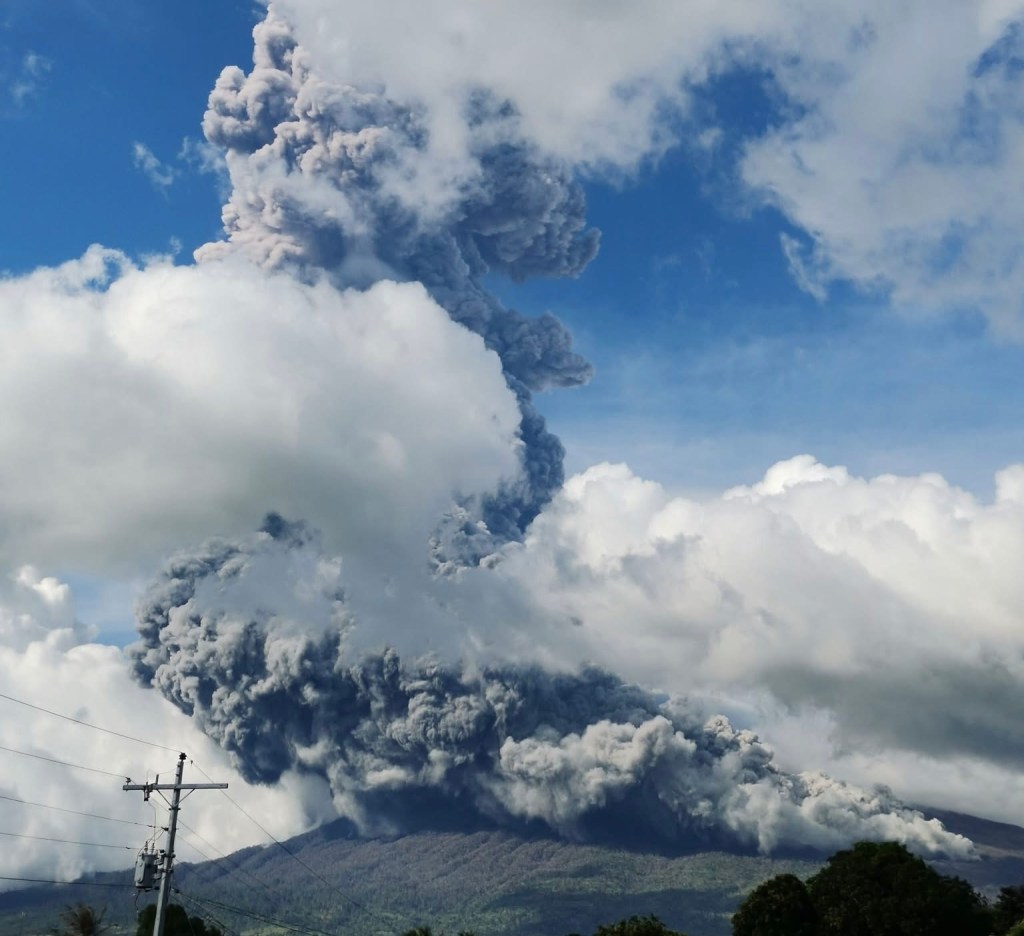
MANILA, Philippines — Following the massive eruption of the Kanlaon Volcano in Negros Occidental, several towns reported ashfall and emission of Pyroclastic density currents (PDCs) within the area, the Philippine Institute of Volcanology and Seismology (Phivolcs) said Tuesday.
In its morning bulletin,the agency said that the ash plume, driven west-southwest by strong winds, caused widespread ashfall across Negros Occidental, Negros Oriental, Iloilo, Guimaras, and Antique provinces.
Local authorities reported ashfall in several areas, including Ara-Al in La Carlota City, Yubo in Hinigaran, San Miguel in Valladolid, and La Granja in Pulupandan. Barangays in Pontevedra, San Enrique, La Castellana, Murcia, and Bago City were similarly affected.
More affected barangays
In Negros Oriental, Canlaon City barangays such as Mananawin and Masulog were blanketed with ash, alongside Pula in San Miguel. Over in Iloilo, ashfall was reported in Tigbauan, Iloilo City, Igbaras, Miag-Ao, and Oton, while Guimaras recorded ash in San Lorenzo, Nueva Valencia, and Sibunag. Antique also reported ashfall in San Jose de Buenavista, Belison, San Remigio, and Patnongon.
The smell of sulfur was reported in several barangays of Negros Occidental after Kanlaon Volcano’s eruption, reaching as far as the town proper of Bago City.
Prior to this event, Phivolcs raised the alert to Level 3 over Kanlaon Volcano.
“This means that there are increased chances for sudden and even stronger explosive eruptions to occur and endanger communities at risk with life-threatening volcanic hazards,” it said.
Hot gas, ash, rocks
Phivolcs likewise reported that PDCs—hot mixtures of gas, ash, and rocks—were also observed moving down the south-southeastern slopes of the volcano. These flows traveled up to 3.4 kilometers from the crater, staying within the four-kilometer Permanent Danger Zone (PDZ).
Barangays in La Castellana, Negros Occidental, such as Biak-na-Bato, Mansalanao, Cabagna-an, Sag-ang, and Masulog, were affected. In Canlaon City, Negros Oriental, Mananawin and Masulog also reported impacts.
Authorities have warned residents to avoid the danger zone and stay alert for further activity.
“It is therefore recommended that communities within a six-kilometer radius of the summit crater be evacuated due to the danger of pyroclastic density currents or PDCs, ballistic projectiles and ashfall, lava flows, rockfalls and other related hazards,” Phivolcs said.
Before it erupted
Before the eruption, Kanlaon Volcano showed weaker summit emissions compared to previous days, with a lower sulfur dioxide (SO2) flux averaging 1,669 tonnes per day. Only six weak volcano-tectonic earthquakes were detected, and no seismic activity signaled the eruption.
Ground deformation monitors recorded minor inflation on the volcano’s southeast flank since late November, indicating pressure buildup in shallow areas. However, this inflation was less intense than the one observed in mid-2024, which did not lead to an eruption.
Since October 19, Kanlaon has been emitting ash without accompanying seismic signals. Analysis of earlier ash samples revealed they were made entirely of old pulverized rock, with no signs of new magma. Fresh ash from the December 9 eruption is now being examined to understand what triggered the event, the bureau said.
Kanlaon Volcano erupted explosively at its summit vent yesterday, December 9, at 3:03 PM, producing a massive plume of ash that reached up to 4,000 meters above the vent.
The eruption, which lasted for 3 minutes and 55 seconds, was detected by all thirteen monitoring stations of the Kanlaon Volcano Network and several stations of the Philippine Seismic Network in Central Visayas.



 Republika News
Leave a comment