
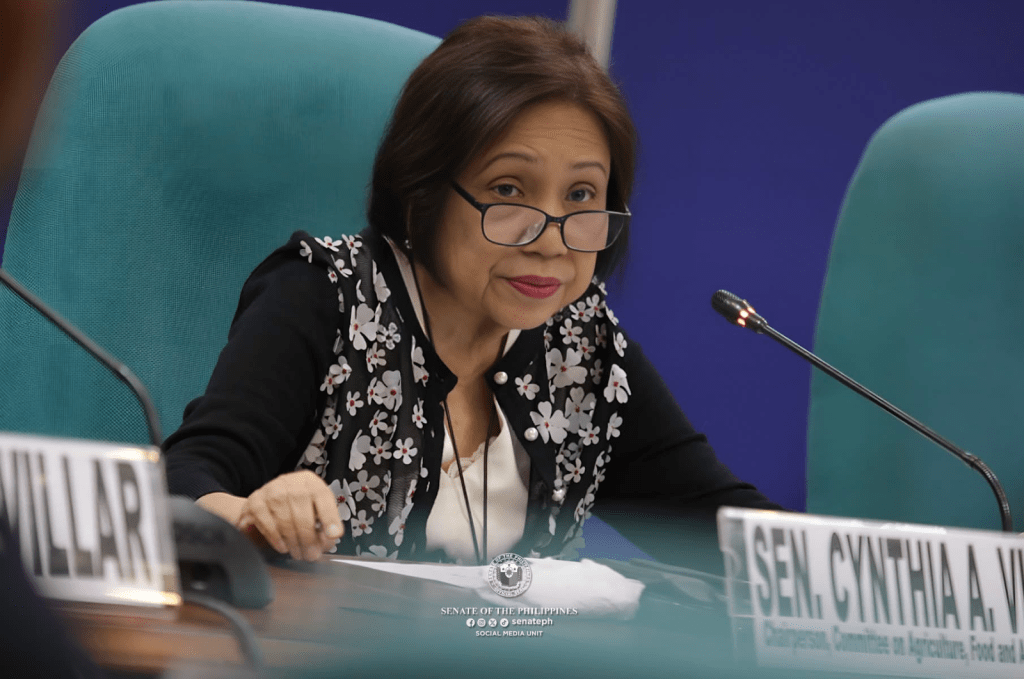
MANILA, Philippines — Sen. Cynthia Villar fired back at critics of the Rice Tariffication Law (RTL), saying calls to restore the National Food Authority’s (NFA) importation powers ignore the very reforms already in place to support farmers and stabilize the rice market.
Villar, who chairs the Senate Committee on Agriculture, Food, and Agrarian Reform, defended the law amid mounting criticism over its impact on local palay prices.
She said critics have been peddling the “wrong notion” that private rice traders now monopolize the market, squeezing out farmers.
“That is simply not true,” Villar said in a statement.
“The RTL created competition, not killed it. The NFA still buys palay directly from local farmers to maintain buffer stocks. Farmers are not left at the mercy of private traders.”
NFA revival is a step backwards
In response to proposals seeking the return of the NFA’s previous functions, including importing and distributing rice, Villar said history should serve as a warning.
“Let’s not forget the NFA’s track record. It was plagued with inefficiencies, mismanagement, and massive debt. Bringing it back to power will only resurrect the same old problems,” she said.
From 2010 to 2017, Villar noted, the NFA’s rice distribution only covered about 8.5 percent of the national consumption, dropping to just 2.1 percent by early 2018—too little to influence retail prices. Meanwhile, audit reports revealed that over 68 percent of subsidized rice beneficiaries were not even poor households.
“Where’s the sense in bringing back a system that fails to reach the people it’s meant to help?” she asked.
Boosting farmers, cutting out middlemen
Villar highlighted the RTL’s Rice Competitiveness Enhancement Fund (RCEF) as a game-changer for farmers. Through this fund, 151 rice cooperatives have already received modern drying and milling equipment, with more units in the pipeline.
“These cooperatives will soon be capable of processing 2.06 million metric tons of rice per hour. That’s direct empowerment. Farmers won’t have to rely on traders to process or market their produce,” she said.
She added that these facilities, along with the NFA’s existing 22 milling and 116 drying facilities, are transforming how rice is handled post-harvest, improving price transparency and cutting post-harvest losses.
Amended RTL grants DA more teeth
Villar also pointed to Republic Act No. 12078, signed by President Ferdinand Marcos Jr. in December 2024, as further proof that the government is refining—not abandoning—the RTL. The law strengthens the Department of Agriculture’s (DA) regulatory powers, increases the RCEF from P10 billion to P30 billion until 2031, and sets up a P5-billion buffer fund for rice emergencies.
The amended RTL also authorizes the DA to directly import rice through a designated agency (not the NFA) via government-to-government deals during shortages.
“Everything critics are calling for—government intervention, buffer stocks, farmer support—it’s already in the law. They just haven’t read it,” Villar said.
To further protect the agricultural sector, Villar cited RA 12022 or the Anti-Agricultural Economic Sabotage Act, signed in October 2024, which classifies smuggling, hoarding, and cartels as economic sabotage.
“The government is not standing idly by. We’re arming our institutions with the laws and resources they need to protect farmers and consumers alike,” she said.
Villar concluded with a challenge to RTL critics: “Before calling for a return to failed policies, understand the reforms we’ve passed. This is not the time to undo progress—we should build on it.”

 Republika News
Leave a comment