
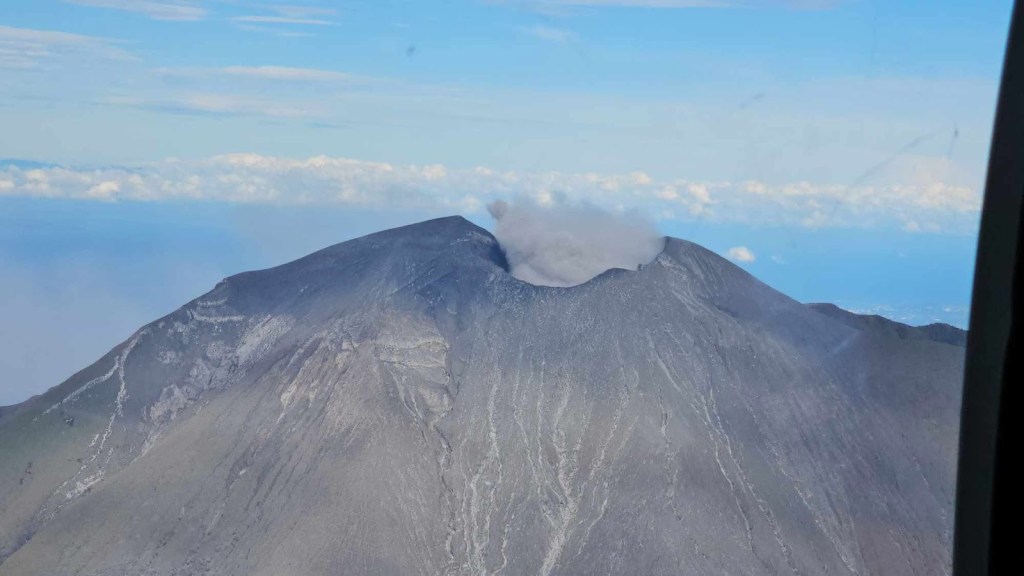
MANILA, Philippines —A total of 72 volcanic earthquakes have been recorded at Kanlaon Volcano within a 12-hour period on Monday, signaling continued magmatic unrest beneath the active stratovolcano, the Philippine Institute of Volcanology and Seismology (Phivolcs) reported Monday.
According to Phivolcs, the earthquakes were registered between 12:00 AM and 12:00 PM today, May 12, and ranged in magnitude from ML0.3 to ML3.1. These were detected at depths between 0 to 8 kilometers below the northern and northwestern flanks of Kanlaon’s edifice.
In total, 135 volcanic earthquakes have been recorded since 12:00 AM of May 11, 2025. The agency noted that several of these were classified as volcano-tectonic (VT) quakes—tremors caused by rock fracturing beneath the surface due to the intrusion of magma or magmatic gas.
“The increase in VT activity strongly indicates progressive rock-fracturing beneath the volcano as rising magma or magmatic gas drives a path towards the surface,” Phivolcs said.
In addition to seismic activity, sulfur dioxide (SO₂) emissions measured through mobile Differential Optical Absorption Spectroscopy (mDOAS) on May 11 averaged 554 tonnes per day. While this marks a decline from an average of 4,144 tonnes/day in June 2024 to 2,114 tonnes/day in April 2025, PHIVOLCS warned that this trend may suggest a dangerous “closed-system degassing,” wherein trapped gases build up pressure within the volcano.
“This pressurization and swelling of the edifice may potentially lead to a moderately explosive eruption,” the agency warned.
Kanlaon remains under Alert Level 3, which indicates high-level magmatic unrest. Under this status, short-lived, moderately explosive eruptions are possible, and life-threatening hazards such as pyroclastic density currents (PDCs), ballistic projectiles, ashfall, and rockfall may occur, it said.
Authorities are urging residents and tourists to stay away from the 6-kilometer Permanent Danger Zone (PDZ) around the volcano. Local government units have been advised to remain on high alert and prepare for possible evacuations should the situation escalate.
Communities near river channels are also warned of potential lahars or sediment-laden streamflows in the event of heavy rainfall during ongoing volcanic activity.
Meanwhile, civil aviation authorities are strongly advising pilots to avoid flying near the volcano’s summit, as sudden ash emissions pose a significant threat to aircraft.
Phivolcs assured the public that Kanlaon Volcano is under constant surveillance and that any new developments will be promptly communicated.
Kanlaon Volcano, located on Negros Island, is among the most active volcanoes in the Philippines, with a history of phreatic and magmatic eruptions.




 Republika News
Leave a comment