
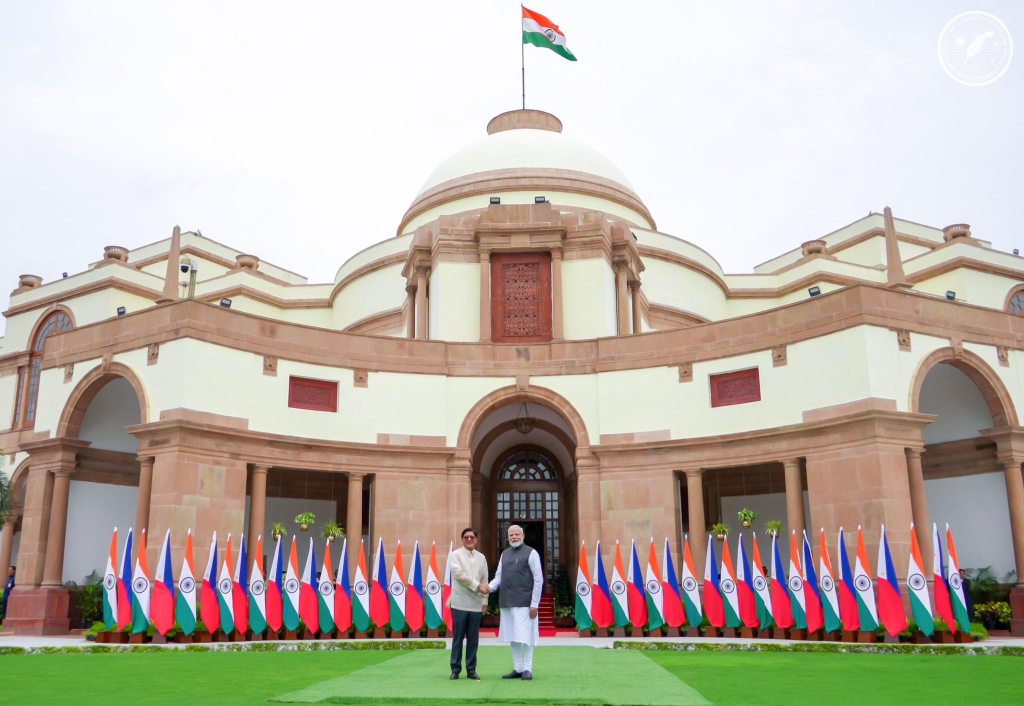
MANILA — President Ferdinand R. Marcos Jr. concluded a five-day State Visit to India that produced USD 446 million in actual investments and up to USD 5.8 billion in potential deals in sectors such as digital infrastructure, renewable energy, healthcare, manufacturing, and IT-BPM.
The agreements are expected to generate over 4,000 direct jobs and provide digital training to more than 26,000 Filipinos by 2026. Marcos described the trip as “one of the most productive and constructive” state visits, citing major milestones in strengthening ties with one of Asia’s fastest-growing economies.
The visit began on August 4 in New Delhi with a meeting with the Filipino community, where the President joined overseas Filipino workers and Cabinet members in karaoke sing-alongs — an informal icebreaker he dubbed “Karaoke diplomacy.”
On August 5, Marcos and First Lady Louise Araneta-Marcos received a ceremonial welcome from Prime Minister Narendra Modi and President Droupadi Murmu. The two leaders elevated Philippine-India relations to a Strategic Partnership and witnessed the signing of 13 agreements covering defense, maritime cooperation, legal assistance, science and technology, tourism, space research, and cultural exchange.
Marcos lauded India’s lifting of its export ban on non-basmati rice, calling it vital for Philippine food security. Modi announced free e-visas for Filipino tourists, reciprocating Manila’s visa-free entry for Indians. Marcos also announced the resumption of direct flights between the Philippines and India in October.
Business engagements included the August 6 Philippines-India CEO Roundtable, where Marcos pitched the country’s “most open and liberal” investment environment to executives from infrastructure, energy, healthcare, and manufacturing sectors. He also met with GMR Group, co-developers of the US\$3–4 billion Sangley Aerocity Project in Cavite.
While in India, Marcos ordered a 60-day suspension of rice imports starting September 1 to protect local farmers from falling palay prices due to a global rice surplus and cheap imports.
In Bengaluru, the country’s technology hub, Marcos headlined the Philippines-India Business Forum and witnessed the signing of 18 memoranda and letters of intent in renewable energy, healthcare, education, digital services, and manufacturing. He also met with executives from Hinduja Group, NephroPlus, iSON Group, and Tata Group.
Marcos capped his trip on August 8 with a media forum, where he highlighted the importance of the Strategic Partnership and reiterated his call for regional cooperation to uphold international law, strengthen maritime security, and promote inclusive growth in the Indo-Pacific.



 Republika News
Leave a comment