
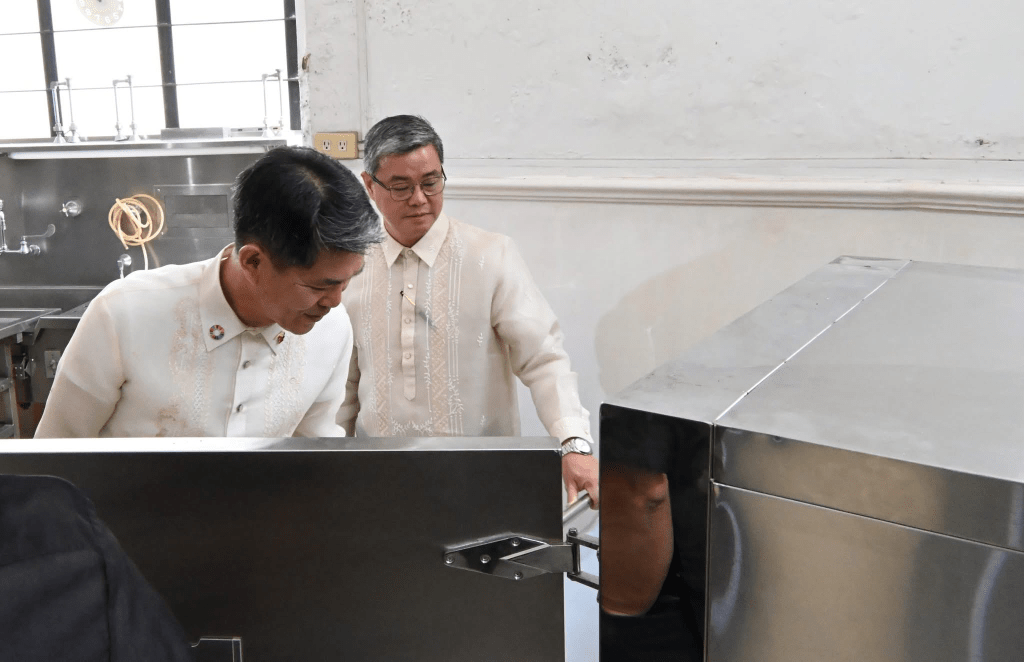
MANILA — The Philippine government said the donation of new forensic equipment from Japan’s Ministry of Justice strengthens the country’s capacity to uphold justice and human rights, in line with President Ferdinand R. Marcos Jr.’s governance agenda of transparency, accountability, and respect for human dignity.
Executive Secretary Lucas P. Bersamin described the donation as both “a gesture of compassion and a boost to the country’s forensic capacity” through local and international partnerships.
In his keynote message during the handover ceremony at the University of the Philippines Manila (UPM), Bersamin said the autopsy instruments signify more than a technical upgrade.
“At first glance, handing over autopsy instruments can feel like a clinical moment,” Bersamin said. “Yet this simple act is charged with compassion: it affirms that every life, no matter how brief, deserves respect, and that even in loss, we are committed to honoring dignity, comforting those who grieve, and uncovering the truth.”
The donation of mortuary refrigerators, autopsy carts, and body scales was made under Japan’s “Institutional Investigation of Custodial Deaths Project.” The United Nations Office on Drugs and Crime (UNODC) facilitated the handover from the Japanese Embassy in the Philippines.
The equipment forms part of the ongoing establishment of the National Forensics Institute (NFI), a commitment the Philippines announced during the 75th anniversary of the Universal Declaration of Human Rights in Geneva in December 2023.
Bersamin cited the July 11, 2024 Declaration of Cooperation signed by the Department of Justice (DOJ), UPM, and UNODC Philippines to strengthen procedures in investigating custodial deaths. Under the agreement, remains of persons deprived of liberty (PDLs) who die in Bureau of Corrections facilities in Metro Manila will be transferred to UPM for independent autopsy and forensic examination.
“This is a moral commitment to uphold the prompt reporting and independent investigation of custodial deaths,” Bersamin stressed.
Japanese Ambassador to the Philippines Kazuya Endo said the donation, the first from Japan for the NFI, would help strengthen the forensic capabilities of law enforcement and judicial authorities.
UPM Chancellor Michael Tee said the new equipment would improve the university’s forensic pathology facilities, while UP President Angelo Jimenez reaffirmed UP’s role as the academic backbone of the NFI.
Justice Secretary Jesus Crispin Remulla, in a statement read by Undersecretary Deo Marco, emphasized that the donation is “more than technology; it is a lifeline for truth.”
“It is a way to ensure that every person deprived of liberty, regardless of their circumstances, is treated with dignity, and that any loss of life is examined with transparency, accountability, and care,” Remulla said.
Bureau of Corrections Director General Gregorio Pio Catapang Jr. highlighted ongoing reforms to improve conditions of PDLs, including collaborations with UP on online education.
UNODC Philippines Country Head Daniele Marchesi cited the ease of international cooperation with the Philippines, while forensic pathologist Dr. Raquel del Rosario-Fortun expressed hope that the NFI’s mandate would expand beyond custodial deaths to all unresolved cases.
The NFI Technical Working Group is co-chaired by the Office of the Executive Secretary and DOJ, with members from the Department of the Interior and Local Government, Department of Foreign Affairs, Department of Health, Department of Budget and Management, Commission on Higher Education, UPM, and the Presidential Human Rights Committee Secretariat.


 Republika News
Leave a comment