
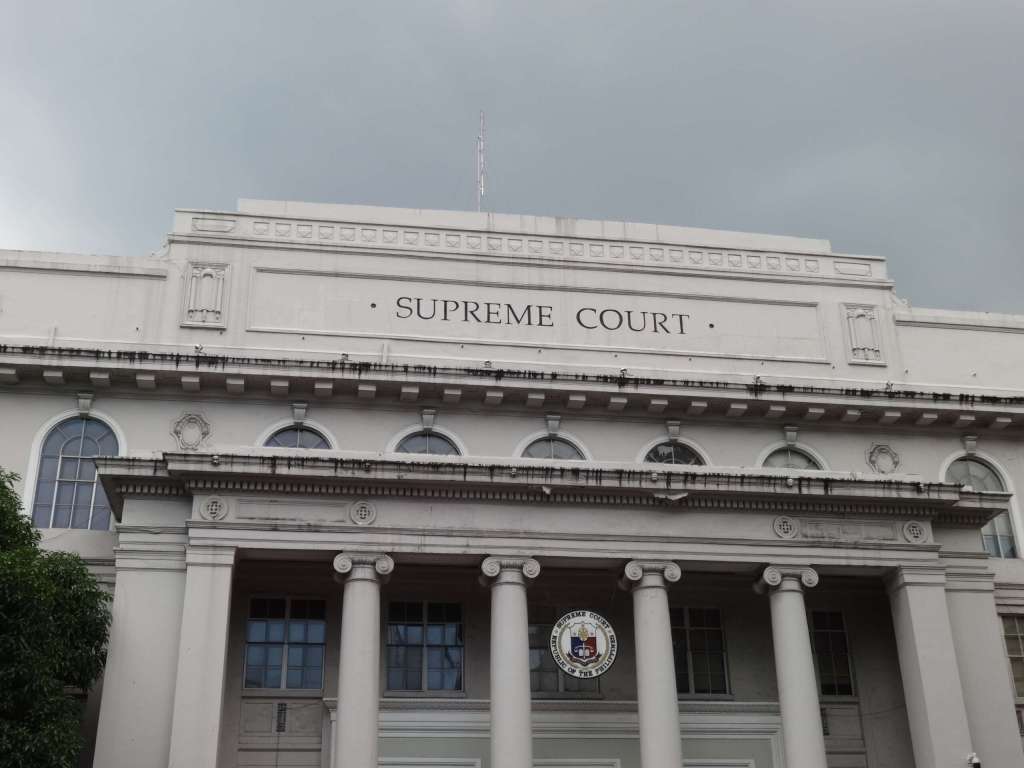
MANILA — The Supreme Court (SC) has ruled that a marriage officiated by a person without legal authority is generally void—but not if one or both spouses genuinely believed that the officiant had such authority.
In a decision penned by retired Associate Justice Mario V. Lopez, the SC’s Second Division dismissed a petition filed by a wife seeking to void her marriage on the ground that the person who solemnized it was not a judge, contrary to what she believed at the time.
The couple were married at the Municipal Hall of Tarlac City, and their marriage contract listed Judge Conrado De Gracia as the officiant. Over two decades later, the wife’s lawyer claimed that the man in their wedding photos was actually Rosalio Florendo, a fellow member of the Tarlac City Rotary Club, not Judge De Gracia.
She then filed a petition before the Regional Trial Court (RTC) to nullify the marriage due to lack of authority of the solemnizing officer. The RTC denied the petition, citing insufficient evidence to prove the officiant’s true identity and noting that the wife herself admitted she believed it was Judge De Gracia who officiated the ceremony.
The Court of Appeals (CA) upheld the RTC’s decision, ruling that the marriage contract, being a public document, is prima facie evidence of the marriage and its details. The wife failed to present clear and convincing proof to rebut this presumption.
The Supreme Court affirmed both rulings. It held that under Articles 3 and 4 of the Family Code, one formal requirement of a valid marriage is the authority of the solemnizing officer. Article 7 lists those authorized, including incumbent judges within their jurisdiction, while Article 35(2) provides that a marriage is void if the officiant lacks authority—unless one or both parties believed in good faith that the officiant was authorized.
The Court found that the wife failed to prove that the officiant lacked authority, noting that the marriage certificate identified Judge De Gracia as an incumbent judge in Tarlac City who had legal authority to solemnize marriages.
While the wife later alleged that someone else conducted the ceremony, the Court said she presented no documentary or testimonial evidence to support this. It also noted that she admitted believing during the wedding that the officiant was Judge De Gracia and only questioned this almost 30 years later based on her lawyer’s unsubstantiated claim.
Given the presumption in favor of the marriage contract’s validity and the wife’s good faith belief in the officiant’s authority, the SC ruled that the marriage falls under the exception in Article 35(2) and remains valid.
In a dissenting opinion, Senior Associate Justice Marvic M.V.F. Leonen argued that even if the officiant’s lack of authority were excused, the absence of a personal declaration by the spouses taking each other as husband and wife during the ceremony renders the marriage void. He said the irregularities in the officiant’s identity and the ceremony itself raise reasonable doubt about the marriage’s validity.




 Republika News
Leave a comment