
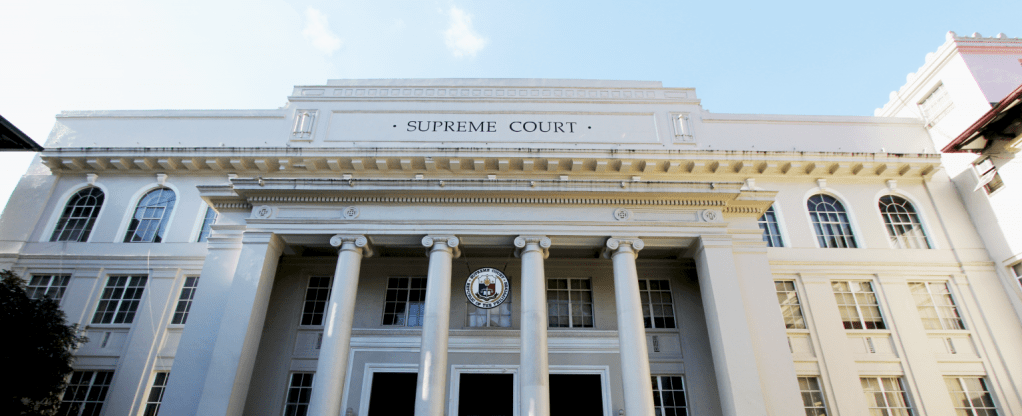
MANILA – The Supreme Court has ordered the Regional Trial Court (RTC) to reassess the compensation owed by the City Government of Pasay to Arellano University for a property taken and converted into a public road, emphasizing that just compensation must consider all relevant factors and not merely market value.
In a Decision written by Associate Justice Samuel H. Gaerlan, the Court’s Third Division underscored that determining just compensation in land expropriation cases requires a comprehensive evaluation of multiple considerations.
The University filed a complaint before the RTC in 2015, claiming that the Pasay local government unit (LGU) took its 805-square-meter land in Barangay San Isidro and turned it into a public road, now known as Menlo Street, without undergoing expropriation proceedings or paying just compensation.
After mediation failed, both parties agreed to refer the case to a board of commissioners composed of Pasay LGU officials. The board used a base value of PHP 200 per square meter based on the 1978 General Revision of the City Assessor’s Office and added 6% annual interest from 1978 to 2017, resulting in a valuation of PHP 2,060 per square meter.
The University disputed the computation, arguing that the interest rate should follow those published by the Bangko Sentral ng Pilipinas (BSP) and that other factors—such as inflation, fiscal policies, and currency fluctuations—should also be considered. Based on these, it proposed total compensation of PHP 5,793,664.63.
The RTC upheld the commissioners’ base value but applied a different interest rate, ordering the Pasay LGU to pay PHP 161,000 plus 12% annual interest from 1978 to 2018.
The Court of Appeals (CA) later found that the RTC’s computation relied solely on the 1978 assessment and failed to consider other relevant factors, prompting it to remand the case to the RTC. The Supreme Court affirmed the CA’s ruling, finding that the RTC’s decision was based on incomplete data.
Citing Article III, Section 9 of the Constitution, the SC stressed that private property cannot be taken for public use without just compensation, which must be “real, substantial, full, and ample.” It added that determining such compensation is a judicial function.
The Court clarified that local government assessors’ appraisals are not controlling in expropriation cases since they often cover wide areas and overlook property-specific characteristics. While tax values may guide the process, they cannot replace a comprehensive judicial assessment.
The SC emphasized that courts must apply a “totality of circumstances” approach, taking into account all facts about the property’s condition, surroundings, existing improvements, and potential. These include the Bureau of Internal Revenue’s zonal valuation, acquisition cost, tax declarations, size, shape, location, and the current value of comparable properties.
It also cited the 2006 Manual on Real Property Appraisal and Assessment Operations, which identifies additional factors such as property classification and use, development costs, declared value by the owner, current selling prices of nearby properties, and compensation for removing improvements.
In this case, the SC noted that the RTC relied only on the 1978 Pasay City Assessor’s valuation and barely referenced the BIR’s zonal valuation or other data. Because the computation was based on incomplete and inaccurate information, the Court ordered the case returned to the RTC for proper reassessment.
The SC also upheld the use of a 6% annual interest rate, consistent with the prevailing BSP rate, to apply from the finality of judgment until full payment.
In a Separate Opinion, Associate Justice Alfredo Benjamin S. Caguioa wrote that the interest in expropriation cases should not be treated as “forbearance of money” due to the State’s delay in payment but as part of the compensation itself to ensure that it remains truly just.



 Republika News
Leave a comment