
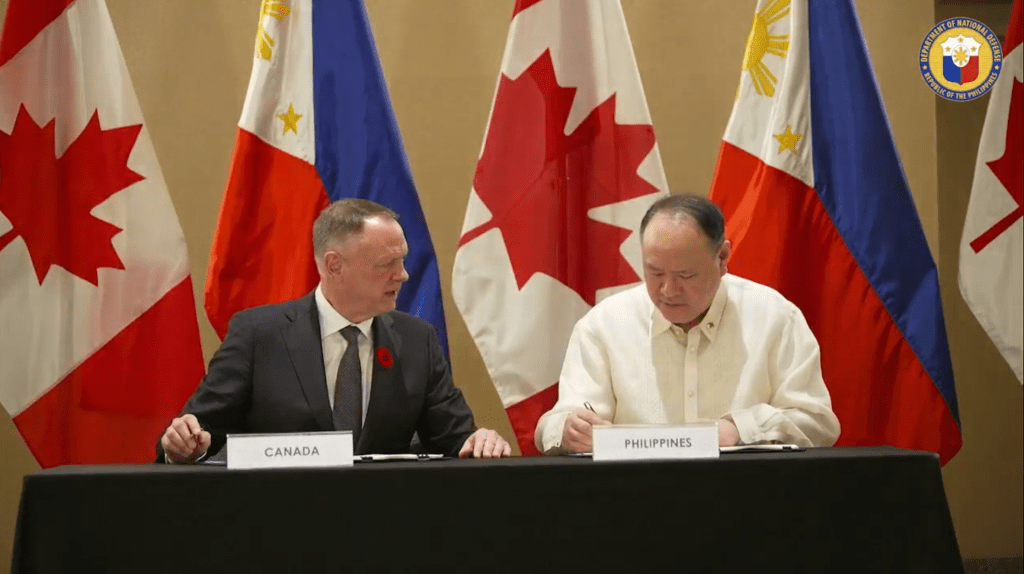
MANILA – The Philippines and Canada have entered into a Visiting Forces Agreement (VFA) that will enable military personnel from both nations to enter, train, and operate within each other’s territories.
The accord, signed on Sunday, November 2, marks Canada as the fifth nation to formalize a troop agreement with the Philippines, following similar pacts with the United States, Australia, Japan, and New Zealand — all of which have condemned China’s aggressive actions in the South China Sea.
In a report, Defense Secretary Gilberto Teodoro Jr. and Canadian Defense Minister David McGuinty signed the agreement in Manila during bilateral defense discussions.
The Canada-Philippines VFA is the third defense accord concluded under President Ferdinand Marcos Jr.’s administration. It follows the Reciprocal Access Agreement with Japan, which took effect in September, and a VFA with New Zealand, signed in April but still pending implementation.
Talks on the VFA began last year and concluded within 12 months. Negotiations were finalized in March, and the final draft was exchanged by August before the signing this weekend.
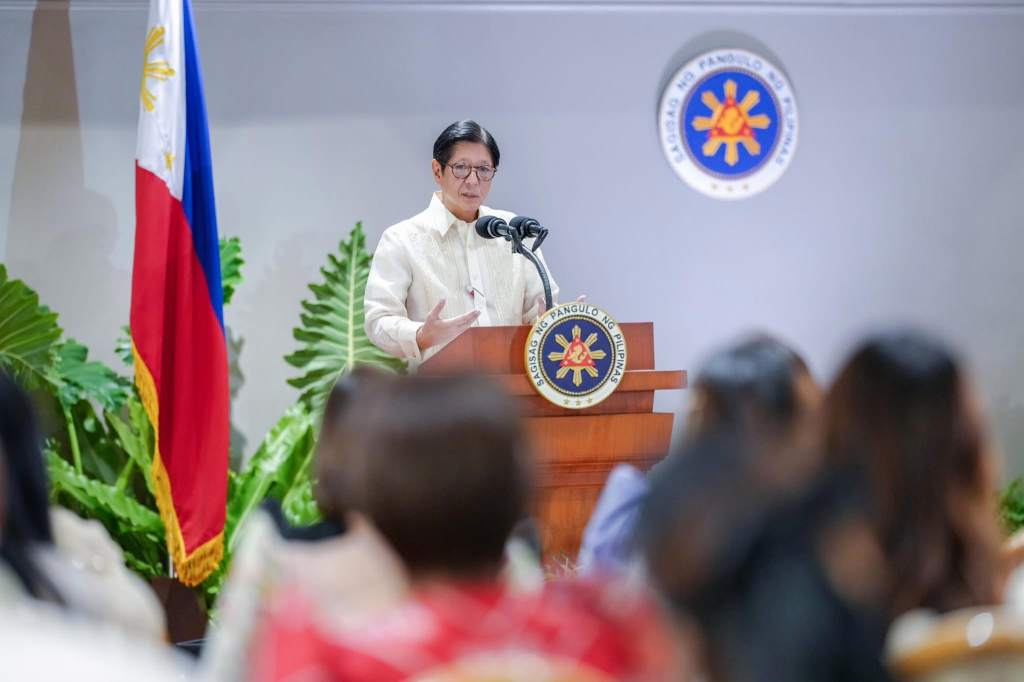
The agreement will require ratification by President Marcos and approval by the Senate before it can take effect.
Canada has consistently voiced support for the 2016 arbitral ruling that invalidated China’s sweeping territorial claims in the South China Sea. The country has also increased its naval presence in regional maritime exercises alongside the Philippines and other allies in the West Philippine Sea — the part of the South China Sea that lies within the Philippines’ exclusive economic zone.
The VFA is expected to pave the way for greater Canadian participation in joint patrols and military exercises in the Indo-Pacific region.
“Underpinning this SOVFA is the foundation in which it is built: preserving the international order and the rules-based order, respecting the sovereignty and dignity of not only states but also their people as human beings,” Teodoro said.
Teodoro added that each VFA is shaped by the unique strengths and experiences of the armed forces involved. “We have much to learn and converge with Canada distinct from Australia and other countries we have. But we will converge with them in upholding the rules-based international order,” he said.
Calling the signing a “big day” for both countries, McGuinty emphasized that the new pact would strengthen cooperation across various defense areas.
“Mr. Secretary [Teodoro] and I discussed moments ago, that the result of [our countries’] partnership expansion will be moving forward on training fronts, exchanges from our military colleges, information sharing, and understanding cybersecurity,” McGuinty said.
“And of course, for maritime domain awareness. We hope to be present in the military exercises like Balikatan… There’s so much positive that comes from this agreement today. It builds on those 75 years of partnership and trust and loyalty to each other,” he added.
Canada previously joined the annual Philippine-US “Balikatan” exercises as an observer in April.
Beijing has frequently criticized the Philippines’ growing defense cooperation with its allies, accusing Manila of “provoking tensions” through joint patrols with the US and other partners. China maintains sweeping claims over nearly the entire South China Sea.
The Marcos administration has sought to broaden the country’s defense partnerships with nations that back the Philippines’ maritime rights in the West Philippine Sea, in an effort to counter China’s increasingly assertive behavior in the disputed waters.
 Republika News
Leave a comment