
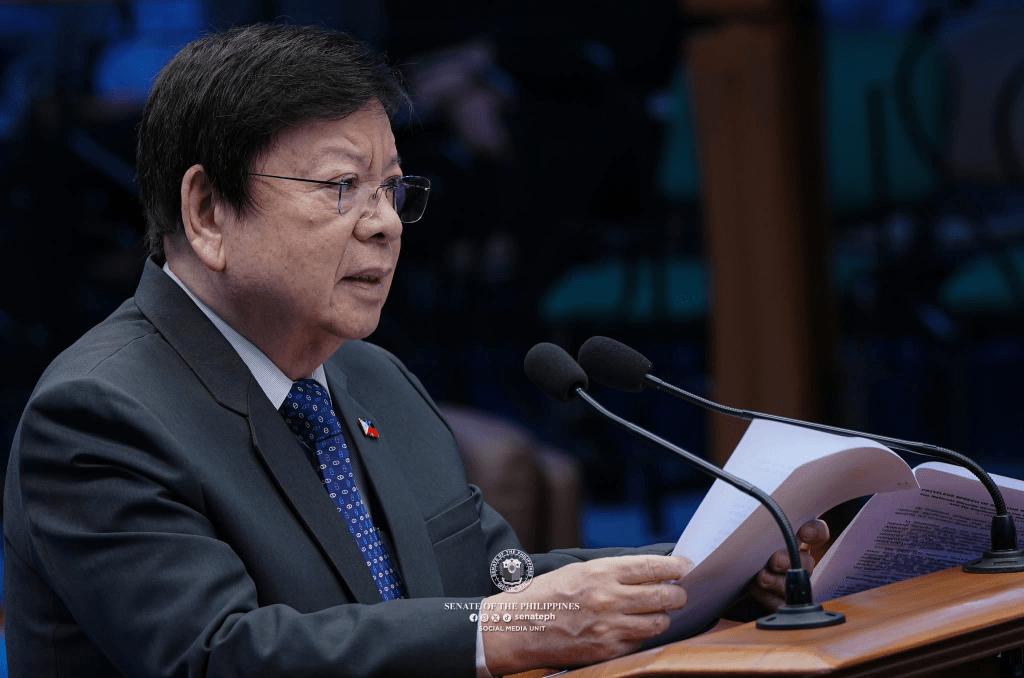
MANILA — Senator Rodante D. Marcoleta warned that the United States’ new National Security Strategy signals a major shift in global power dynamics and carries serious implications for the Philippines’ sovereignty, security, and economic direction.
In a privilege speech, Marcoleta said the 2025 US National Security Strategy marks a move away from post–Cold War globalism toward a narrower, interest-driven approach that prioritizes American security, economic strength, and sovereignty above all else.
“The Philippines is no longer peripheral,” Marcoleta said, noting that the country’s geographic location places it at the center of strategic competition in the Indo-Pacific, particularly amid rising tensions between the US and China.
Marcoleta explained that the strategy emphasizes “America First,” peace through strength, economic nationalism, burden-sharing among allies, and the primacy of national sovereignty. Under this framework, US support for allies is no longer automatic but increasingly conditional on their ability to contribute meaningfully to defense and security efforts.
He said the Philippines’ position along the so-called First Island Chain—stretching from Japan to Indonesia—has elevated its strategic value, but also comes with expectations that Manila will invest more in its own defense capabilities and allow greater military access.
The senator raised concerns that long-standing assumptions about the Mutual Defense Treaty with the US may no longer guarantee security, stressing that alliances are now based on capability and contribution rather than history alone.
“For decades, we relied on the idea that alliance alone assures protection. That assumption is no longer valid,” Marcoleta said, adding that national security must be grounded in the country’s own capacity and resolve.
He also pointed to delays in the Armed Forces of the Philippines’ modernization and limited maritime patrol capabilities, warning that sovereignty cannot be defended by rhetoric alone but requires concrete investments in ships, aircraft, personnel, and sustained political will.
Marcoleta further underscored that economic security has become inseparable from national security, citing the US push to diversify supply chains away from China as a potential opportunity for the Philippines. However, he cautioned that structural problems such as high power costs, weak infrastructure, corruption, and policy instability could cause the country to miss out on these investments.
He urged the government to modernize infrastructure, ensure affordable and reliable energy, create predictable investment rules, and align education and workforce development with high-value industries.
In closing, Marcoleta said the Philippines should not simply choose sides in global rivalries but must be prepared for all scenarios by strengthening its economy, defense readiness, and strategic direction.
“National development, defense readiness, and strategic purpose must move together,” he said, warning that failure to act decisively could leave the country sidelined in a rapidly changing world.




 Republika News
Leave a comment