
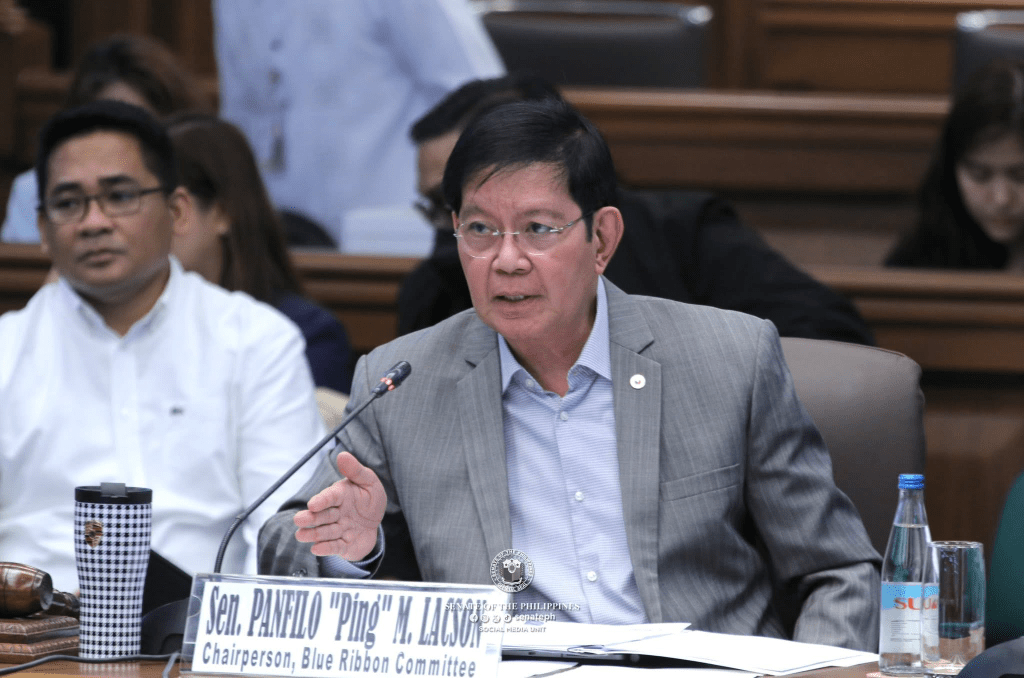
MANILA — Senate President Pro Tempore Panfilo “Ping” M. Lacson said evidence, and not public noise, will indict and convict those involved in corruption linked to anomalous flood control projects, as the Senate Blue Ribbon Committee resumed its hearings on the issue.
At the hearing, Lacson criticized “skeptics, detractors, and hijackers” whom he accused of twisting public anger to divide the nation.
“Your noise will not silence the truth; neither does it provide any help in our investigation. Your noise cannot convict — and won’t even indict the malefactors in this flood control mess. Only evidence does,” Lacson said.
“With all that being said — as the Chairman of this committee — I say to you: Shut the f… up!” he added, referring to critics of the committee’s work.
Lacson said insinuations that the Blue Ribbon Committee is useless are “not only insensitive to its members but an insult to our fellow Filipinos who have consistently followed our hearings and participated in the trillion-peso march,” including members of the clergy, students, workers, and other concerned citizens.
He said these Filipinos became aware of what he described as “unbridled and systemic corruption” largely due to the committee’s hearings and media coverage of the proceedings.
According to Lacson, the Blue Ribbon Committee under his chairmanship uncovered through its hearings a “top-to-bottom systemic misuse and abuse of public funds involving high officials in the executive and legislative branches, even the Commission on Audit.”
He said some individuals now face charges before the Sandiganbayan and other courts, while others are undergoing preliminary investigations before the Office of the Ombudsman and the Department of Justice. These include contractors and high-ranking officials in both the executive and legislative branches.
Lacson said at least ₱21.7 billion in bank accounts and other assets have been frozen by written order of the Court of Appeals. He added that some individuals have agreed to cooperate in restituting funds and strengthening government cases, including plunder, malversation of public funds through falsification, and graft.
The committee hearings also exposed conflicts of interest within the Philippine Contractors Accreditation Board, the resurfacing of blacklisted companies under new names, the widespread practice of license-renting, and the awarding of billion-peso contracts to severely undercapitalized firms, Lacson said.
He said the hearings led to transparency reforms in the budget process, including livestreamed and open bicameral meetings that detail budget amendments and insertions that can now be traced to their proponents, as well as safeguards to prevent vague or undefined infrastructure projects from being included in the General Appropriations Act.
“We laid out how this deeply rooted scheme operates with systemic precision. It involves a network of actors: namely, the Contractors Group, who collude among themselves — to rig public biddings and monopolize flood control projects; key DPWH coordinators, who manage project allocations and orchestrate the collection and delivery of kickbacks; and intermediaries, agents or bagmen, who receive these illicit funds allegedly in behalf of their principals,” Lacson said.
“Let me emphasize one point: we always go where the evidence leads us. We do not target any particular person; nor do we have the intention to cover up for anybody,” he added.


 Republika News
Leave a comment