
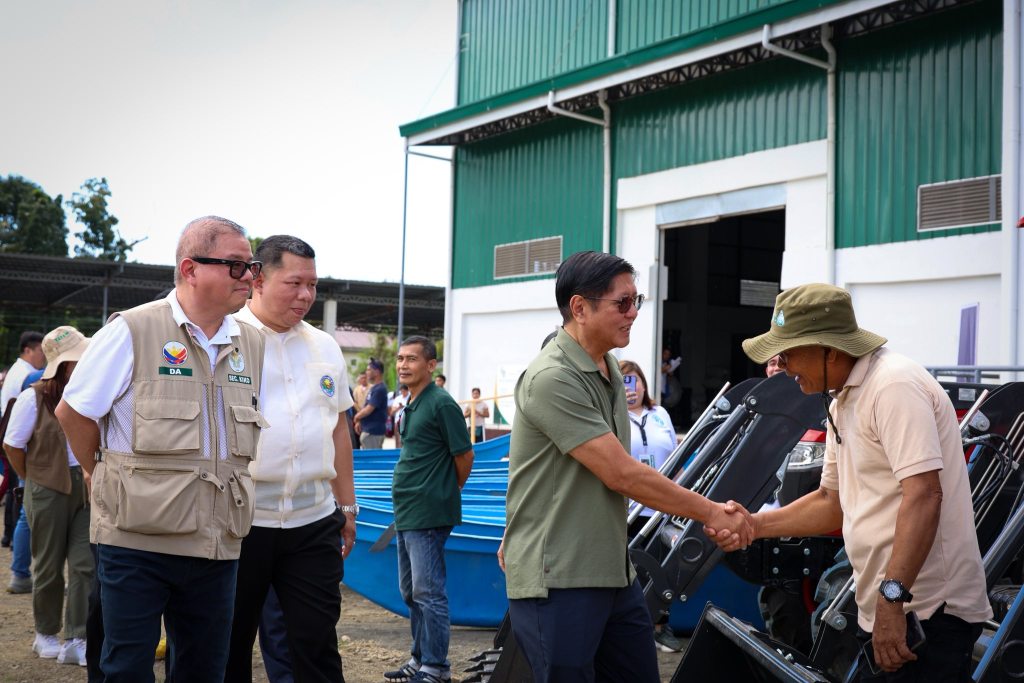
MANILA — President Ferdinand Marcos Jr. and Agriculture Secretary Francisco P. Tiu Laurel Jr. on Monday inspected the newly completed P94.8-million rice processing facility of the Hamtic Multi-Purpose Cooperative in Antique, highlighting the government’s efforts to modernize agriculture and boost farmer incomes in a key rice-producing province in the Visayas.
The Rice Processing System (RPS), located in Barangay Poblacion 5, Hamtic, was constructed by the Department of Agriculture’s Philippine Center for Postharvest Development and Mechanization (PhilMech) and funded through the Rice Competitiveness Enhancement Fund. The facility is designed to reduce post-harvest losses and improve milling efficiency, which is expected to increase recovery rates, enhance rice quality, and allow farmers to secure better market prices.
“This investment gives our rices farmers here in Antique the tools to be more productive and improve their lives, while supporting the Marcos administation’s determined push for national food security,” Tiu Laurel said.
The RPS features a multi-stage rice mill with a capacity of two to three tons per hour worth P54.7 million, and two mechanical dryers capable of handling six tons per batch valued at P6.18 million. The Department of Agriculture’s National Rice Program funded a warehouse and operations building costing P25.9 million, as well as an additional equipment package that includes a hauling truck, forklift, weighing scale, and moisture meter, bringing the total project cost to nearly P95 million.
In addition to the inspection, the Department of Agriculture distributed various forms of assistance to farmers and fisherfolk in Antique. Financial assistance and insurance claim checks were released through the Philippine Crop Insurance Corporation to rice farmers from Hamtic and San Jose de Buenavista affected by weather-related crop losses, with selected beneficiaries receiving ceremonial check handovers from the President.
The Bureau of Fisheries and Aquatic Resources also turned over Php770,000 worth of 11 units of 20-foot fiberglass plastic-reinforced boats with marine engines and accessories to fisherfolk beneficiaries. Agricultural machinery, including four-wheel tractors and rice combine harvesters, was distributed to farmer and producer groups to support land preparation and harvesting.
Support for livestock and poultry development was also extended through the establishment of multiplier farms for cattle, carabao, native pigs, goats, chickens, and ducks under the Department of Agriculture’s LEED Program. Several cooperatives received photovoltaic solar power systems aimed at reducing energy costs and improving sustainability.
The Department of Agriculture said the interventions reflect a value-chain approach that integrates production, post-harvest facilities, mechanization, and energy efficiency to raise farm incomes and strengthen national food security.


 Republika News
Leave a comment