
By Gerry Lirio
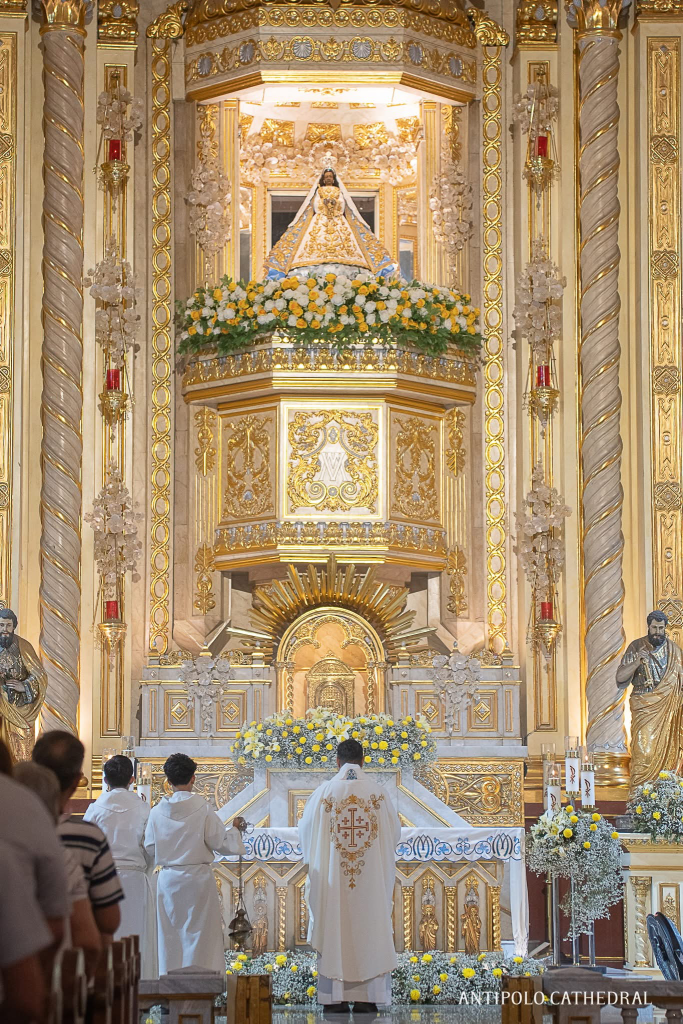
AFTER the celebrated devotions to the Black Nazarene and to the Sto. Nino now comes the enduring image of the Virgin Mary in Antipolo, more popularly known as the Our Lady of Peace and Good Voyage, taking center stage, blocking almost the entire 2026 Catholic calendar in celebrations of the Catholic faith.
The year marks the 400th year since the Marian image of Antipolo, possibly the oldest in the Philippines, first came to the Philippines from Mexico through the Manila-Acapulco Galleon Trade, headed by Governor Juan Nino de Tabora, in 1626.
This year also marks the 100th year since the Vatican held the “canonical coronation” of the image on November 27, 1926, making it a double celebration for the Marian faithfuls.
The celebrations centered on a theme titled “Paglalakbay, Pag-aakay, Pag-aalay”, with the Antipolo Bishop Rupert Santos, extolling the Marian image, “like our very own mothers,” who never abandoned her children, even in times of crisis, and thus the faithful must hang to their belief that the virgin mother would always keep the believers.
Speaking at a gathering at the Antipolo Cathedral last week, referring to the billion-peso flood control controversy involving some government officials, Bishop Santos said, the people will manage to make it through the scandal.
“Tayo ay ninakawan, sinira ating tiwala, pero hindi tayo bibitaw,” he said.
The celebrations come with meaning and symbolism, rites and rituals for the faithful, Filipinos and foreigners alike.
A replica of the Antipolo image will be brought in 28 different jubilee voyage churches in different Rizal towns in activities divided into four—Road of Faith, Road of Hope, Road of Peace, and Road of Love. Each road consists of a series of pilgrims, processions, masses in seven different churches in Antipolo, Binangonan, Cardona, Angono, Taytay, Cainta, Teresa, Baras, San Mateo, Tanay, and Morong.
The four road celebrations, otherwise called The Theology of “Ad Intra”, are color-coded: Faith is Yellow, Peace is blue, Hope is green, and Love is Pink.
Together, the parishes from the different Rizal towns located in the North, South, East and West form a colorful cross-shaped pilgrimage map, whose center is the Our Lady of Peace and Good Voyage.
Ad Intra refers to the embarkation, or the journeying toward the international shrine, referring to the cathedral, which has been declared an international shrine.
Embarkation represents the pilgrim’s inner journey (or inner Rizal province). By stepping into a jubilee voyage church, the faithful begin a spiritual inward movement “seeking renewal of heart, healing of memory, strengthening of faith, deepening of devotion.”
The image will travel in a glass case, similar to the Pope’s automobile, hoping to connect the local parishes to the international shrine.
After the Ad Intra, comes the “Ad Extra” or disembarkation, or Mission with Mary after the Pilgrimage.
“Yes, the journey does not end at the (Antipolo) shrine,” said Bishop Santos.
“After the disembarking, the pilgrim is set forth on a mission, with Mary, for the Church, and into the world.”
This is the movement outward, called the ad extra: “To bring peace where there is conflict, healing where there is hurt, faith where there is doubt, hope where there is despair.”
Schedules of activities for Ad Intra and Ad Extra will take place up to the end of the year.
Year 2026 is a Jubilee year, Santos said, and the cross-shaped map “becomes a visible proclamation that Mary draws her people from the four corners of the diocese into one heart, one home, one mission.”
After touring the Antipolo archdiocese, the Our Lady of Peace and Good Voyage will travel north and south of the country, as shall have a pilgrimage in Portugal, Spain, France, Italy.
While she came to the Philippines 400 years ago, Our Lady is definitely older, more than 400 years. As of today, the image has not undergone major repairs and rehabilitation.
She got her name through the safe voyages in the galleon travels, becoming a powerful symbol of protection for travelers and a major pilgrimage site, surviving fires and World War II.
“Now, as we celebrate not only the 400th Year anniversary of her arrival but also the centennial of her canonical coronation, we remember: this is more than history—it is heritage, living and alive in us.” Santos said.
“The crown placed upon her a hundred years ago was not just gold, but the collective love of a people who found in her a mother, a protector, a guide,” he added.




 Republika News
Leave a comment