
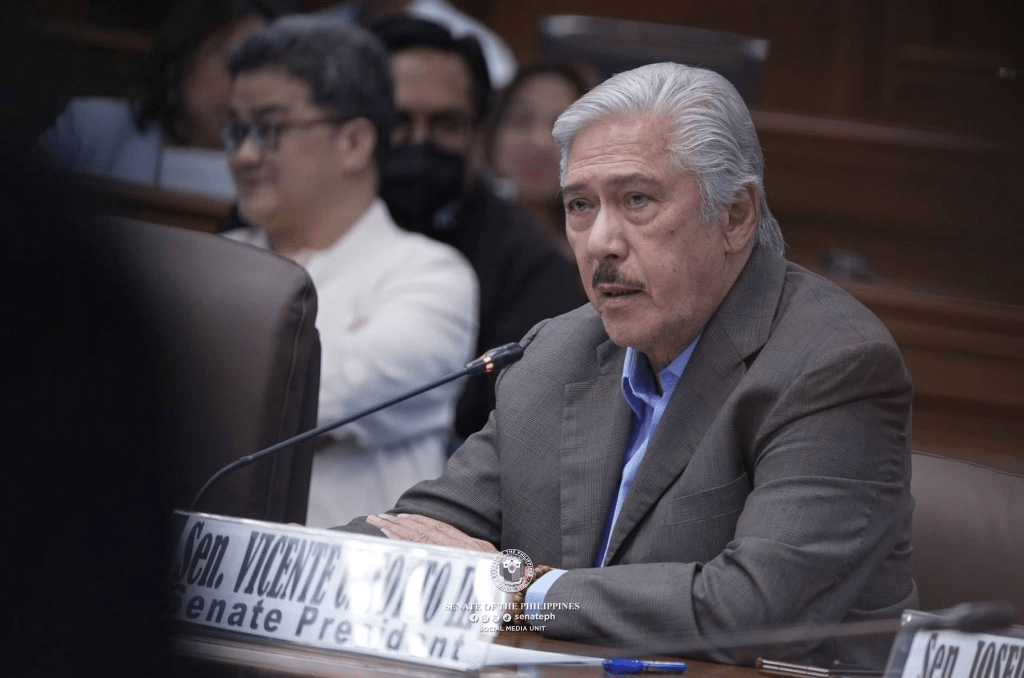
MANILA – The Senate is set to take up proposed reforms to the party-list system and an anti-political dynasty bill when sessions resume tomorrow, with both measures seen as having a strong chance of passage, Senate President Vicente Sotto III said.
In a report, Sotto said President Ferdinand Marcos has emphasized the urgency of several priority measures, including reforms to the party-list system, which he said has strayed from its original purpose of representing marginalized sectors.
“The President wants almost all of these measures expedited,” Sotto said in a radio interview with dwIZ, noting that other priority bills in advanced stages include the Freedom of Information measure, the Classroom Acceleration Act, and the Philippine Geriatric Center bill.
Sotto described the correction of party-list abuses as particularly pressing, citing rulings by the Commission on Elections and the Supreme Court that expanded recognized sectors from fewer than 10 to nearly 100. “The eight marginalized sectors are no longer there. What happened is that it ballooned to nearly a hundred sectors – everyone is now considered marginalized,” he said.
He stressed that the 1987 Constitution and existing laws identify intended beneficiaries such as farmers, fisherfolk, the urban poor, senior citizens, youth, women, indigenous peoples, and persons with disabilities. “How did Bicol, Cebu or Davao become marginalized? How did contractors become marginalized?” he asked.
Sotto said legislation is now needed to repeal and replace the current enabling law to restore clarity and discipline in the party-list system, which could also result in significant government savings. He noted that district lawmakers are beginning to reassess the growing influence of party-list groups, some of which have chaired powerful committees such as appropriations.
The Senate is also expected to revisit the proposed anti-political dynasty bill, though crafting a workable version remains challenging. “There is a strong chance of passage as long as interpellations do not stall the process. If the discussion is clear and cooperative, the public will see who is deliberately blocking the measures,” Sotto said.
Senator Sherwin Gatchalian said the current Congress may be the first to seriously pursue the anti-political dynasty provision mandated by the 1987 Constitution. “There is a big chance. The remaining question is the form it will take and the level of political dynasty to be covered,” he said.
The Senate Committee on Electoral Reforms and People’s Participation, chaired by Senate President Pro Tempore Panfilo Lacson, will deliberate on both the anti-political dynasty and party-list reform bills, which are included in the Legislative Executive Development Advisory Council’s (LEDAC) common legislative agenda.
Gatchalian welcomed President Marcos’ openness to pursuing the measure despite belonging to a prominent political family. “In my more than 20 years in politics, this is the first time I have heard the executive – especially the President himself – actively push for this measure,” he said.
Several anti-political dynasty bills have been filed by Lacson, Senators JV Ejercito, Bam Aquino, Risa Hontiveros, Kiko Pangilinan, and Robin Padilla. Ejercito noted that he filed the measure despite benefiting from a political dynasty, saying it could give others a chance to serve.
Studies cited in the proposed measures show that corruption and poverty tend to persist in areas dominated by political dynasties. Article II, Section 26 of the 1987 Constitution prohibits political dynasties as may be defined by law; in the absence of enabling legislation, the ban has remained unenforced for over 30 years.



 Republika News
Leave a comment