
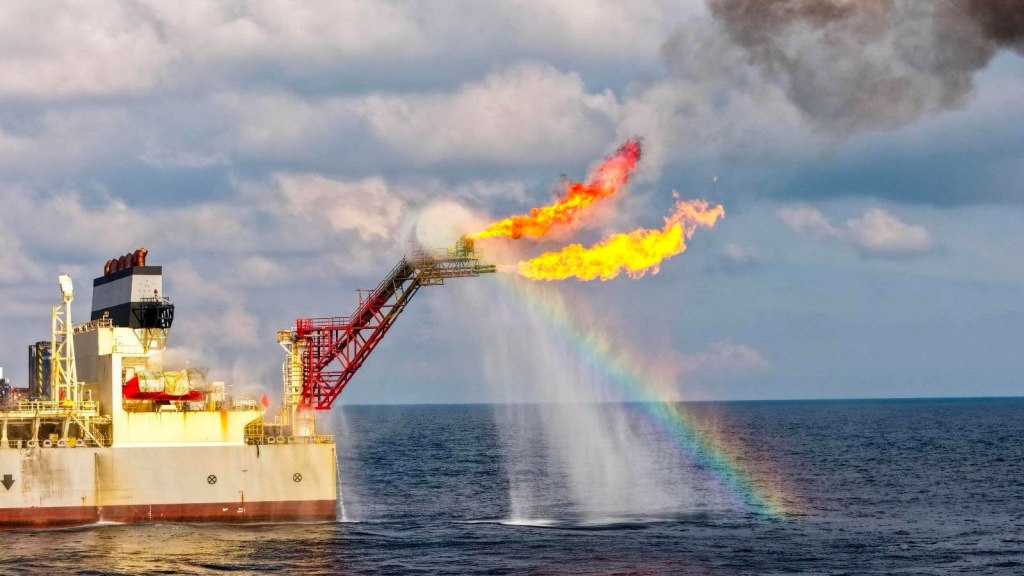
MANILA – The Armed Forces of the Philippines (AFP) is employing all available means, including space-based sensors, to protect the Malampaya oil and gas field in Palawan from potential intruders, a senior Philippine Navy official said Tuesday.
Rear Admiral Roy Vincent Trinidad, Philippine Navy spokesperson for the West Philippine Sea, said the military is relying on a combination of land-, sea-, air-, and space-based detection systems to maintain maritime domain awareness over Malampaya and the nearby Malampaya East-1 (MAE-1) field.
“Without going into details, the posture of the Armed Forces in securing Malampaya and Malampaya East-1 (MAE-1) is based, first and foremost, on the detection capability for maritime domain awareness. We utilized land-based, sea-based, air-based, and even space-based sensors,” Trinidad said.
Asked if the space-based sensors referred to satellite surveillance, Trinidad declined to specify, but affirmed that the AFP is using all appropriate capabilities for the mission.
Trinidad added that aside from detection, the AFP has the capability to respond to threats or intrusions via sea and air assets. “Monitoring is not about numbers; it is about capability. The PN – the AFP as a whole has the capability to monitor Malampaya East-1 (MAE-1), it being five kilometers adjacent to the Malampaya Project,” he said.
The Western Command, through Joint Task Force Malampaya, has been assigned to secure MAE-1, according to the spokesperson.
The Malampaya East-1 field is estimated to hold about 98 billion cubic feet of gas and represents the first milestone under the Malampaya Phase 4 drilling campaign. The campaign also includes the Camago-2, Camago-3, and Bagong Pag-asa wells, which aim to secure additional gas resources.
The project is being carried out by the SC3A consortium led by Prime Energy, in partnership with UC38, PNOC Exploration Corporation, and Prime Oil & Gas Inc.



 Republika News
Leave a comment