
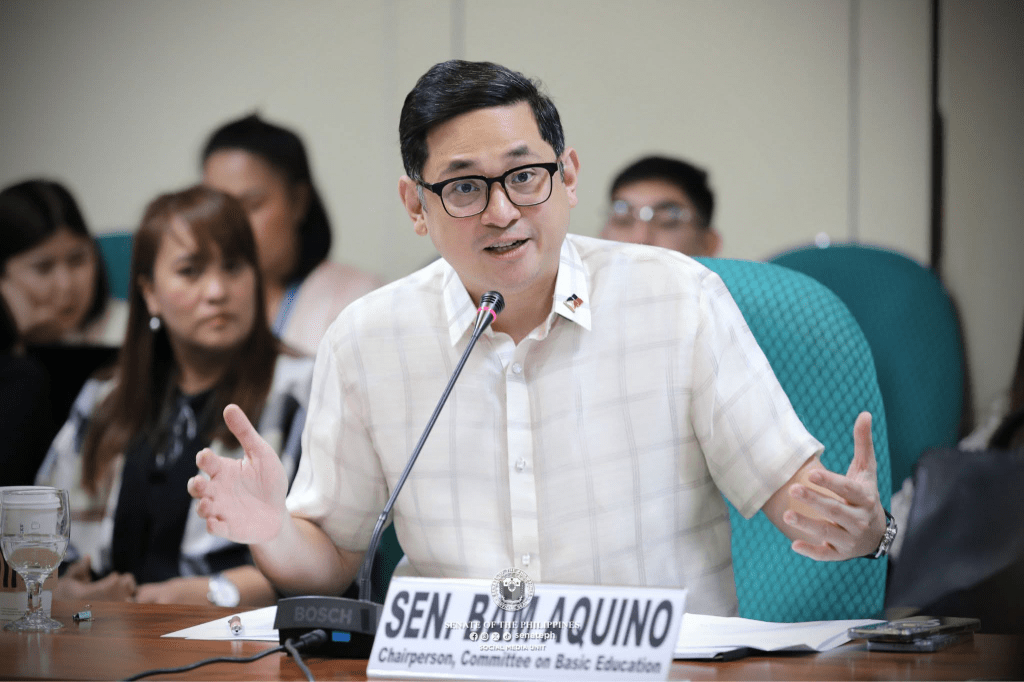
MANILA – Former Senator Bam Aquino highlighted the role of public-private partnerships (PPPs) in addressing the Philippines’ classroom gap during the Basic Education hearing on PPPs.
“Magandang, magandang umaga po sa ating lahat. Maraming, maraming salamat sa mga ating mga bisita mula sa mga iba’t ibang grupo na kakampi natin at kasangga sa pagsulong ng mga reporma na kinakailangan ng ating educational system,” Aquino said in his opening message.
Aquino noted that the country’s classroom shortage was already estimated at 166,000 before last year’s earthquake and typhoons, leaving many students crowded in classrooms, studying in hallways, or sharing covered courts.
He said the government aims to build 25,000 classrooms in 2026, with at least 26,000 construction projects started within the year. Aquino outlined three modalities for classroom construction: through local government units (LGUs), the Department of Public Works and Highways (DPWH), and public-private partnerships.
“The PPP… nakapagpatayo ng 9,000 classrooms,” Aquino said, recalling past PPP initiatives under the administration of former President Benigno Aquino III and emphasizing the need to review how many classrooms were completed and carried over during the Duterte administration.
Aquino stressed that funding for PPP classrooms would not come from the national budget but from private sector partners, potentially including international lenders like the World Bank or Asian Development Bank. He called for clarity on the source of funding, as well as updates on DPWH capacity and ongoing LGU-led projects.
He also emphasized the importance of ensuring uniform pricing and standards across all modalities, citing a cost range of P1.5 million to P4 million per classroom last year.
“Uulitin ko po, iyong presyo mahalagang mapag-usapan… hindi po dapat nagkakalayo ang presyo ng classroom dahil iisa lang ang standard na ginagamit natin,” Aquino said.
Aquino further highlighted the need for proper legal processes and efficient implementation to ensure classrooms are completed in a timely manner. He cautioned that addressing the classroom gap would require sustained funding and could take six to ten years, covering not just classrooms but also facilities, feeding programs, and internet connectivity.
“Wag na ho nating palampasin pa iyong mga opportunities na nandito tayong lahat… siguraduhin natin na taun-taon, iyong pondo sa edukasyon, nandiyan, nababantayan, at… nasa tamang presyo, nasa tamang paraan, at nasa tamang panahon,” he said.
Aquino concluded by commending the Department of Education and stakeholders for their efforts to provide solutions to the country’s educational challenges.


 Republika News
Leave a comment