
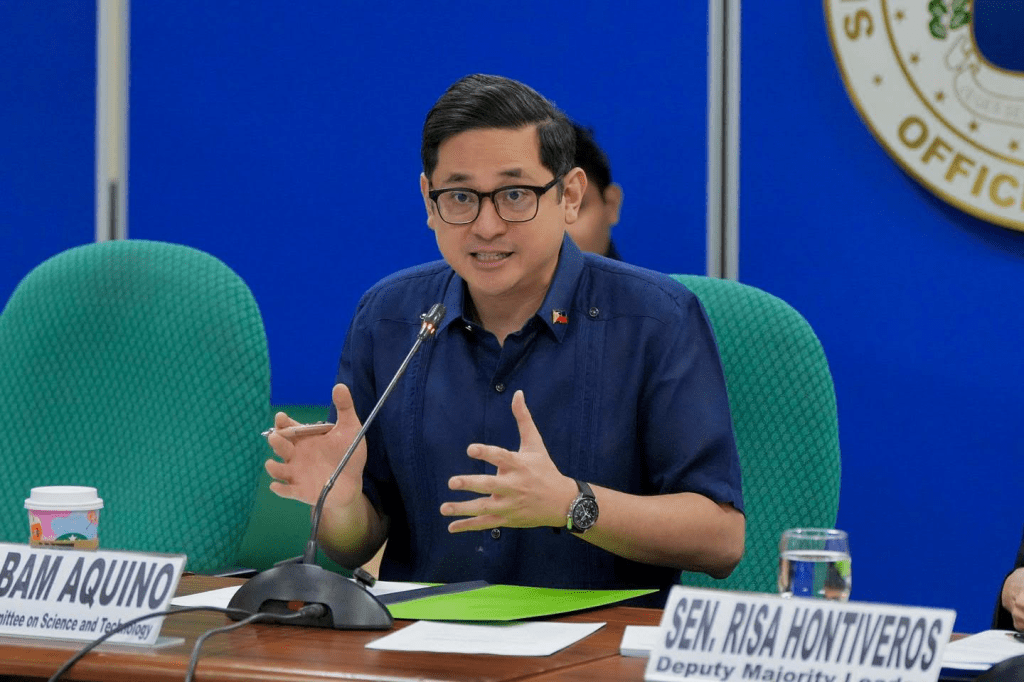
MANILA — Senator Bam Aquino announced that he will not seek the Vice Presidency in the 2028 national elections.
“I will not run for Vice President in 2028,” Aquino said in a post on Facebook, responding to speculation that he might be a running mate for Vice President Sara Duterte, who formally declared her presidential bid for 2028 on Wednesday.
Aquino emphasized that political ambitions should take a backseat as Filipinos continue to face urgent challenges such as the education crisis, unemployment, rising prices, and corruption.
“Nakakahiyang mamulitika habang napakaraming pinagdadaanan ng taumbayan,” he said. “Iyong bansa natin, pagdating sa edukasyon, pagdating sa ekonomiya, presyo ng bilihin, sa pagtugis sa korapsyon, napakaraming hinaharap. Iyan dapat iyong inuuna natin, hindi dapat ang pamumulitika.”
“Iyong 2028, dadating rin iyan. At may tamang panahon na pag-usapan iyan. Pero ngayon, ang tamang gawin, pag-usapan iyong mga mahalaga sa taumbayan,” Aquino added.
As chairperson of the Senate Committee on Basic Education, Aquino said he remains focused on priority legislative measures for Filipinos, particularly students and youth. Several of his proposed bills have been included in the Legislative-Executive Development Advisory Council (LEDAC) priority agenda, including the Classroom-Building Acceleration Program (CAP) Act, the Citizen Access and Disclosure of Expenditures for National Accountability (CADENA) Act, and the Party-list System Reform Act.
The Senate recently approved the CAP Act (Senate Bill No. 1482) and the CADENA Act (Senate Bill No. 1506), also known as the Blockchain the Budget Bill, on third and final reading with votes of 22-0 and 17-0, respectively.
The CAP Act aims to address the reported 166,000-classroom shortage by allowing local government units (LGUs) and credible non-government organizations (NGOs) to construct classrooms, provided they comply with Department of Education standards.
The CADENA Act mandates government agencies to upload and maintain detailed budget-related documents—including contracts, project costs, bills of materials, and procurement records—on a Digital Budget Platform. Files are publicly accessible, tamper-resistant, traceable, open-source, and verifiable. Officials who fail to comply or submit fraudulent information face administrative and criminal penalties, reinforcing transparency and accountability in public spending.

 Republika News
Leave a comment