
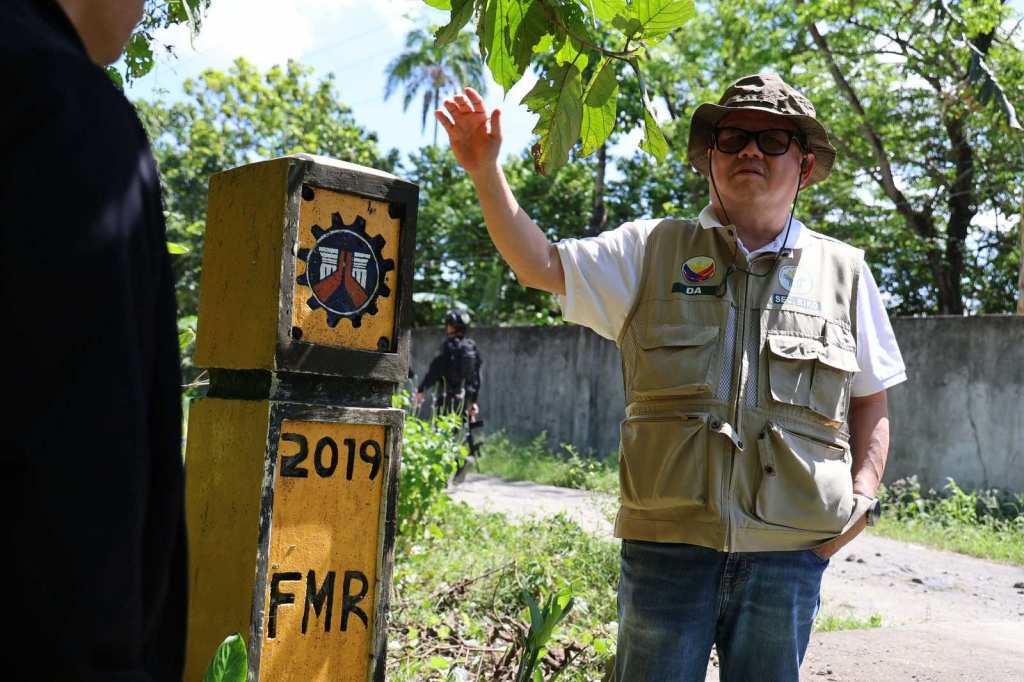
GUINOBATAN, Albay — Agriculture Secretary Francisco P. Tiu Laurel Jr. personally checked a suspected “ghost” farm-to-market road (FMR) project in Barangay Lower Binogsacan on Monday, raising new concerns over a 1-kilometer, 5-meter-wide road intended to help farmers transport their produce and boost local development even before the pandemic.
Findings from an earlier validation conducted by the Department of Agriculture’s Internal Audit Service (IAS) in November showed that the project had not been carried out in its approved location.
“Our auditors were told the road had been relocated upon the request of the former district representative in April 2021, citing unspecified right-of-way and environmental constraints that supposedly hindered the project,” Tiu Laurel said.
According to the agriculture chief, personnel from the Department of Public Works and Highways (DPWH) and the Regional Agricultural Engineering Division (RAED) led auditors to a supposed relocation site of the 2021 FMR project. However, the location bore a road marker indicating “2019 FMR,” which typically denotes the year a project was completed, raising questions about the project’s timeline and legitimacy.
In a separate inspection, the audit team also examined another FMR project in Camarines Sur, which was found to be significantly overpriced. The project, measuring 74.3 meters for a one-lane portion and 32 meters for a two-lane section, had a total cost of P14.6 million.
The inconsistencies have triggered concerns over possible irregularities in how the projects were implemented and reported. The FMR initiatives are designed to improve farmers’ access to markets and minimize post-harvest losses.
Tiu Laurel said the department has launched a more thorough probe, including a review of project documents, funding disbursements, and coordination with relevant agencies to establish accountability and prevent similar issues in future infrastructure projects.
“This is exactly why we are strengthening oversight of FMR projects,” he said. “Farmers deserve infrastructure that actually exists—and works.”


 Republika News
Leave a comment