
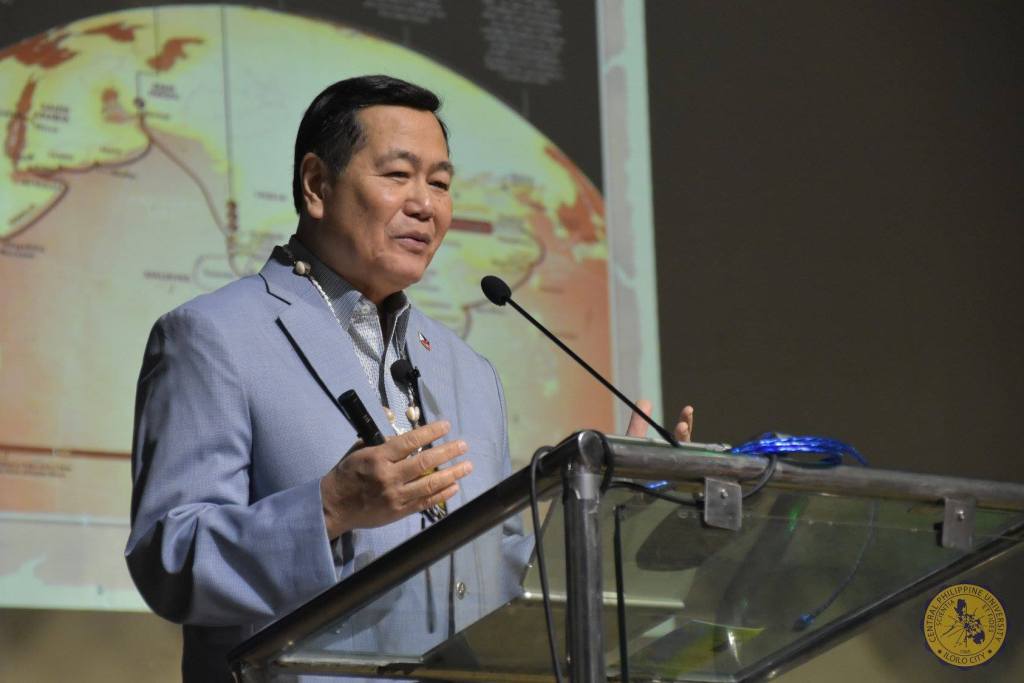
MANILA – Retired Supreme Court Associate Justice Antonio Carpio cautioned that proposed joint oil and gas explorations with China in the West Philippine Sea could undermine the Philippines’ sovereign rights.
“Joint development is a trap because joint development means, you go to the website of China, it says joint development means China owns the gas, the oil, all the natural resources,” Carpio said during a visit to Pag-asa Island.
“China has the sovereign rights. That’s from the point of view of China. So why will we accept that?” he added.
Carpio was on Pag-asa to attend the groundbreaking of a Catholic church, marking his second visit to the island—the first was 14 years ago when the Philippines was preparing its case against China’s nine-dash line claim.
During the visit, the Philippine Coast Guard showed Carpio Chinese structures under construction at Panganiban Reef within the country’s exclusive economic zone, as well as Chinese maritime militia vessels in Sabina Shoal.
President Ferdinand “Bongbong” Marcos Jr. has previously said he is open to restarting discussions with Beijing on a joint energy project in the South China Sea. Foreign Affairs Secretary Maria Theresa Lazaro clarified that no joint exploration is happening at present, though such an arrangement could be considered in the future to ensure energy security amid global oil supply concerns.
“Not at this point in time, but it may be forthcoming,” Lazaro said.
The Chinese Embassy in Manila described the talks as having made “positive progress,” noting that the two countries held “in-depth discussions” on joint development in the disputed waters.
Meanwhile, the Philippines and China have resumed negotiations under the 11th Bilateral Consultation Mechanism (BCM) in Fujian, addressing West Philippine Sea issues and discussions on a Code of Conduct amid Middle East tensions and rising global oil prices.
Foreign Affairs Undersecretary for Policy Leo M. Herrera-Lim described the discussions as exploratory, focused on exchanging views on potential cooperation and the impact of oil prices.
“Exploratory lang at best kung papayag sila na explore namin na mag-exchange ng views on potential values for cooperation, exchange of views on ‘yung impact ng prices sa Middle East, areas for cooperation,” he said.
Talks on joint energy projects remain sensitive due to sovereignty issues, constitutional boundaries, and overlapping claims. China asserts ownership of nearly 90% of the South China Sea, overlapping with Philippine and other neighboring countries’ waters.
In 2016, an international tribunal in The Hague ruled in favor of the Philippines, declaring China’s claims “have no legal basis.” China has yet to recognize the decision.



 Republika News
Leave a comment