
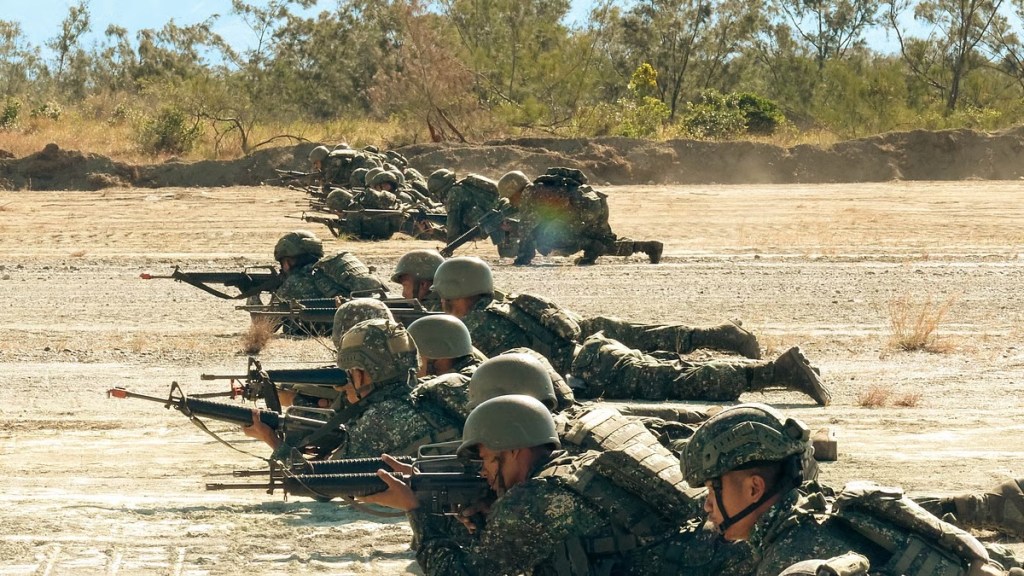
MANILA — The Armed Forces of the Philippines (AFP) said it is prepared for any potential escalation following warnings from China over this year’s Balikatan Exercise with the United States.
In a report, AFP spokesperson for the West Philippine Sea, Rear Adm. Roy Vincent Trinidad, said the military has contingency measures in place amid possible reactions from Beijing.
“I would not like to speculate on how they would react after Balikatan. What I would like to say is your AFP is prepared for any escalation, for any eventuality,” Trinidad told reporters.
“We have the appropriate contingency plans in place. And we have seen in the past that your AFP has been able to stand up to any challenge posed to us by the adversary in the maritime domain,” he added.
China earlier cautioned against actions that may heighten tensions in the region. Chinese Foreign Ministry spokesperson Guo Jiakun said the Asia-Pacific should maintain “peace and tranquility,” warning that military cooperation must not undermine stability or target other nations.
“No military and security cooperation should be conducted at the expense of mutual understanding and trust as well as peace and stability in the region,” he said.
“Such cooperation should not target any third party or harm the interests of any third party. For countries that tie their own security to others, it is important to bear in mind that this may very well backfire,” he added.
Despite the warning, Trinidad said the Philippines will proceed with joint military activities with allied nations, noting that broader participation signals international backing.
“We will not be deterred from performing our mandate, from continuing exercises with our like-minded partners,” he said.
Around 17,000 troops from the United States, the Philippines, and other partner countries are set to take part in this year’s Balikatan drills, which will include operations in the West Philippine Sea.
Tensions persist in the South China Sea, where China asserts sweeping claims over waters also claimed by several countries, including the Philippines, Vietnam, Indonesia, Malaysia, and Brunei. The area is a major global shipping route handling more than $3 trillion in trade annually.
The Philippine government refers to portions of the South China Sea within its jurisdiction as the West Philippine Sea, covering waters west of the archipelago, including the Luzon Sea and areas surrounding the Kalayaan Island Group and Bajo de Masinloc.
In 2016, the Permanent Court of Arbitration ruled in favor of the Philippines, stating that China’s claims in the South China Sea have “no legal basis.” China has rejected the ruling.


 Republika News
Leave a comment