
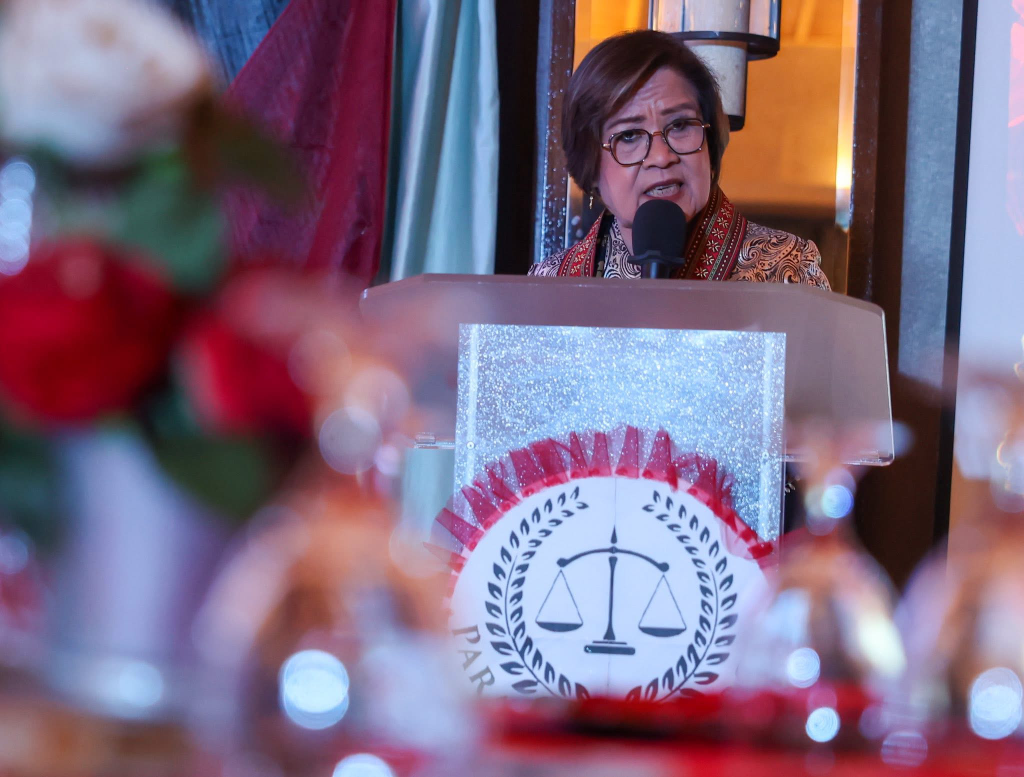
MANILA – House Senior Deputy Minority Leader and Mamamayang Liberal (ML) Party-list Rep. Leila de Lima maintained that the House Committee on Justice’s impeachment proceedings involving Vice President Sara Duterte do not violate the bank secrecy law or any other law, following plans by Duterte’s camp to file criminal complaints against officials and lawmakers involved in the inquiry.
In a report, De Lima issued the statement after lawyer Manases “Mans” Carpio, Duterte’s husband, announced he would file complaints against officials of the Bangko Sentral ng Pilipinas (BSP), the Anti-Money Laundering Council (AMLC), and members of the House justice committee, citing alleged violations of the Anti-Money Laundering Act (AMLA), bank secrecy laws, and the Data Privacy Act.
In a statement, Carpio’s lawyers said BSP Governor Eli Remolona Jr., AMLC Executive Director Ronel Buenaventura, and House justice panel members Reps. Gerville Luistro, Percival Cendaña, Chel Diokno, and De Lima were among those who allegedly disclosed confidential banking records.
De Lima said Carpio has the right to file a complaint but added she will wait for an official copy before responding in detail with her legal team.
“But, as far as the House Committee on Justice is concerned, the proceedings cannot be considered violative of any law. Cases of impeachment, being sui generis, are not covered by the prohibition under the Secrecy of Bank Deposits Law,” said De Lima, a former Justice secretary and senator.
She explained that the committee is conducting hearings to determine probable cause on duly filed impeachment complaints against Duterte. She also noted that the panel relied on records from the AMLC involving reported suspicious and covered transactions, not direct bank account details.
De Lima cited Republic Act 9160 or the Anti-Money Laundering Act, saying covered institutions such as banks are required to report suspicious transactions to the AMLC, and that such reporting is expressly not a violation of the Bank Secrecy Law (RA 1405).
“Also, the prohibition on disclosure applies only to officers and employees of banks and banking institutions,” she said.
“The fact that evidence of ill-gotten wealth was exposed in the course of the impeachment proceedings does not make such exposure criminal. It is a direct consequence of impeachment as an accountability mechanism,” De Lima added.
During a recent hearing, the AMLC confirmed before the House justice committee that at least 18 bank transactions linked to Duterte and her family members matched records cited in the affidavit of former senator Antonio Trillanes IV. It also reported that Duterte was subject of 27 suspicious transaction reports from August 2024 to January 2026, allegedly tied to drug trafficking, graft and corruption, and malversation of public funds and property.
The AMLC further said that about P6.7 billion in covered and suspicious transactions were recorded under the names of Duterte and her husband from 2006 to 2025.
April 29 hearing
House human rights committee chair and Manila 6th District Rep. Bienvenido “Benny” Abante Jr. urged the Vice President to attend the House justice committee hearing on April 29, saying she should personally face the allegations if she has nothing to hide.
“Sa akin naman, sinabi ko, it is better for the Vice President to attend, take an oath and answer all the allegations, instead of going to the media. Sapagka’t sa amin naman, kung wala ka namang itinatago, bakit ka matatakot mag-appear, ‘di ba?” Abante said.
He added that the April 29 hearing could be Duterte’s final opportunity to appear before the committee as it deliberates on probable cause for the impeachment complaints, assuring she will be given due process if she attends.
House public accounts committee chair and Bicol Saro Rep. Terry Ridon said he believes probable cause has already been established, citing grounds of betrayal of public trust and culpable violation of the Constitution.
Ridon said the committee needs a majority vote of 21 out of 39 members to recommend impeachment, after which articles of impeachment may be drafted for transmittal to the plenary. At least one-third of House members must then vote in favor for the case to be sent to the Senate for trial.
“Sa Miyerkules, inaasahan natin ang botohan sa probable cause. Kapag positibo, aakyat na ito sa plenaryo, at inaasahan natin sa Mayo ang desisyon kung maipapadala ito sa Senado,” Ridon said.
 Republika News
Leave a comment