
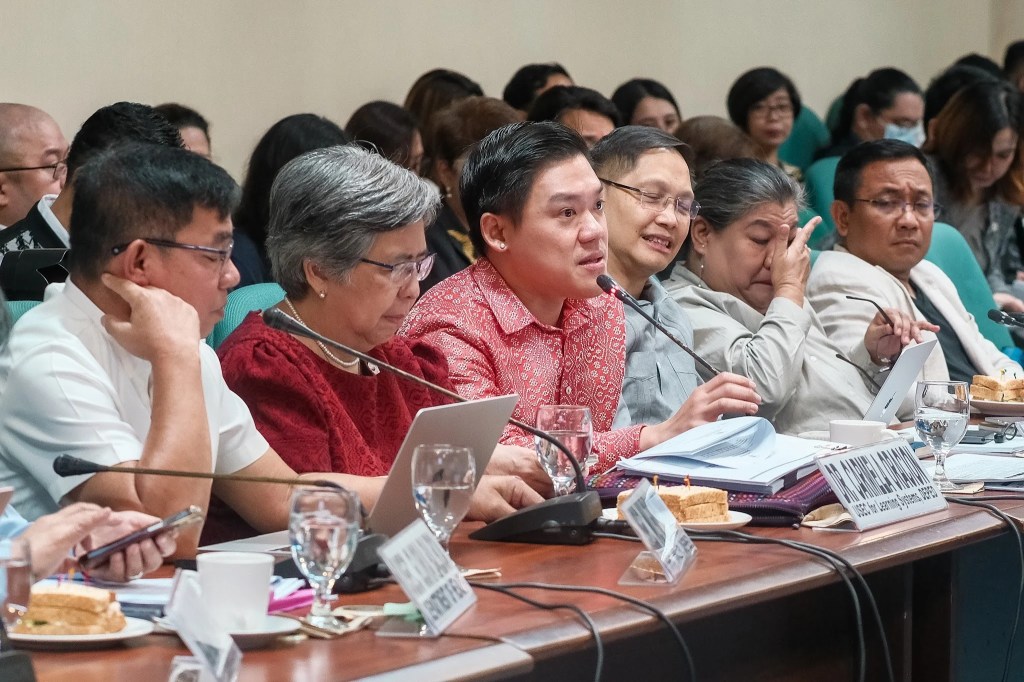
MANILA — The Senate Committee on Basic Education tackled a proposed measure seeking to give the Department of Education (DepEd) greater authority to reorganize and subdivide heavily congested Schools Division Offices (SDOs) to address administrative bottlenecks.
Senate Bill 2089 aims to amend Republic Act No. 9155 or the Governance of Basic Education Act of 2001 by authorizing the Education Secretary, in coordination with the Department of Budget and Management, to create, merge, reorganize, realign, or subdivide SDOs based on learner population, geographic conditions, school coverage, and workload demands.
During the hearing, EDCOM 2 Co-Chairperson Senator Loren Legarda said the existing law prevents DepEd from addressing severe congestion in large divisions.
“So the Secretary of Education is not allowed to solve this problem regardless of who or how brilliant or hardworking or disciplined the Secretary is, because a law has not been passed all these years,” Legarda said. “The DepEd’s Secretary’s hands are tied because this law was never enacted.”
She added, “Maski anong budget ibigay namin sa inyo, if the law does not allow DepEd to create the positions and structures needed to respond to growing demands, wala rin. The workload is simply too great, yung dami ng trabaho, kulang ang qualified competent personnel, this should be allowed by law,” she emphasized.
Based on EDCOM 2 findings, the country’s 228 Schools Division Offices are supported by 22,356 regular personnel, resulting in an average ratio of one SDO staff member for every 1,237 learners.
The Commission also reported wide disparities in workload, noting that while some divisions oversee fewer than 100 schools, others manage more than 1,300 schools under the same organizational structure.
It cited Leyte SDO, which supervises 1,363 schools, compared to Isabela City, which oversees 74 schools, despite both operating under the same framework under RA 9155.
DepEd Undersecretary Wilfredo Cabral expressed support for the proposed amendment, saying several divisions are already operating beyond manageable capacity.
“There are 140 medium, 27 large, and 4 very large divisions,” Cabral said, identifying Cebu, Iloilo, Quezon, and Camarines Sur among the most burdened.
He said some divisions handle as many as 1,472 schools and about 400,000 learners, creating significant administrative strain.
“So the amendment is a welcome move because it will allow the DepEd to provide more foot soldiers and even address the choke points. Kasi kahit malaki ang division iisa din ang kanyang legal officer, iisa din yung kanyang HR, dealing with this number of personnel,” Cabral continued.
He added that the measure would also help address geographic challenges in island and mountainous areas by allowing better deployment of personnel.
EDCOM 2 Executive Director Karol Mark Yee said the current structure makes educational support dependent on geography rather than actual need.
“If pag nasira po ang isang classroom sa isang division tulad ng Quezon, pag sabay-sabay nasira, itong isang division engineer kailangan pumunta, tingnan, mag-coordinate, hindi po talagang magagawa. So despite all of our efforts to resource, without the manpower on the ground, DepEd would really have a difficult time to address this. And the same goes for librarian, nurses, medical officers, which are all division level services,” Yee said.
Legarda also stressed urgency in passing the measure.
“If there’s so much density and there’s a need, then we amend the law and give the Secretary the power. I cannot imagine something so important and urgent has not passed. This is a low-hanging fruit, we should pass this,” she said.




 Republika News
Leave a comment