
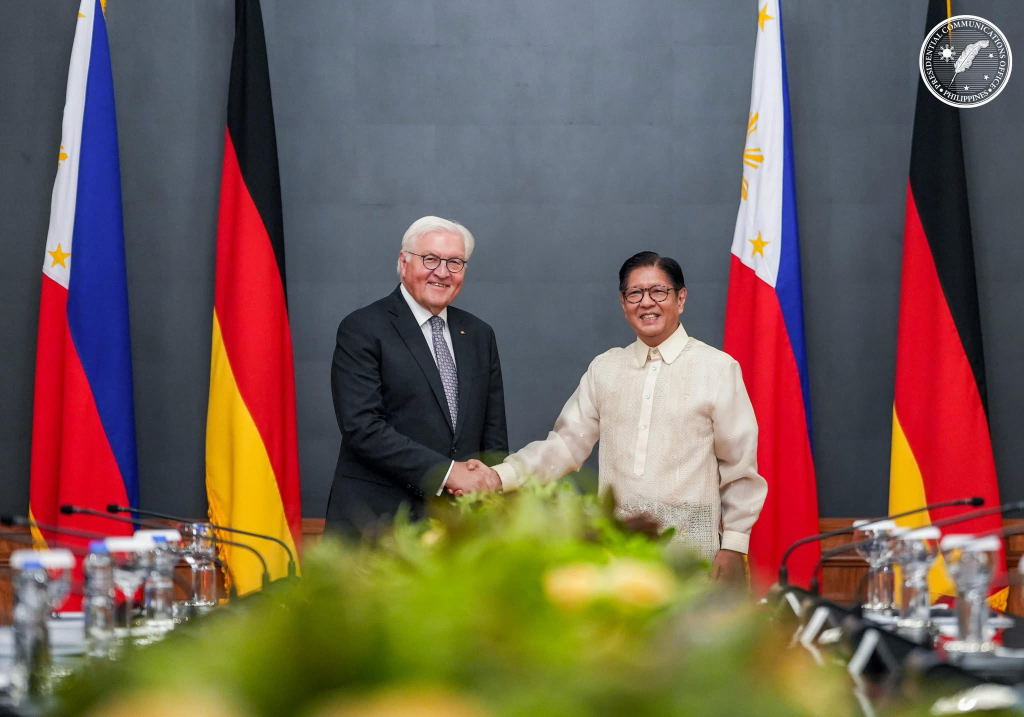
MANILA — The Philippines and Germany reaffirmed their commitment to deepen bilateral cooperation in key areas, including trade and investment, defense, renewable energy, and labor.
In a joint statement following a bilateral meeting at Malacañan Palace, President Ferdinand Marcos Jr. said discussions with German President Frank-Walter Steinmeier covered a wide range of issues, including peace and development, maritime affairs, climate change, and regional security concerns.
Marcos described Germany as a key trade partner and the Philippines’ largest trading and investment partner among European Union member states, with bilateral trade reaching about USD 5.5 billion and net foreign direct investments totaling around USD 10.26 million in 2025.
He cited major German firms such as Siemens, Lufthansa Technik, Deutsche Bank, Bayer, and Bosch as contributors to the Philippine economy.
“Our relations with Germany are important not just because our portfolio of cooperation spans a wide array of sectors, but because these partnerships and projects have proven to be successful and beneficial to our national development efforts,” Marcos said.
He also welcomed Germany’s support for the early conclusion of the Free Trade Agreement between the Philippines and the European Union, noting that the sixth round of negotiations was held in Manila in May.
Marcos said Germany is also a key defense partner, citing its participation as an observer in the Philippine “Balikatan” military exercises since 2024.
He added that Germany has supported efforts to strengthen the Philippine Coast Guard through donations of Airbus H145 helicopters and unmanned aerial vehicles to enhance maritime and aviation capabilities.
The President also thanked Germany for its support of the Philippines’ position in the South China Sea, particularly its advocacy for adherence to the 2016 arbitral ruling.
“Germany is also an important partner and like-minded country in the Philippines’ efforts to promote the rule of law and the rules-based international order,” he said.
“We also had an exchange of views on regional and international matters of mutual concern, including the security situation in the Indo-Pacific, in Europe, and in the Middle East. The Philippines looks forward to continuing to enhance our partnership with Germany in the years ahead.”
Marcos said both countries share strong interest in expanding cooperation in renewable energy, noting Germany’s technology and the Philippines’ natural resources as complementary strengths.
He also highlighted people-to-people ties, noting that about 45,000 Filipinos live and work in Germany, many of them in healthcare and other skilled professions.
“Beyond their roles in the labor market, they are essential partners in Germany’s society and economy, bringing world-class expertise, skills, and a professional work ethic to the sectors that matter most for Germany, such as the healthcare sector, finance, engineering, and IT (information technology) services,” Marcos said.
He added that cooperation in technical and vocational education and training will continue through research, innovation, and capacity-building initiatives, with support from the German Society for International Cooperation (GIZ).
German President Frank-Walter Steinmeier said his state visit highlights the importance of the Philippines as a partner in promoting global peace and stability amid rising geopolitical tensions.
He also expressed support for closer cooperation on South China Sea issues and welcomed efforts to expand migration and skills training programs.
“Our cooperation is not only marked by international and regional developments. Our peoples too, continue to grow together. The great and continuously growing number of Philippine-skilled workers in Germany plays an important part in that regard. We welcome them with open arms and are very grateful for the important job they are doing,” Steinmeier said.
 Republika News
Leave a comment