

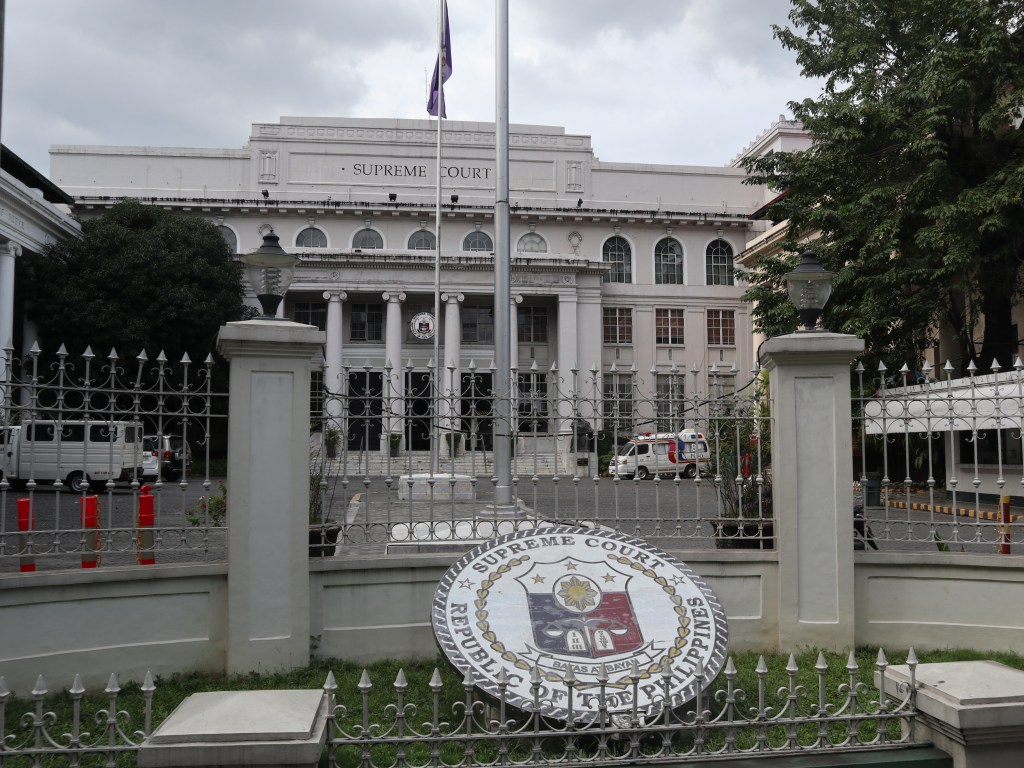
MANILA — The Supreme Court (SC) has struck down a Government Service Insurance System (GSIS) rule that barred certain secondary beneficiaries from receiving survivorship benefits, ruling that the provision exceeded the agency’s authority under the law.
In a decision penned by Associate Justice Henri Jean Paul Inting, the SC Third Division declared Section 24.2.2 of the Revised Implementing Rules and Regulations of Republic Act No. 8291, or the Government Service Insurance Act of 1997, as ultra vires, or beyond the GSIS’ rule-making powers.
The ruling prohibits the GSIS from enforcing the provision insofar as it conflicts with Section 21(c) of the GSIS Act.
The case stemmed from a claim filed by Petronilo Laroco following the death of his daughter, Cristie Laroco, a public school teacher who had rendered 13 years of government service and paid GSIS premiums for 12 years.
Cristie died without a spouse or children.
The GSIS denied Petronilo’s application for survivorship benefits, citing a provision in its implementing rules that limited eligibility for secondary beneficiaries to cases where the deceased member had served at least 15 years in government service.
Because Cristie had only 13 years of service, the GSIS maintained that only primary beneficiaries, such as a spouse or children, would have been entitled to the benefit.
Ruling in favor of Petronilo, the Supreme Court said a secondary beneficiary may receive survivorship benefits under the GSIS Act if there is no primary beneficiary, the claimant satisfies the law’s dependency requirements, the member was in government service at the time of death, and the member had rendered at least three years of service.
The Court found that the disputed GSIS rule imposed an additional requirement not found in the law by restricting survivorship benefits for secondary beneficiaries to cases involving at least 15 years of government service.
According to the SC, while the GSIS may have sought to address what it viewed as an unequal situation under the law, it cannot amend statutory provisions through an administrative issuance.
The Court said that by issuing the rule, the GSIS effectively encroached on Congress’ lawmaking authority.
“[The GSIS’] conduct also runs counter to the fundamental principle that social security statutes, such as [the GSIS Act], must be liberally construed in favor of the employee and their beneficiaries precisely because such laws are designed to promote social justice and to protect the workers and their families from contingencies, such as disability and death, that result in loss of income or financial burden,” the SC ruled.
The Court added that if the GSIS believes changes to the survivorship provisions of the GSIS Act are necessary, it should seek legislative action from Congress.
The case was remanded to the GSIS Committee on Claims for the computation of the survivorship benefits due to Laroco.




Leave a comment