
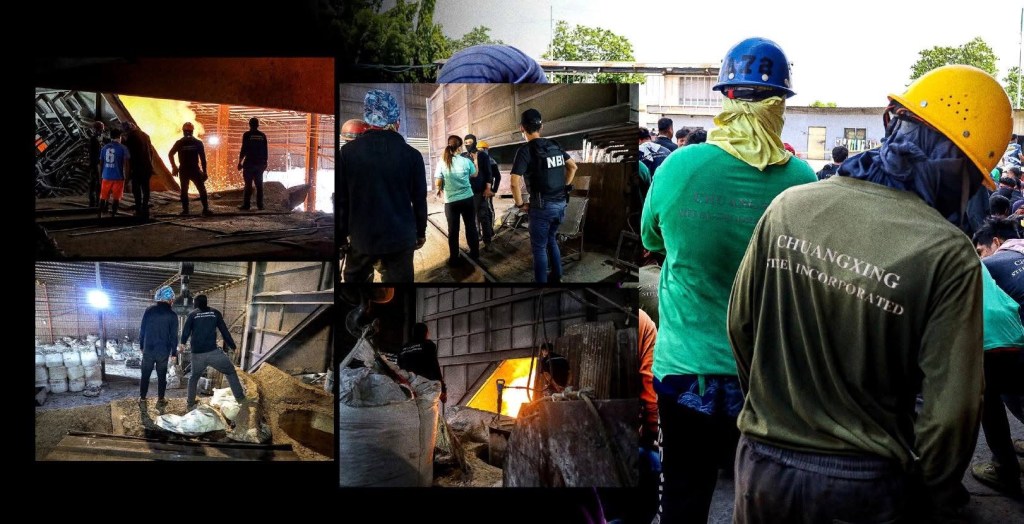
MANILA — The National Bureau of Investigation (NBI) said it uncovered an alleged large-scale industrial and public safety threat involving the unlawful possession and use of radioactive-bearing industrial materials and the manufacture and distribution of structurally substandard steel products during an operation in Magalang, Pampanga on July 18.
In a statement, the NBI said the discovery stemmed from a joint intelligence and law enforcement operation conducted by its Chemical, Biological, Radiological, Nuclear, and Explosives and Foreign Malign Influence Unit (CFMIU), the Office of the Director, and the Presidential Anti-Organized Crime Commission (PAOCC).
Authorities implemented a search warrant at CHUANGXING STEEL INCORPORATED, resulting in the seizure of radioactive-bearing and structurally substandard finished steel products, contaminated production equipment, and other radioactive industrial materials with an estimated value of more than PHP3 billion.
The operation also led to the arrest of four company officers and the removal of 347 Filipino and 37 Chinese workers from what authorities described as hazardous industrial conditions.
The NBI said the operation, supported by the Armed Forces of the Philippines, Philippine Nuclear Research Institute (PNRI), Philippine Air Force and Philippine Coast Guard CBRN Units, Department of Environment and Natural Resources (DENR), Department of Labor and Employment (DOLE), Department of Health (DOH), and the local government of Magalang, halted the production and nationwide distribution of the allegedly hazardous construction materials.
According to the agency, the products could have been used in the construction of homes, schools, hospitals, bridges, evacuation centers, airports, seaports, government buildings, military installations, power facilities, and other critical infrastructure.
Government inspectors also reported alleged labor and occupational safety violations, including wage-related violations, failure to provide mandatory employee benefits, the absence of required occupational safety and health programs and qualified safety personnel, inadequate personal protective equipment, and unsafe industrial equipment and operations.
The NBI added that 10 workers were identified as having suspected occupational radiological exposure after the PNRI detected alpha- and gamma-emitting radioactive materials at the facility. The DOH recommended continued radiological evaluation and long-term medical surveillance for the affected workers.
Meanwhile, the DENR ordered the immediate cessation of the company’s operations after determining that the facility posed an imminent and potentially irreversible danger to worker safety, public health, and the environment.
Investigators also reported finding evidence of the melting of coins for industrial use and discovered undeclared metallurgical capabilities, including a separate furnace, at least six industrial lathe machines, other heavy metalworking equipment, and tungsten pellets, despite the apparent absence of any connection between the materials and the company’s declared manufacturing process.
Based on its investigation, the NBI said it found probable cause that CHUANGXING STEEL INCORPORATED unlawfully possessed, processed, stored, transported, and used radioactive-bearing industrial materials without the required licenses, permits, and regulatory authorizations while manufacturing and distributing reinforcing steel bars that allegedly failed to comply with mandatory Philippine National Standards.
The NBI said it has recommended the filing of charges against 12 company officers, incorporators, and stockholders, including the four arrested during the implementation of the search warrants, for alleged violations of Republic Act No. 12305, or the Philippine National Nuclear Energy Safety Act; Republic Act No. 6969, or the Toxic Substances and Hazardous and Nuclear Wastes Control Act; Presidential Decree No. 1586; Republic Act No. 8749, or the Philippine Clean Air Act; Republic Act No. 7394, or the Consumer Act of the Philippines; and other applicable laws.


Leave a Reply