
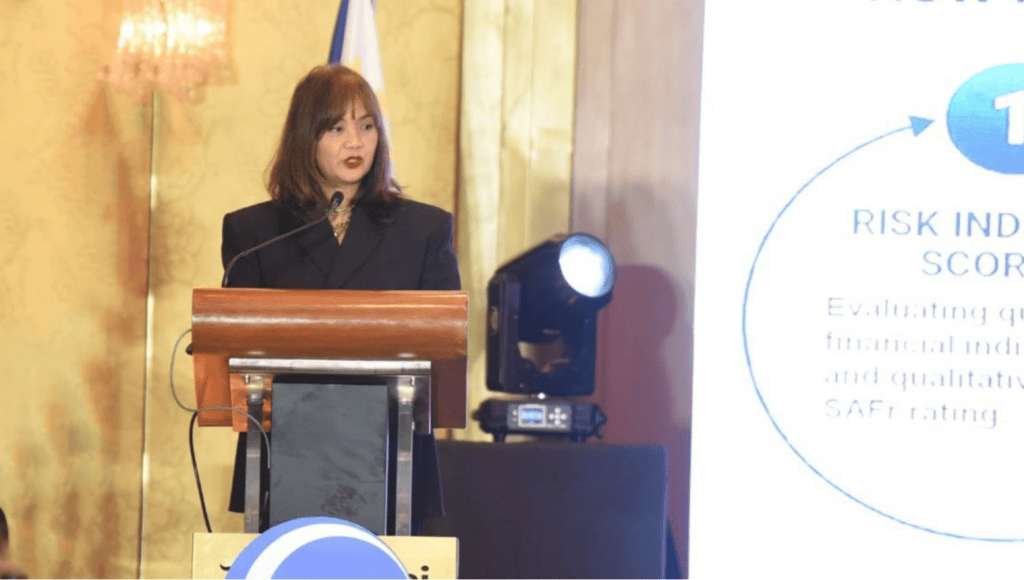
Insurance Corporation (PDIC) highlighted its ongoing efforts to strengthen financial stability and
depositor confidence through the development of a Risk-Based Assessment System (RBAS) for
deposit insurance. During the panel discussion at the 52nd Annual Convention of the Chamber of
Thrift Banks (CTB), PDIC General Counsel Maria Antonette I. Brillantes-Bolivar emphasized that
while digital transformation continues to reshape banking, public trust remains anchored on sound
governance, prudent risk management, and strong institutions. Developed in collaboration with the
World Bank Group, the RBAS framework will introduce a more equitable approach to premium
assessments by aligning rates with each bank’s risk profile, thereby encouraging stronger risk
management practices and enhancing the resilience of the banking system.
MANILA – The Philippine Deposit Insurance Corporation (PDIC) is preparing to introduce a risk-based system for assessing deposit insurance premiums, a reform it said would promote stronger risk management and fairer treatment among banks.
The proposed Risk-Based Assessment System (RBAS) was discussed during the 52nd Annual Convention of the 42-member Chamber of Thrift Banks, where PDIC General Counsel Maria Antonette Brillantes-Bolivar underscored the importance of sound governance and prudent risk management in maintaining public confidence in the banking sector.
The reform will replace the current flat-rate assessment scheme, under which banks pay a uniform rate equivalent to one-fifth of one percent of their total deposit liabilities.
Under RBAS, a bank’s assessment rate will instead be based on its individual risk profile, including its financial condition, governance and risk management practices.
The PDIC said the system is intended to recognize banks that maintain responsible risk management practices rather than impose an additional burden on the industry.
The reform is particularly relevant to thrift banks, which serve more than 10.4 million deposit accounts nationwide and provide financial services to households, entrepreneurs and small and medium enterprises.
The PDIC said banks can further expand access to formal financial services by combining digital technologies with their established community presence, particularly as financial institutions continue to adapt to rapid technological changes.
Before the system is fully implemented, the PDIC will conduct a one-year shadow run to allow banks to familiarize themselves with the assessment framework.
The period will also give banks an opportunity to determine how their operations are evaluated, address potential weaknesses and improve their risk management systems before the new premium assessments take effect.
The corporation also assured banks that information generated through the RBAS would be protected by strict confidentiality measures.
These safeguards will cover bank-specific assessments, simulated scores and risk ratings. The framework will likewise provide mechanisms for banks to seek clarification and review, while allowing the system to undergo periodic recalibration based on changing industry conditions.
The PDIC said RBAS is aligned with international practices and the Core Principles for Effective Deposit Insurance Systems of the International Association of Deposit Insurers (IADI).
The principles call for deposit insurers to have access to timely and relevant information for assessing risks, establish meaningful differences among risk and premium categories, maintain transparency in premium calculations and protect confidential information involving institution-specific ratings and rankings.
They also call for deposit insurance systems to be regularly reviewed and updated to ensure their continued effectiveness.
The PDIC said the reform is ultimately intended to strengthen the country’s deposit insurance system and support the stability of banks, depositors and the wider economy.
“RBAS is not about imposing additional burden on banks. It is about creating greater fairness, stronger incentives, and a more resilient banking system, one that benefits the millions of Filipino savers we all serve,” Bolivar said.



 Republika News
Leave a comment