
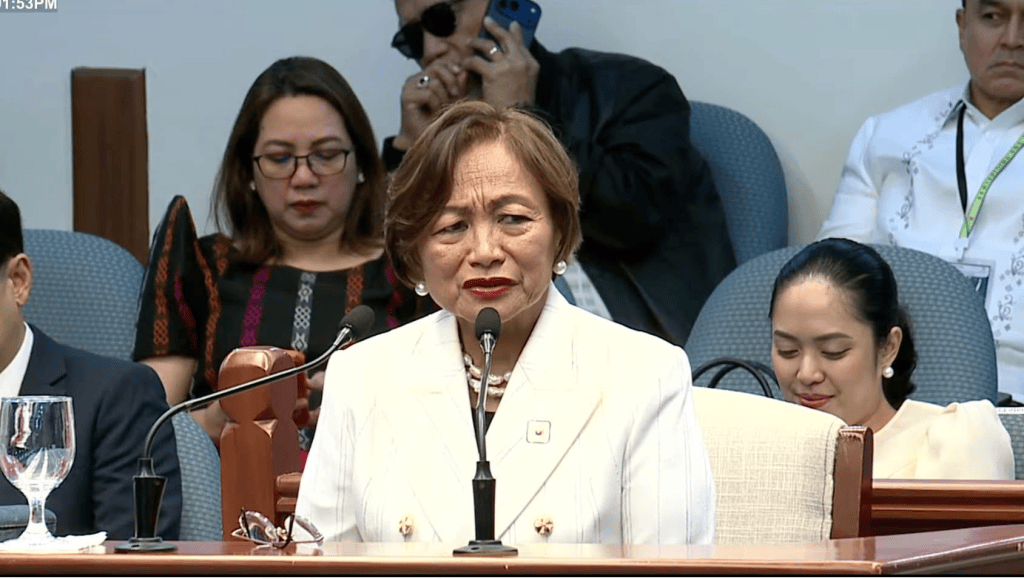
MANILA – The 1987 Constitution prohibits the President and Vice President from directly or indirectly engaging in business while in office, retired Sandiganbayan Presiding Justice Amparo Cabotaje-Tang testified Monday as House prosecutors began presenting evidence for the unexplained wealth charge against Vice President Sara Z. Duterte.
During direct examination, Akbayan Rep. Chel Diokno asked Cabotaje-Tang whether the President or Vice President may participate in business while serving their terms.
“Hindi po,” Cabotaje-Tang replied.
She cited Section 13, Article VII of the Constitution, which sets restrictions on the President, Vice President, Cabinet members and their deputies or assistants during their tenure.
The provision prohibits these officials from, among others, directly or indirectly participating in business, practicing another profession, and holding financial interests in government contracts, franchises or special privileges.
Diokno asked Cabotaje-Tang to explain what indirect participation in business means.
“Indirectly simply means hindi sila gumagawa, pero iba ang gumagawa but in their name. So ibang tao ang gumagawa para sa kanila,” she testified.
Asked who would benefit from such an arrangement, Cabotaje-Tang said: “‘Yung official.”
She also explained the concept of beneficial ownership, which refers to circumstances where the actual owner of property or financial interest in a corporation is different from the person named in legal documents.
“Ang beneficial owner ay ‘yung tunay na taong nagmamay-ari ng ari-arian, or sa interest sa korporasyon, although based on legal documents ibang tao ang nakapangalan doon,” she said.
Cabotaje-Tang agreed that the person identified in official documents may differ from the individual who actually holds or benefits from the financial interest.
She said the Constitution imposes particularly stringent restrictions on the country’s top executive officials.
“There are stricter prohibitions on the President and Vice President, and even actually the Cabinet secretaries, their undersecretaries and assistants,” she testified.
Citing the Supreme Court’s ruling in Civil Liberties Union v. Executive Secretary, Cabotaje-Tang said the stricter restrictions are intended to address the greater potential for abuse arising from the officials’ positions.
“There is the greater possibility of abuse in their office given their positions,” she said.
The Supreme Court has described the restrictions under Article VII, Section 13 as “sweeping, all-embracing prohibitions.”
Cabotaje-Tang also discussed the ban on the President and Vice President holding financial interests in government contracts, franchises or special privileges, as well as their obligation to avoid conflicts of interest.
“Conflict of interest simply means na ‘yung interest ng official, pribadong interest ng official na ‘yun ay salungat sa interest ng pamahalaan na kanyang pinagsisilbihan,” she said.
Cabotaje-Tang is the prosecution’s first witness for Article II of the Articles of Impeachment, which covers allegations involving Duterte’s unexplained wealth, Statements of Assets, Liabilities and Net Worth (SALNs), and business and financial interests.
Her testimony dealt with general constitutional and legal principles and did not establish whether Duterte herself violated the restrictions she described.
The House prosecution is expected to present corporate, government and financial records following Cabotaje-Tang’s testimony as it builds its case against the Vice President.

 Republika News
Leave a comment