
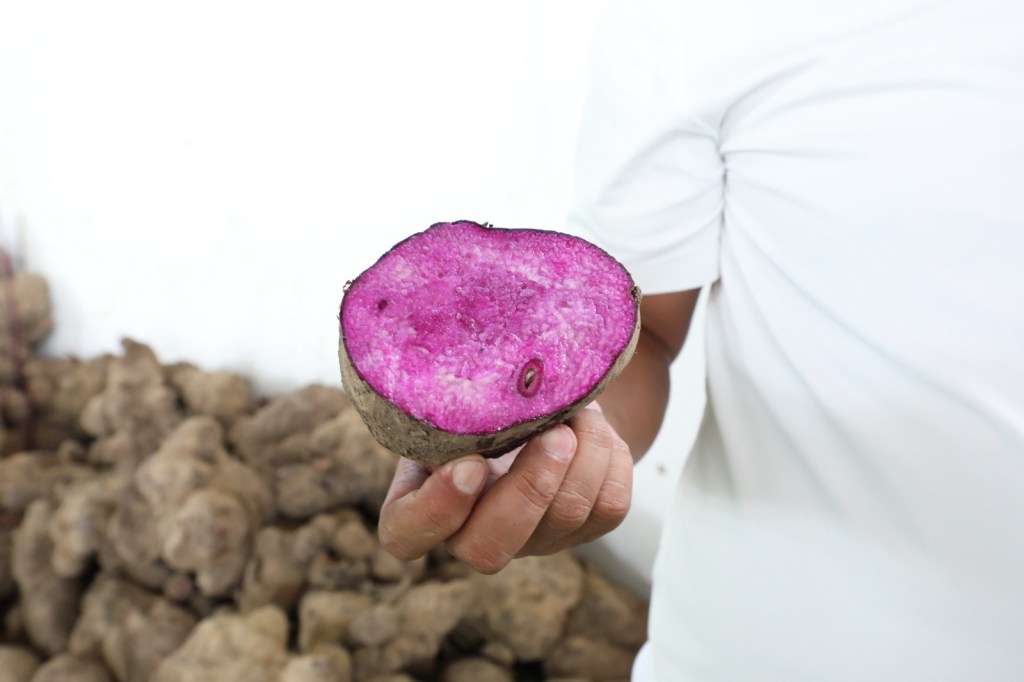
MANILA – The Department of Agriculture (DA) has indefinitely suspended the export of fresh purple yam, or ube, as the government moves to address a shortage of planting materials and expand domestic production.
The Bureau of Plant Industry (BPI) implemented the suspension in mid-August, covering fresh ube and propagative planting materials regardless of whether the shipments are intended for consumption, planting, or research.
Agriculture Secretary Francisco P. Tiu Laurel Jr. said the measure aims to keep planting materials in the Philippines while the local industry develops its production capacity.
“We severely lack planting material ourselves, and we don’t want to export it to countries that could use Philippine ube varieties to compete with us,” Tiu Laurel said.
The suspension comes as demand for Philippine ube continues to increase, with processors and overseas buyers seeking both fresh and processed products.
Ube is used in products such as powder, halaya, jam and paste. Philippine ube products are already being shipped to Canada, the Middle East and parts of Asia, while the United States, South Korea and Europe are seen as additional markets.
However, farmers continue to face limited access to quality planting materials, constraining the expansion of domestic production.
BPI Director Glenn Panganiban said he had informed the Bureau of Customs about the export suspension as an interim safeguard while the government works on policy and regulatory changes to formally classify fresh purple yam among commodities subject to export restrictions.
Plant quarantine stations have also been directed to stop issuing phytosanitary certificates for affected ube shipments, Panganiban said.
Government ramps up ube production
The DA is pursuing several measures to increase the availability of quality planting materials, including tissue culture, community-based nurseries and mini-set propagation.
President Ferdinand R. Marcos Jr. has also approved a P300-million budget for the ube industry in 2027 as the DA works to strengthen production and organize the sector.
The government and industry have likewise established United Ube PH Association Inc., bringing together farmers, processors, traders, exporters, researchers and other stakeholders.
The DA, through the BPI and researchers from the University of the Philippines Los Baños, is also genetically mapping Philippine ube varieties for registration.
The initiative seeks to protect native varieties from biopiracy, establish the authenticity of Philippine ube in export markets, and support the development of varieties that produce higher yields and can better withstand challenges.
With the export suspension, the government is prioritizing the expansion of the country’s planting-material base and domestic supply before further increasing ube exports.


 Republika News
Leave a comment