
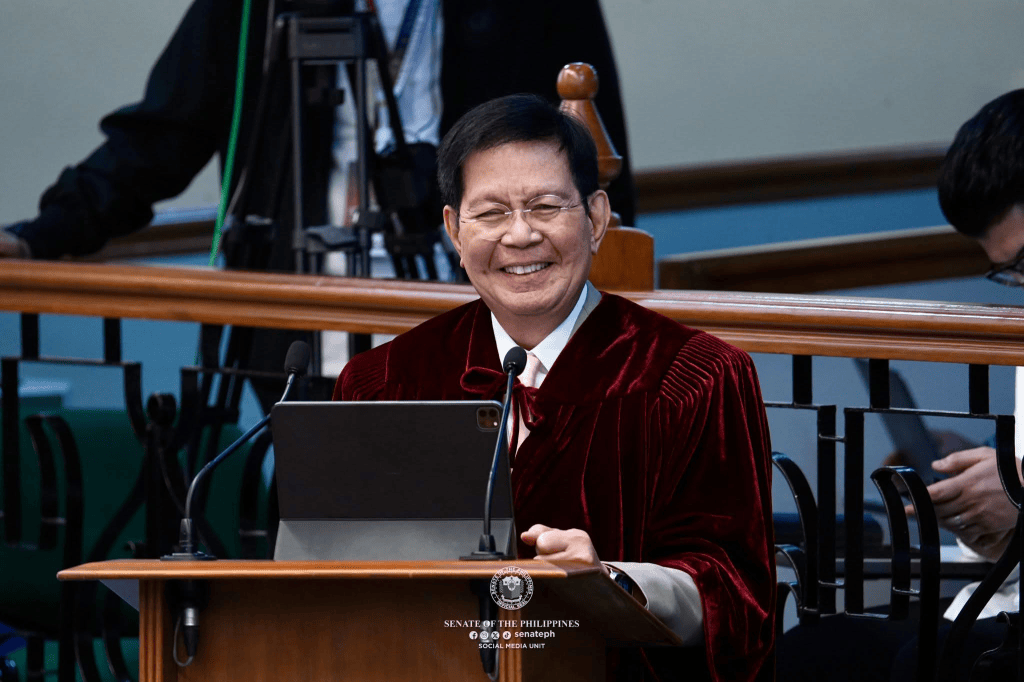
MANILA — Senator-Judge Panfilo “Ping” M. Lacson questioned how the Senate impeachment court could ensure fairness to the Filipino people if nine of its 24 members are unable to attend the proceedings, leaving only 15 senator-judges.
Lacson raised the issue during the appearance of retired Supreme Court justices as amici curiae, or friends of the court, as the impeachment tribunal considers how to apply the constitutional requirement that a conviction must secure two-thirds of all Senate members.
He said the current composition of the impeachment court presents a situation that may not have been anticipated by the framers of the 1987 Constitution, citing two senator-judges who are detained, one who is abroad and another who is in hiding.
Lacson presented a hypothetical scenario in which nine senator-judges were unable to attend because they were stranded abroad.
“Saan po mapupunta ang fairness sa Filipino people, kung walang mapanagot sa accountability? Hindi ko sinasabing guilty ang respondent dito, ito po ay hypothetical. Saan tayo gagawi para ma-achieve ang fairness kung alam nating 15 ang present, available, ang capacitated na member kasi 9 incapacitated, hindi makarating dito? Ito opinion ko lang, di ako makikipagdebate, na yan ang magiging unfair tayo sa Filipino people (Where will fairness to the Filipino people go in such a situation? I am not saying the respondent is guilty; this is a hypothetical situation – how can we ensure fairness when we know only 15 are present, available and capacitated because nine are incapacitated and cannot attend? This is just my opinion, I am not debating with you – the situation may be unfair to the Filipino people),” he said.
Lacson said he agreed with retired Chief Justice Reynato Puno that the voting threshold could not be treated as immovable because circumstances may evolve.
“Palagay ko di nyo na-anticipate or na-foresee na meron palang isang magtatago, may dalawang makukulong na walang bail, at may isang nasa ibang bansa… Sasangayunan ko ang kay (former) Chief Justice (Reynato) Puno na hindi pwedeng immovable kasi nag-e-evolve ang sitwasyon, circumstances, pumapasok ang bago. At kung tayo ay napaka-rigid at plain language ang textual meaning ng ating Constitution ay naka-fix sa 16, ang 2/3 define na natin as 16 di inantala na may situation mangyayari dito babalik kay Chief Justice Panganiban ang fairness (I believe no one anticipated or foresaw our current situation where one senator-judge is in hiding, two are detained without bail, and one is abroad. I agree with former Chief Justice Reynato Puno that we cannot be so rigid as to fix the voting threshold to 16, which is 2/3 of 24 senator-judges),” he added.
Earlier, retired Chief Justice Artemio Panganiban said senators could interpret the Constitution “in accordance with their mandate as representatives of the people, especially reflecting the common sense of the people, guided by two fundamental standards, namely truth and fairness.”
Panganiban said truth involves facts established through the study and verification of documents and papers and through hearing and observing witnesses.
Fairness, he added, requires due process “where all sides are given the opportunity to explain their language and actions.”
Responding to Lacson, Panganiban said fairness could be rendered by two-thirds of those present, noting that the 15 senator-judges remaining could still act and render justice.
Panganiban added that the Constitution had empowered senators to act and trusted their judgment.
Retired Associate Justice Adolfo Azcuna offered a different interpretation, saying that if only 15 senator-judges remain while the Senate still has 24 members, there “can be no conviction” under the constitutional requirement of two-thirds of all members.
Azcuna compared the situation to a Supreme Court case in which justices fail to obtain the votes required to declare a law unconstitutional, resulting in the denial of the petition for lack of the necessary votes.
“It’s a rare occasion, rare event which in that case is a price we pay for the internal check of a supermajority threshold. There are occasions where accountability through impeachment will fail. But there are other modes of accountability, criminal case for instance; forfeiture of cases; and ultimately the ballot box… So impeachment is not the only mode of accountability,” Azcuna said.
Aside from Panganiban and Azcuna, Puno attended Wednesday’s impeachment proceedings as an amicus curiae. Retired Chief Justice Hilario Davide Jr. submitted a memorandum that was read before the impeachment court.
Lacson also asked Panganiban whether inviting the retired justices could help protect the impeachment court from future accusations of grave abuse of discretion, which could be raised before the Supreme Court.
“Sasagutin ko partly ang aking tanong, meron kaming due diligence (I will partly answer my question – we practiced due diligence). We took time to listen to eminent people like you,” he said.
Panganiban agreed, describing the move as “a wise, prudent move” and saying that “your questions are piercing, intelligent, enlightening, and edifying.”

 Republika News
Leave a comment