
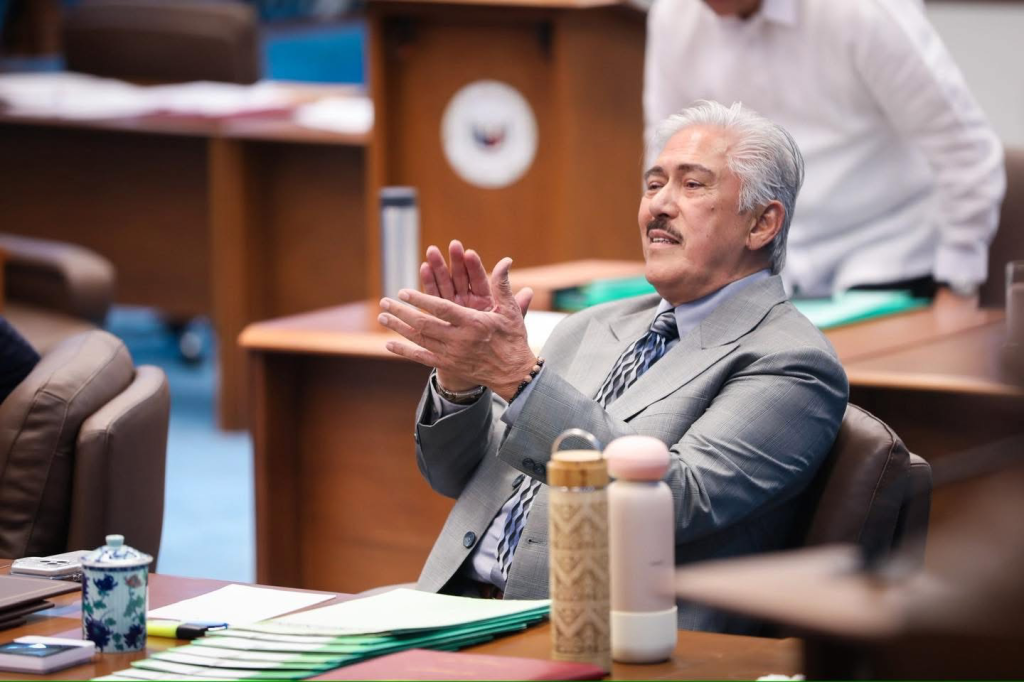
MANILA— The Supreme Court (SC) has dismissed an indirect contempt petition against Senator Vicente “Tito” Sotto III, ruling that his public criticism of the tribunal’s decision on the impeachment proceedings against Vice President Sara Duterte was protected by the constitutional guarantee of freedom of speech and expression.
In a decision penned by Senior Associate Justice Marvic M.V.F. Leonen, the SC En Banc said Sotto’s remarks did not meet the legal standards for contempt, stressing that political speech receives the highest degree of constitutional protection.
The petition was filed by lawyer Manuelito Delos Reyes Luna and others after Sotto questioned the Court’s ruling in Duterte v. House of Representatives et al. (G.R. Nos. 278353 and 278359). The senator had claimed in media interviews and social media posts, among others, that the decision’s ponente was unfamiliar with congressional rules and that the ruling effectively amended the Constitution.
The petitioners argued that Sotto’s statements were highly disrespectful toward the Court and could erode public confidence in the Judiciary.
Under Section 3(d), Rule 71 of the Rules of Court, conduct that impedes or obstructs the administration of justice may be punished as indirect contempt. However, the SC said allegations involving speech must also be evaluated against constitutional protections.
Citing Tolentino v. Heydarian (G.R. Nos. E-01742 and E-01747), also penned by Leonen, the Court reiterated that the Judiciary, like other branches of government, is subject to public scrutiny and criticism.
Under the doctrine of fair comment, statements about public officials performing their duties do not automatically become punishable because they are false, harsh or offensive.
As the Court explained, “the guarantee of free speech was enacted to protect not only polite speech, but even in its most unsophisticated form.”
The SC further emphasized that “political speech is accorded the greatest degree of protection” because it directly exercises the people’s sovereignty.
Court weighs context in assessing speech
In determining whether speech may be restricted, the SC said courts must examine not only the words used but also “how, when, where it was expressed, and who spoke it.”
The assessment must consider the nature and content of the statement, the speaker’s identity, the medium used, and the message’s likely and actual effects.
The Court also acknowledged that social media platforms can amplify content according to users’ preferences and biases, strip statements of context, and rapidly spread false or misleading information. It observed that “many ideas that thus emerge in the marketplace of ideas of today are corrupted or are premised on falsities.”
In response to these developments, the SC said it was “shifting to a more egalitarian approach in evaluating the limitations on free speech,” recognizing that people have unequal opportunities to make their voices heard online and in traditional public forums.
Sotto’s remarks fail incitement test
Because the senator’s statements concerned a political issue, the SC applied the incitement test, which it described as the strictest among the tests discussed in the decision.
The test examines whether speech intentionally encourages the public to distrust the Judiciary’s independence or obstruct the administration of justice, and whether such consequences are likely and imminent under the totality of the circumstances.
The Court found no evidence that Sotto’s remarks posed such a threat.
It also clarified that the incitement test is not the only standard applicable to contemptuous speech. The clear and present danger test may govern restrictions on harsh criticism, particularly amid concerns over stochastic or random terrorism. Under this test, the State may restrict speech only when there is a “clear and present danger of a substantive evil that the State has a right to prevent.”
Although online statements can quickly reach large audiences, be amplified by algorithms and bots, and remain accessible indefinitely, the SC stressed that “provocative, harsh, or critical statements are still protected speech.”
The Court found that Sotto’s remarks did not result in violence, stochastic or otherwise. It also found no link between his statements and a clear and present danger of imminent, inevitable harm.
“There is no showing he intended to incite or rally the public to lose trust in the independence of the Judiciary,” the Decision stated. “There is no sign of bad faith or malice.”
The SC noted that while Sotto’s position as a public official meant “the reach of his statements is large” and his authority “undeniably influences many in the public sphere,” most of his remarks were made in response to questions from the media.
It warned that punishing the senator for disagreeing with the ruling would amount to “an undue stifling of the ordinary exercise of free expression.”
“As a matter of paramount public interest,” the SC stressed, “discussions on impeachment proceedings, including opinions critical of the Court’s decisions, should be free and unrestricted by fears of subsequent punishment.”
SC calls for respect among government branches
Despite dismissing the petition, the Court underscored the importance of mutual respect among government institutions and public officials.
“The Court regards Senator Tito Sotto with the greatest respect and understands his frustration with some of our Decisions, or even with one member of the Court,” the Decision stated. “Courts must be receptive to all forms of criticisms.”
The SC also urged public officials to express their criticisms “with sobriety, respect, and the understanding that actions are only one part of a person’s personality and humanity.”
“Democracy is founded on respect,” the Court concluded. “With this decision, we double down not only on freedom of expression but on full respect for the respondent.”




Leave a Reply