
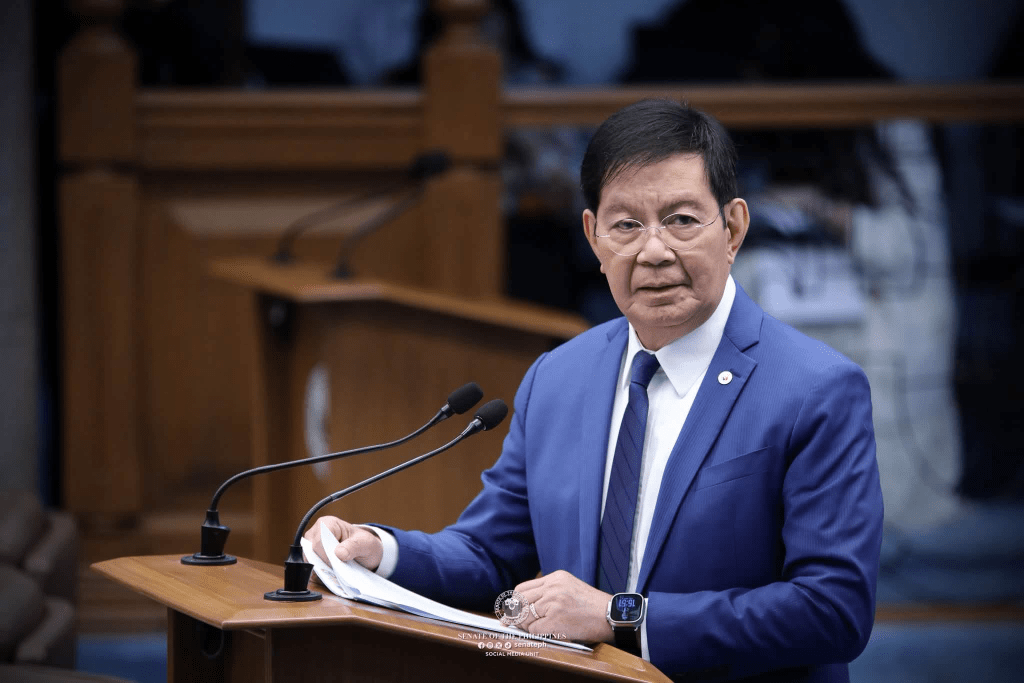
MANILA— The Senate plans to slash about P2 billion from its proposed 2027 budget to demonstrate fiscal discipline and encourage the House of Representatives to follow suit, Sen. Panfilo “Ping” Lacson said.
Lacson, chairperson of the Senate Committee on Accounts, said he and Senate President Vicente Sotto III had agreed to reduce the upper chamber’s proposed allocation under the National Expenditure Program (NEP), which initially stood at P7.7 billion.
“Nagkasundo kami nina Senate President (and I agreed) the other day… we will reduce our budget, ‘yung Senate budget, by about P2 billion pesos from the [National Expenditure Program],” Lacson said in an ambush interview.
“Magbabawas kami just to set the example or set the trend for the House to follow because ang House, nagdagdag sila ng P5 billion,” he added.
Lacson said the reduction would not disrupt Senate operations because unused funds from previous allocations remained available.
“Wala naman, kasi mayroon pang unused eh na puwede pang gamitin,” he said.
The planned cut comes amid calls for reforms in the national budgeting process following a Supreme Court ruling that declared the 2024 and 2025 General Appropriations Acts unconstitutional, along with portions of the 2026 national budget.
Lacson described the ruling as timely, saying it underscored the need to address irregularities in budget preparation and approval.
He said the Senate expects to receive further recommendations on budget reforms during a hearing with representatives of civil society organizations (CSOs) scheduled for Monday.
Among the concerns raised by CSOs was a P55-million farm-to-market road project supposedly intended for Quezon province but whose map coordinates allegedly pointed to waters near Brunei.
“The CSOs are disinterested. They have no self-interest but are acting out of advocacy. Before the recent hearing, I thought there could be nothing worse than the case of a Taguig project that had grid coordinates in Leyte. It turns out Taguig’s record was broken,” Lacson said.
The senator also opposed calls to recall the House-approved version of the 2027 budget, warning that such a move could result in a reenacted budget.
Instead, he urged senators to scrutinize the House proposal and remove unnecessary allocations, with disputed provisions to be addressed during bicameral conference committee proceedings after the Senate passes its own version.
“Recalling the House budget measure is worse as it will lead to a reenacted budget, the solution is for the Senate to scrutinize and cut all the fat from the House version of the budget,” Lacson said.
“The result is a reenacted budget, which makes things worse. All the items from the 2026 budget will be floating and there is no itemized provision. It will be a lump sum. So, it is not the solution. House members should address their concerns to their own colleagues, who will be members of the [bicameral committee] after the Senate passes its version,” he added.
The Supreme Court voided the 2024 national budget after Congress increased unprogrammed appropriations by P449.5 billion beyond the amount recommended by the President in the NEP.
The High Court also struck down the 2025 budget over an additional P17.99 billion allocated to the Department of Public Works and Highways’ Special Road Fund. It likewise ruled unconstitutional Special Provisions 1(a) and (b) of Chapter XLIII of the 2026 General Appropriations Act, which authorized unprogrammed appropriations.
Lacson said those responsible for misusing provisions of the 2024 and 2025 budgets must be held accountable.
“Even before I returned to the Senate, I was already calling out the bloated unprogrammed appropriations. The budgets of 2024 and 2025 were the worst budgets ever because of the tinkering made by some lawmakers; I think this is even worse than the Disbursement Acceleration Program in 2013,” he said.
He also cited the “doctrine of operative fact,” under which certain effects of actions taken before a ruling declaring a law unconstitutional may be recognized. Lacson said funds already disbursed before the Supreme Court ruling might not be invalidated, while unused funds covered by the ruling could no longer be utilized.


Leave a Reply