
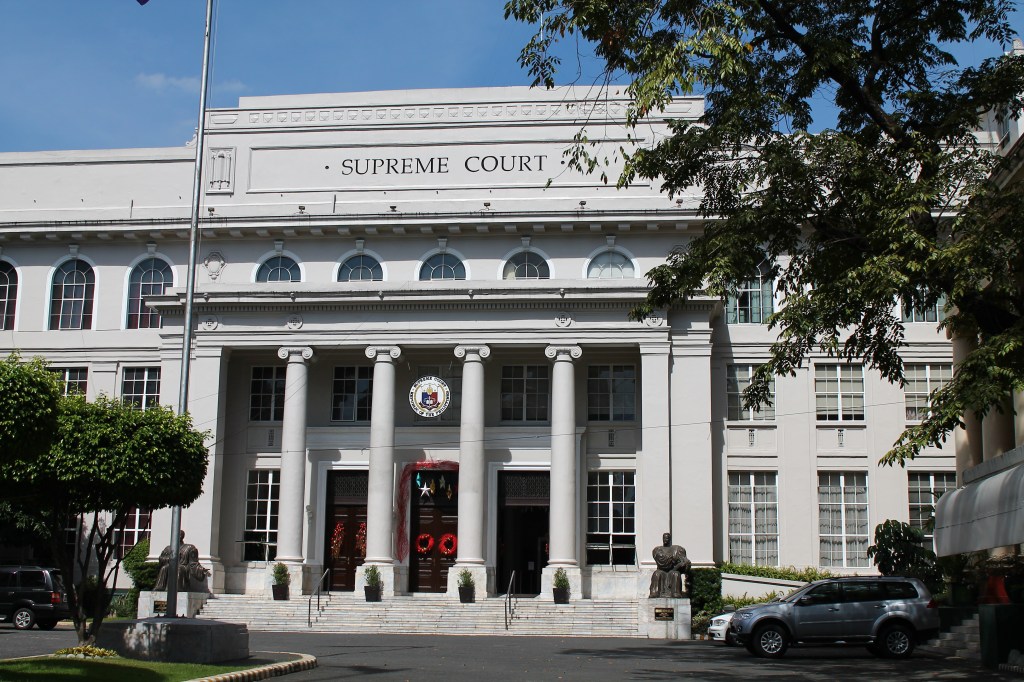
MANILA— The Supreme Court (SC) has reduced the administrative penalty imposed on a former elementary school principal over the unauthorized cutting of trees on school grounds, ruling that the evidence did not establish grave misconduct or prove that he personally profited from the sale of the lumber.
In a Decision penned by Associate Justice Antonio T. Kho, Jr., the SC Second Division partially granted the petition of Melencio E. Corpuz, former principal of Bagong Sikat Elementary School, and lowered his liability to simple misconduct and simple neglect of duty.
The Court ordered a six-month suspension instead of dismissal, with the penalty convertible into a fine equivalent to six months of his salary if he was no longer in government service.
The case stemmed from an administrative complaint filed by Radamalyn F. Cardoza and others, who accused Corpuz of violating Republic Act No. 3571 and committing grave misconduct.
The complainants alleged that Corpuz ordered the cutting of trees within the school premises without securing the necessary permits, used some of the lumber for personal benefit, and sold other cut trees as firewood to Lopez Bakery.
They also claimed that proceeds from the sales were pocketed by Corpuz, while some of the lumber was used to make cabinets for teachers.
The complaint further involved the demolition of a school building without proper authorization and accounting of the salvaged materials.
The Office of the Ombudsman found Corpuz guilty of grave misconduct, simple neglect of duty, and simple misconduct. The Court of Appeals initially sustained the grave misconduct finding and imposed dismissal from service.
However, the SC found that the evidence was insufficient to establish corrupt intent or prove that Corpuz personally appropriated the proceeds from the sale of the trees.
The Court said the statement from Lopez Bakery, which indicated that it purchased wood worth PHP 2,800 from Corpuz, did not establish that he personally received and kept the payment.
“The statement from Lopez Bakery does not, by and of itself, prove that Corpuz personally received the proceeds and appropriated them for himself. At most, it merely established that Lopez Bakery purchased cut trees from the school on three occasions, and that the transactions were made with Corpuz. However, the statement is silent on what happened to the proceeds after the sale. It does not show whether the proceeds were turned over to the school treasurer, deposited in school funds, or retained by Corpuz personally. Without evidence such as receipts, audit reports, or testimony from the school treasurer confirming non-remittance, the Ombudsman’s conclusion that Corpuz profited from the proceeds is purely speculative. It has been held that a presumption or conjecture does not constitute substantial evidence sufficient to sustain a finding of administrative liability.”
The SC stressed that the absence of evidence showing personal gain, demand, or conversion of the proceeds prevented the Court from sustaining the finding that Corpuz benefited from the transactions.
It also clarified that grave misconduct requires substantial evidence of corrupt intent, deliberate wrongdoing, or flagrant disregard of established rules, rather than mere violations of regulations.
Nevertheless, the Court held Corpuz administratively liable for failing to secure permits for the cutting of certain trees and properly account for materials recovered from the demolished school building.
These acts warranted findings of simple misconduct and simple neglect of duty, but did not justify the more serious charge of grave misconduct.
The SC reiterated that administrative liability must be supported by substantial evidence, emphasizing that assumptions and conjectures cannot independently establish wrongdoing.


Leave a Reply