
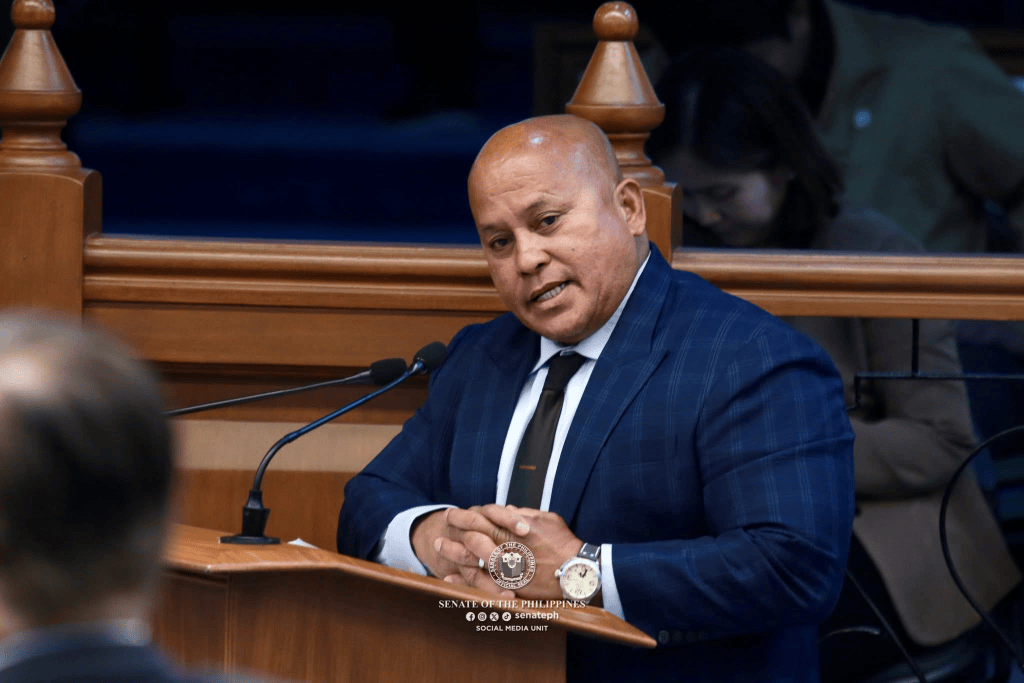
MANILA— Sen. Panfilo “Ping” M. Lacson said Sen. Ronald “Bato” dela Rosa must be afforded due process under Philippine law, including respect for the authority of local courts, should he be arrested.
Lacson said Dela Rosa should first be brought before a Philippine court, even if its role would be largely ministerial, to ensure that he can pursue available legal remedies in the country.
“That’s part of due process, kung mahuli siya, dinala sa local court, nasa custody siya ng local court pwede siyang dumulog hanggang sa Supreme Court tapos finally (SC ang) magde-decide kasi sila ang final arbiter mag-interpret ng batas (That’s part of due process – if he is arrested, he may be placed under the custody of a local court where he can avail of all legal remedies up to the Supreme Court. The Supreme Court will be the final arbiter of the law),” he said in an interview on DZMM radio.
The senator cited Section 17 of Republic Act 9851, or the Philippine Act on Crimes Against International Humanitarian Law, Genocide, and Other Crimes Against Humanity, which establishes the country’s jurisdiction over individuals suspected or accused of committing offenses covered by the law under specified circumstances.
These include cases where the accused is a Filipino citizen, is present in the Philippines regardless of citizenship or residence, or committed the crime against a Filipino citizen.
The law also allows Philippine authorities, in the interest of justice, to defer investigation or prosecution when another court or international tribunal is already handling the case. Authorities may instead surrender or extradite suspects to the appropriate international court or another state under applicable laws and treaties.
It further prohibits criminal proceedings against foreign nationals who have already been tried by a competent foreign court for the same offense and acquitted or convicted and have served their sentence.
Lacson also invoked Article 17 of the Rome Statute of the International Criminal Court, which provides grounds for declaring a case inadmissible when a state with jurisdiction is already investigating or prosecuting it, unless that state is unwilling or unable genuinely to pursue the case.
The provision likewise covers cases in which a state has investigated an offense but decided against prosecution, subject to the same conditions concerning its willingness and ability to genuinely prosecute.
He also cited Article III, Section 2 of the 1987 Constitution, which protects individuals against unreasonable searches and seizures and requires probable cause, determined personally by a judge, before a warrant of arrest may be issued.
Lacson further noted that he was among the senators who signed a resolution expressing the Senate’s position on protecting Filipinos against extraordinary rendition and ensuring they have reasonable time to seek judicial relief and exhaust legal remedies before surrender or extradition.
He maintained that bringing Dela Rosa before a local court would not mean that the Philippine court would determine his guilt or innocence, since it does not have the underlying case.
“Igalang ang ating local court kung saan kung mahuli siya idaan sa local court pero halos ministerial lang yan kasi wala sa local court ang kaso so papaano sila determine ng guilt or innocence ni Sen. dela Rosa kung di sila may hawak ng kaso? It’s almost ministerial but just the same dahil may batas tayo igalang ang batas idaan sa local court (Our local courts should be respected. If he is arrested, he should be placed under the custody of the local court, even if this is ministerial because the local court is not handling his case so it cannot determine his guilt or innocence. It’s almost ministerial but just the same, we have our law and it should be respected),” he said.
The senator added that even subpoenas and summonses issued by foreign or international courts must be coursed through Philippine courts, including regional trial courts, for the issuance of corresponding legal processes.
“Maski ang mga subpoena and summonses na ini-issue ng international or foreign court kailangan idaan sa local court or RTC na sila mag-issue ang kaukulang subpoena para tumalima sa subpoenang ini-issue ng foreign court (Even subpoenas and summonses issued by international or foreign courts must go through Philippine local or regional trial courts, which will issue the corresponding subpoenas and summonses),” he added.





Leave a Reply