
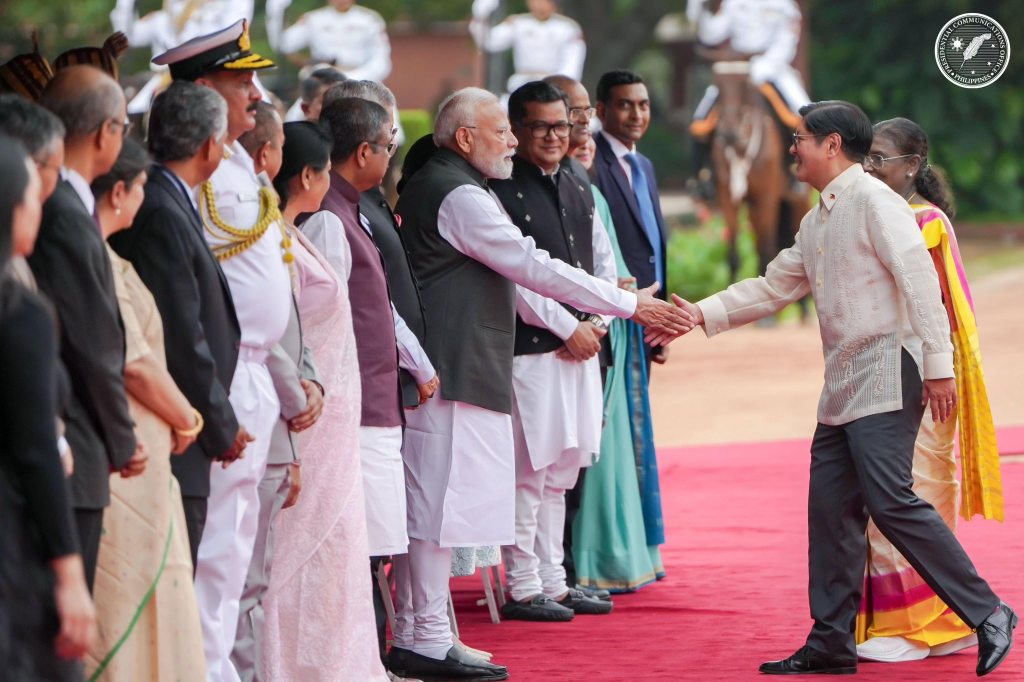
NEW DELHI – President Ferdinand R. Marcos Jr. rejected China’s portrayal of the Philippines as a mere proxy of foreign powers, asserting that the country’s actions in the West Philippine Sea are driven by its own national interest and constitutional duty.
“That would imply we do not have our own agency, that we are just bystanders told what to do. That is certainly not the case,” Marcos said in an interview with Indian news outlet Firstpost on Wednesday.
“It does, I suppose, serve that narrative — that we are acting as a… I don’t know… as a puppet state to the United States, to all the allies of the United States. I think it doesn’t take very much reading and discussing to see very, very clearly, very, very quickly that that’s simply not true.”
Marcos said the Philippines is defending its sovereignty not because of foreign influence but because of its responsibility to protect the nation.
“What we do in the Philippines is because it is our duty as officials, as leaders, as citizens to defend our country,” he said.
He emphasized that the country’s growing security partnerships — including with India, the United States, Australia, South Korea, and Japan — are rooted in shared values and a collective interest in regional stability.
“Friends like India, the United States, Australia, South Korea, Japan — who are also feeling that they must defend their own territory and sovereignty — are joining forces. Who are we to turn down such assistance and such help?”
The President’s remarks come amid ongoing confrontations between Philippine vessels and Chinese ships in the West Philippine Sea. Despite a 2016 ruling by the Permanent Court of Arbitration invalidating China’s sweeping claims, Beijing has continued to expand its presence in disputed waters, frequently blocking and using water cannons against Philippine resupply missions.
Marcos said while war is unlikely, the risk of miscalculation at sea remains high.
“That is precisely what we are worried about,” he said. “You can make a mistake. Some guy pushes the wrong button, navigation goes wrong… and before you know it, it’s a shooting war. That is what we want to avoid,” he said.
He underscored the importance of communication and coordination with allies — and with China — to avoid conflict and preserve peace in the region. (PNA)





Leave a comment