
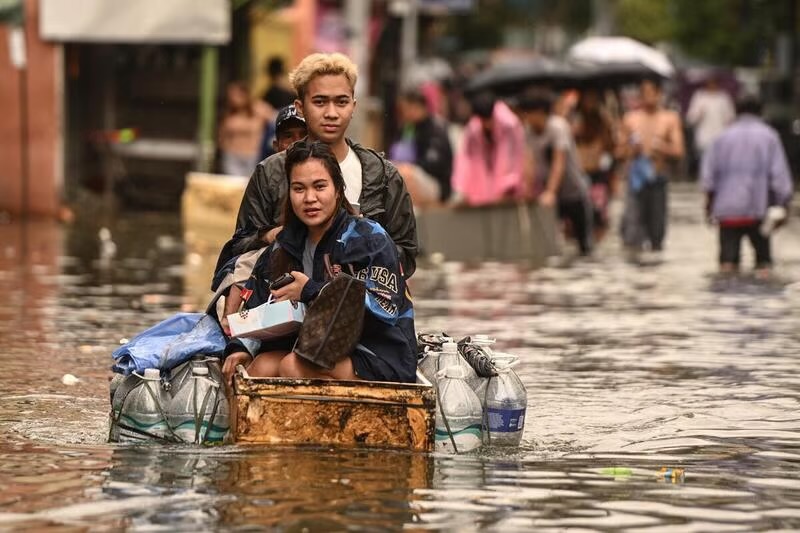
MANILA – Environmental watchdog Greenpeace Philippines warned that as much as P1.029 trillion in government climate-tagged expenditures may have been lost to corruption since 2023, citing anomalous flood control projects under the Department of Public Works and Highways (DPWH).
In a press briefing, Greenpeace said its estimate was based on figures presented in recent Senate hearings. For 2025 alone, it projected that P560 billion of the government’s P1 trillion climate allocation was vulnerable to misuse.
Data from the National Integrated Climate Change Database and Information Exchange System (NICCDIES) show that DPWH oversees about 90% of climate-tagged projects this year, or P800 billion covering 24,764 projects. Of this, Greenpeace estimated that P560 billion could be lost to corruption. Specifically, flood-related projects under DPWH amount to P248 billion in 2025, of which P173 billion may be at risk.
“A trillion pesos is a staggering, absurd amount siphoned by avaricious, self-serving officials and contractor corporations from projects meant to help people cope with escalating climate impacts,” Greenpeace campaigner Jefferson Chua said. “They’re not just plundering government coffers, they’re also crippling the ability of millions of Filipinos to survive in the face of an escalating climate crisis.”
Greenpeace said the alleged corruption worsens the country’s already inadequate climate financing. The Department of Finance earlier estimated that climate-related losses and damages from 2010 to 2020 amounted to ₱506.1 billion, while government spending on disaster risk reduction and management from 2015 to 2022 reached nearly P2 trillion.
Chua also raised concerns about the government’s reliance on foreign loans to fund climate programs. “Given this filthy track record, what assurance does the Filipino people have that the money for climate adaptation won’t end up in the pockets of the greedy?” he said.
Greenpeace called on the government to ensure accountability for both public officials and private contractors, strengthen transparency measures, and create safeguards for climate funds. It also urged authorities to prioritize nature-based and community-led solutions, such as watershed protection, stricter controls on quarrying and reclamation, and a national ban on single-use plastics, instead of focusing heavily on large-scale infrastructure.
“The government must not be deaf to the outrage of Filipinos,” Chua said. “Alongside this corruption probe, President Ferdinand Marcos Jr. must also hold the world’s biggest polluting corporations accountable and make them pay for losses and damages.”




Leave a comment