
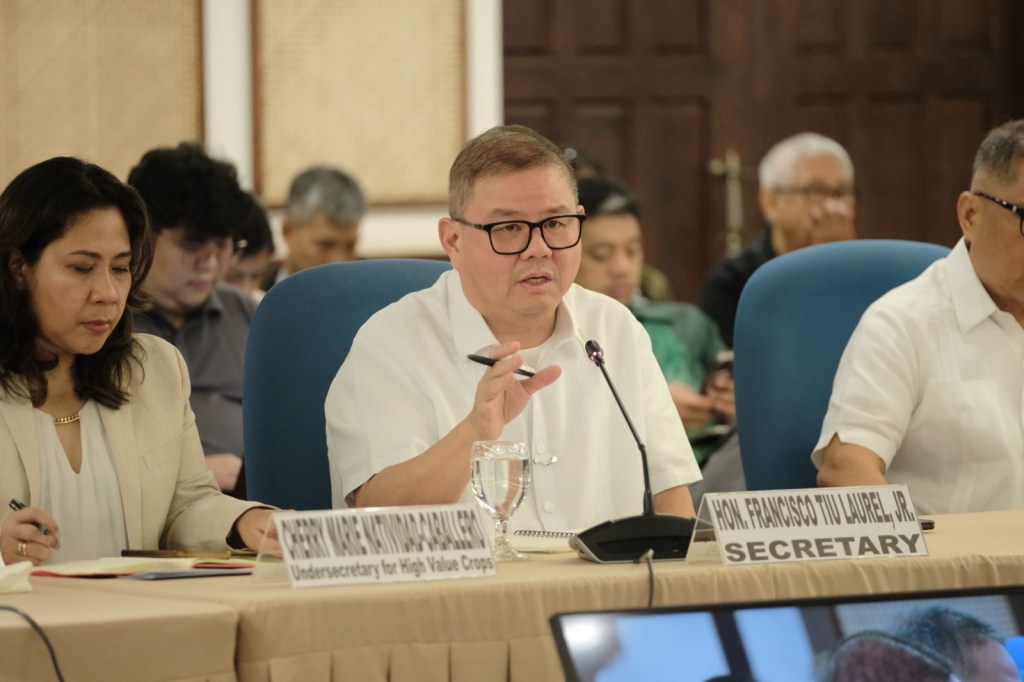
MANILA – Agriculture Secretary Francisco P. Tiu Laurel Jr. assured lawmakers that the government would only resort to importation when domestic supply shortages begin threatening food security and price stability.
“Importation is not our first resort—it is our last line of defense,” Tiu Laurel said in a statement. “Under this administration, we have deliberately reduced dependence on imports. Every decision to allow entry is weighed against its impact on farmers, consumers, and long-term food security.”
Speaking during the House Committee on North Luzon Growth Quadrangle hearing on May 13, the agriculture chief presented the Department of Agriculture’s (DA) preparations against possible external disruptions, including fluctuating oil prices and the expected impact of a severe El Niño later this year.
Tiu Laurel identified North Luzon, composed of Regions 1, 2, and the Cordillera Administrative Region, as a major agricultural production area with more than 2 million hectares of farmland critical to the country’s food supply.
To prepare for the effects of El Niño, the DA is implementing climate-resilient measures aimed at minimizing crop losses during extended dry periods. These include expanding greenhouse farming, building water impounding and storage facilities, and increasing the use of drip irrigation and solar-powered irrigation systems.
The department is also encouraging crop diversification to lessen dependence on water-intensive crops while improving farmers’ income stability.
Tiu Laurel said the agency is shifting toward a more proactive approach in addressing climate-related risks affecting agriculture, particularly recurring water shortages that threaten food production.
During the hearing, the DA also discussed plans to increase the National Food Authority’s palay procurement prices to provide stronger support for farmers.
Under the proposed adjustment, the buying price for freshly harvested palay will increase to P22 per kilo from the current minimum of P17, while dry palay procurement prices will rise to P27 per kilo from P21 beginning in September, subject to higher fertilizer costs.
“The NFA has the funds and warehouse capacity to sustain better farmgate prices by September,” he said.
The agriculture secretary said the broader strategy of the department focuses on increasing local production, improving logistics systems, and strengthening coordination with local governments and industry groups to lessen the need for emergency importation.
He also said the DA is improving forecasting systems to detect possible supply shortages before they worsen.
Lawmakers raised concerns over possible increases in food prices, prompting Tiu Laurel to stress that any importation would remain temporary, data-based, and only implemented when necessary.
The DA and the Philippine Statistics Authority are also undertaking data harmonization efforts to improve access to timely and accurate agricultural information for production planning.
“We will not normalize imports,” he said in a statement. “They will only be deployed when supply truly fails, prices spiral, and consumers are at risk. Our priority is simple: strengthen local agriculture first, and import only when absolutely unavoidable.”




 Republika News
Leave a comment