
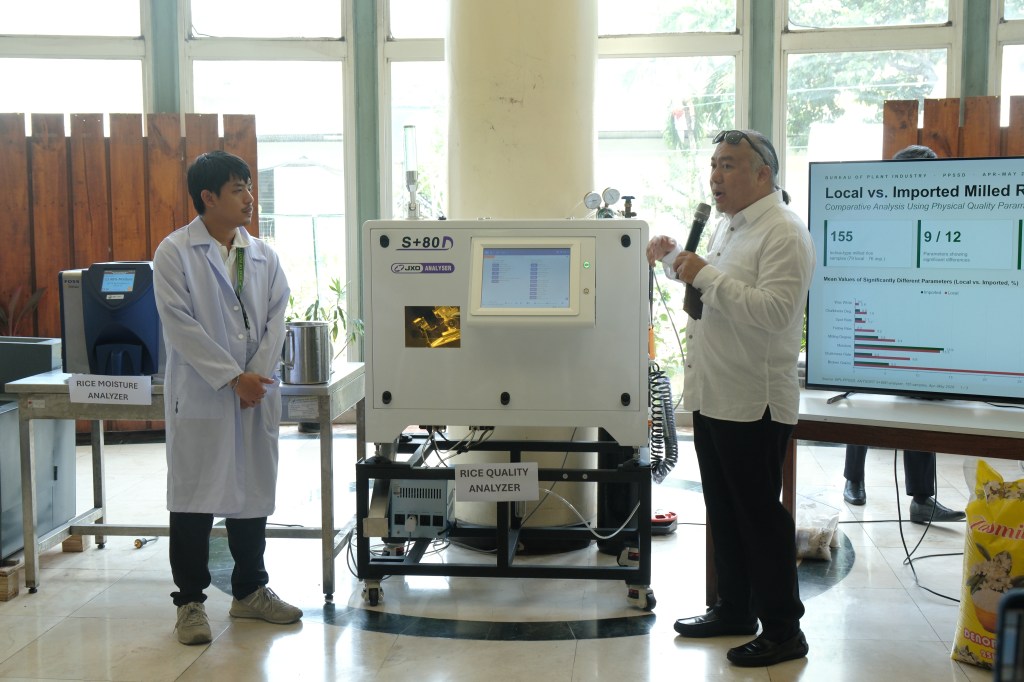
MANILA — The Bureau of Plant Industry (BPI) has acquired a rice quality analyzer (RQA) to enhance government efforts in enforcing Philippine rice standards and in developing technical benchmarks that could help distinguish locally produced rice from imported varieties.
In a report submitted to Agriculture Secretary Francisco P. Tiu Laurel Jr., BPI Director Gerald Glenn Panganiban said the acquisition supports the implementation of Republic Act No. 12078 or the amended Agricultural Tariffication Law through the agency’s Plant Product Safety Services Division (PPSSD).
The law directs the BPI to strengthen its rice quality testing capability through the use of advanced equipment such as the newly acquired analyzer.
Panganiban said the RQA can assess multiple rice quality indicators, including grain size, percentage of broken grains, milling degree or bran retention rate, grain ratio, chalkiness rate, wax white rate, heavy chalkiness rate, chalkiness degree, embryo retention rate, yellow rice rate, dark yellow rate, and spot rate.
“The primary objective of this capability is to support the assessment of rice compliance with the applicable Philippine National Standards,” Panganiban said. “The generated data will also serve as technical reference in determining rice quality classification and in identifying possible indicators that may distinguish local from imported rice, subject to validation and correlation with established reference data.”
Agriculture Secretary Tiu Laurel said the new equipment would strengthen the Department of Agriculture’s (DA) capacity to protect consumers and legitimate industry players from deceptive rice trade practices.
“It will give the DA stronger teeth against rice adulteration, mislabeling, and other deceptive practices by providing science-based evidence that can stand up in investigations and prosecution of violators,” Tiu Laurel said.
The acquisition comes as the DA intensifies monitoring of rice prices and supply following President Ferdinand Marcos Jr.’s order imposing a P50-per-kilo price ceiling on imported rice amid a national energy emergency.
The Plant Product Safety Services Division continues inspections in markets, warehouses, and other points in the rice supply chain to gather quality data that may support enforcement actions and future policy decisions.
In coordination with the DA’s Agribusiness and Marketing Assistance Service and Consumer Affairs unit, the BPI said data generated from the analyzer will help identify and act against traders and retailers violating rice quality, labeling, and classification rules.





Leave a Reply