
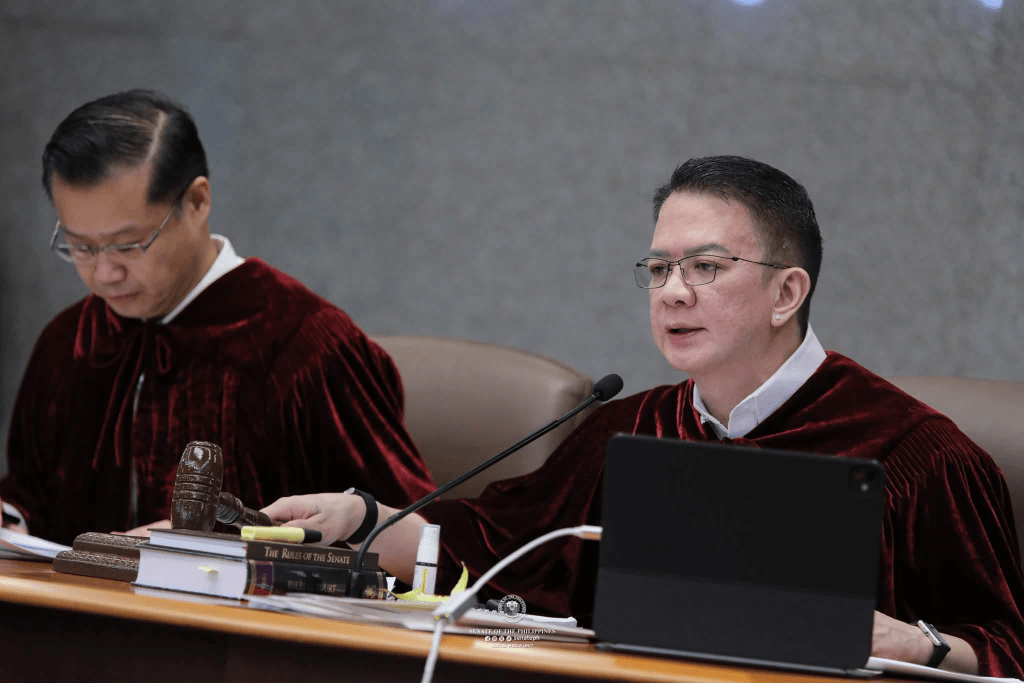
MANILA – The Senate impeachment court on Monday granted the House prosecution panel’s request to issue subpoenas for the bank, Anti-Money Laundering Council (AMLC), and tax records of Vice President Sara Duterte and her husband, lawyer Manases “Mans” Carpio, ruling that the documents are relevant to the allegations under Article II of the Articles of Impeachment.
The ruling was announced by Senate impeachment court presiding officer Sen. Francis “Chiz” Escudero during the seventh day of Duterte’s impeachment trial.
“After a careful examination requested, the Court finds that the requested documents meet the requirements set forth above. They are reasonably described, readily identifiable, prima facie relevant and material to the allegations under Article 2,” Escudero said.
In a separate ruling, the impeachment court also granted the prosecution’s request to subpoena tax records related to the Vice President.
Escudero noted that the ruling authorizes only the production of the requested records, adding that the examination of bank records is not unprecedented in impeachment proceedings, citing the impeachment trial of former Supreme Court Chief Justice Renato Corona.
The court ordered the banks to submit the requested documents on July 30.
However, Escudero clarified that the subpoenas cover only peso-denominated accounts relevant to Article II.
“Foreign currency deposits are excluded, absent the written consent of the respective depositors,” Escudero said.
The impeachment court also denied requests to subpoena records from JTC Group of Companies and Pikimong Pikimong Philippines Corp., two of the 21 entities identified by the prosecution, after finding that neither Duterte nor Carpio was listed as a shareholder.
“The corporate veil may not be pierced on mere suspicion or speculation,” the court said.
Escudero emphasized that while the records may be produced, their admissibility during trial would still depend on the prosecution.
“Their admissibility and evidentiary use shall remain subject to the Prosecution establishing their connection to the alleged unexplained wealth during the Respondent’s present term in relation to Article II of the Articles of Impeachment,” he said.
Earlier during oral arguments, House prosecutor and Akbayan Party-list Rep. Jose Manuel “Chel” Diokno rejected the defense’s claim that the request for Duterte’s financial and tax records amounted to a fishing expedition.
“For these reasons, Your Honors, the fishing expedition argument in our view is totally untenable,” Diokno said.
Responding to a question from senator-judge Pia Cayetano, Diokno argued that the prosecution’s request was supported by sufficiently pleaded allegations, existing evidence, and established jurisprudence.
He said the House had already alleged the “ultimate facts” required under the second article of impeachment, including claims that Duterte amassed unexplained wealth disproportionate to her lawful income, failed to fully disclose the assets of herself and her spouse in their Statements of Assets, Liabilities and Net Worth (SALNs), and maintained business interests while serving as Vice President.
“So na-satisfy po namin ‘yung requirement ng pag-allege ng ultimate facts or essential factual elements sa tatlong bagay na po ito,” he pointed out.
Diokno explained that ultimate facts are the essential factual elements supporting a party’s cause of action or defense.
“Ultimate facts are basically the essential factual elements that make up a party’s cause of action or defense,” he said.
He added that the articles of impeachment also detail the evidentiary facts supporting those allegations.
“The evidentiary facts follow in the succeeding pages of the articles. Doon po namin dinetalye kung ano ‘yung mga iba’t ibang paraan kung paano nakuha o na-amass ni Vice President ‘yung sinasabi natin na unexplained wealth,” Diokno said.
He also disputed the defense’s characterization of the subpoena request as a fishing expedition.
“‘Yun ‘pong fishing expedition po ay halimbawa may subpoena na baka sakali meron tayong makita. ‘Yun po ang ibig sabihin ng fishing expedition,” Diokno said.
“When the party requesting information does not know what might be produced, and just as an off-chance, tries to use that instrument in order to gain evidence that may be used against the other party,” he added.
Diokno argued that the prosecution’s request was based on evidence already presented before the House Committee on Justice, including testimony from the Executive Director of the AMLC.
According to Diokno, the AMLC submitted documents showing that about P6.7 billion passed through Duterte’s bank accounts from 2007 to the present, with more than P3 billion moving through her accounts while she was serving as mayor and vice mayor of Davao City.
“So may basehan po tayo para ipalabas ang bank records. We are not just guessing that there is something there, because the [AMLC] itself has confirmed that there were covered and suspicious transaction reports submitted to them in those amounts that I mentioned,” he said.
Diokno likewise cited Supreme Court jurisprudence, saying authorities must examine a public official’s finances throughout the entirety of his or her incumbency to determine whether unexplained wealth exists.
“It’s very clear, the decisions of the Court are very clear. To know whether a government official has amassed unexplained wealth, we must look at the entire incumbency of that official,” Diokno said.
“Starting from day one, we look at their SALN, we look at all the income that he or she has earned, both lawful and not. And from there, we make a determination whether there was unexplained wealth or not.”




Leave a Reply