
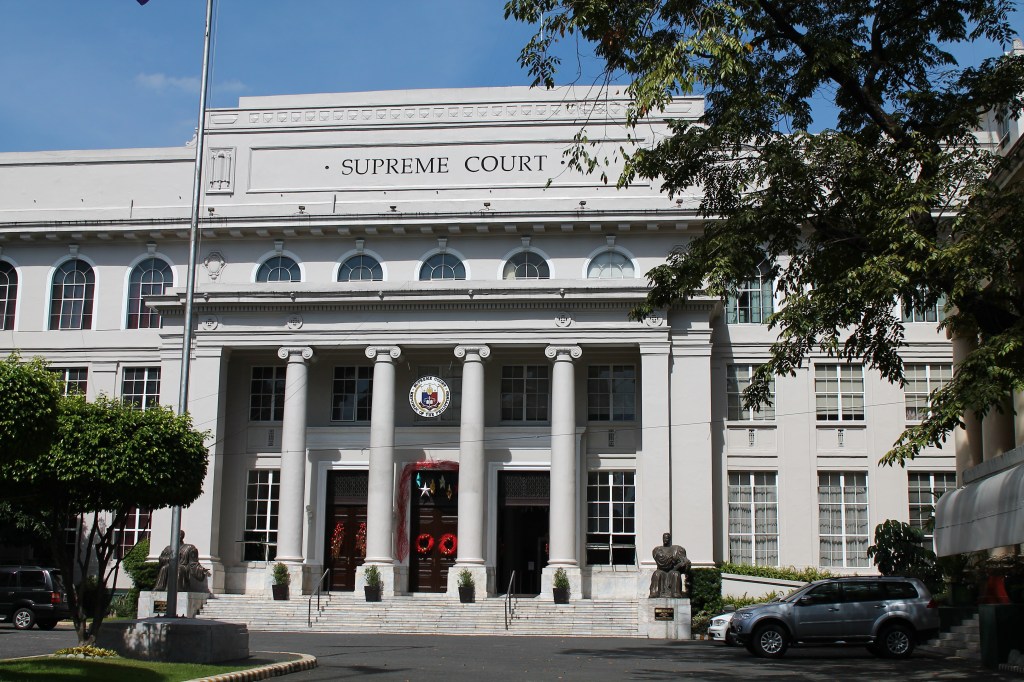
MANILA — The Supreme Court (SC) En Banc has approved rules governing the civil forfeiture of assets linked to prohibited Philippine Offshore Gaming Operator (POGO) activities under Republic Act No. 12312, or the Anti-POGO Act of 2025.
The Rule on the Civil Forfeiture of POGO-Related Assets provides an expedited court process allowing the government to seek ownership of properties connected to unlawful offshore gaming activities, independently of any criminal case.
Under Section 15 of the Anti-POGO Act, buildings, structures, facilities, materials, gaming equipment, paraphernalia and proceeds used in or obtained from prohibited POGO activities are subject to forfeiture in favor of the government.
The law also prohibits the use of houses, buildings, tourism establishments, vehicles, computers, digital platforms and other properties for offshore gaming activities.
Under the new rules, the Republic, through law enforcement agencies and other concerned government offices represented by the Office of the Solicitor General, may file civil forfeiture petitions before the appropriate Regional Trial Court (RTC).
The RTC must determine within 24 hours whether probable cause exists. If probable cause is found, the court may issue measures to preserve the assets and prevent their transfer, concealment, disposal or dissipation while the case is pending.
The proceedings are subject to expedited timelines. Each party is given 30 calendar days to present evidence, while postponements are allowed only in exceptional circumstances, including force majeure, acts of God or a duly substantiated physical inability of a witness to testify.
The court must issue its judgment within 30 calendar days from its action on the last presenting party’s offer of evidence.
If the government establishes its case by a preponderance of evidence, the court must order the forfeiture of the assets in favor of the government and grant other appropriate relief.
A forfeiture judgment takes effect immediately, although the rights of innocent owners, buyers in good faith and secured creditors are protected. An appeal does not automatically suspend enforcement unless an appellate court orders otherwise for compelling reasons.
If the court determines that the respondent lawfully owns or possesses the property and that it is not connected to prohibited POGO activities, the property must be returned, without prejudice to the rights of identified victims.
The rules also provide protections for third parties claiming an interest in forfeited property. Judgments must be posted for seven calendar days in three public places in the city or municipality where the property is located, as well as on the websites of the SC, the Office of the Court Administrator and the Administrative Oversight Committee.
Non-parties claiming an interest in the property may file a verified petition within 15 calendar days from the posting of the judgment.
The Rule also clarifies that seized POGO gaming equipment and paraphernalia generally cannot be destroyed until a final forfeiture judgment is issued. In urgent cases involving public safety, however, courts may authorize their early destruction after notice and hearing and subject to safeguards preserving forensic evidence.
Civil forfeiture proceedings may proceed independently of criminal cases involving violations of the Anti-POGO Act. The status of a related criminal case does not affect the continuation of the forfeiture proceedings.
The Rule was drafted by a Technical Working Group chaired by SC Associate Justice Raul B. Villanueva.
It will take effect 15 calendar days after its publication in two newspapers of general circulation. The publication was made on August 9, 2026.




Leave a comment