

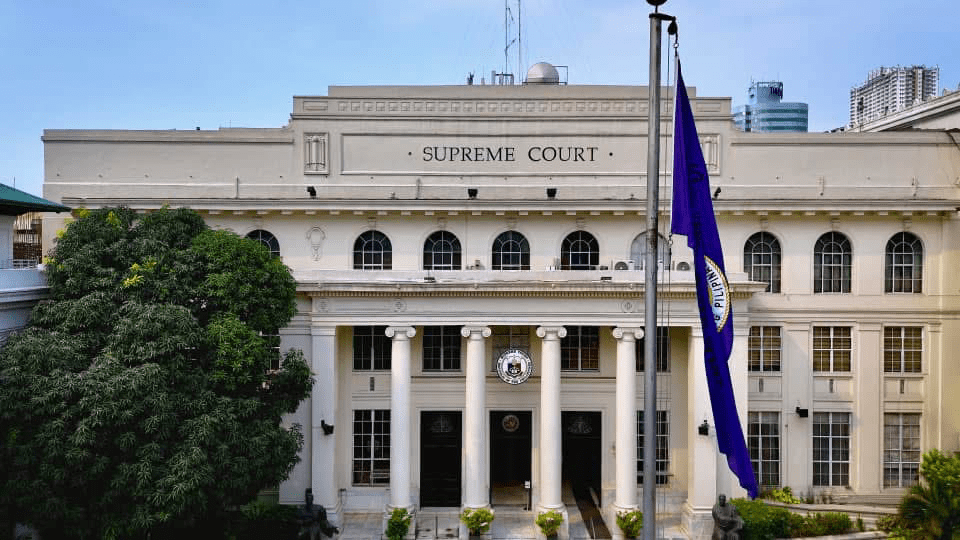
MANILA – The Supreme Court (SC) has ruled that courts may provisionally determine whether a party is alive or dead in an ejectment case when necessary to resolve who has the right to possess a property.
In a Decision written by Chief Justice Alexander G. Gesmundo, the SC’s First Division denied the appeal filed by Belinda E. Soriano and her relatives in an unlawful detainer case brought by Antonio V. Estrella.
Estrella claimed ownership of a property in Quezon City where Soriano and her relatives were living with his permission. After they refused his 2012 demand to vacate the property so he could renovate it, Estrella filed an unlawful detainer case.
Soriano and her relatives sought the dismissal of the case, arguing that Estrella had no legal capacity to sue because he had supposedly died in 1990. They presented his death certificate as evidence.
Both the Metropolitan Trial Court and Regional Trial Court sided with them, ruling that the death certificate had to be recognized unless it was properly cancelled.
The Court of Appeals, however, reversed the ruling after finding that the death certificate was contradicted by other evidence, including Estrella’s valid driver’s license, the occupants’ own admission that he was the registered owner of the property, and a criminal complaint they filed against him in 2013.
The SC affirmed the CA.
Death certificate not conclusive in ejectment case
The high court clarified that while the proper remedy for cancelling a death certificate or correcting a civil registry entry is a separate petition, this does not prevent a court hearing an ejectment case from provisionally determining whether a party is alive or dead when the issue is necessary to resolve possession.
The SC explained that ejectment cases are summary proceedings intended to promptly settle disputes involving physical possession of property.
Requiring a party to first obtain the cancellation of a death certificate before an ejectment case could proceed would defeat the summary nature of such proceedings, the Court said.
However, the SC stressed that the finding is limited to the ejectment case. It does not permanently cancel or invalidate the civil registry entry.
The determination is relevant only to questions such as the party’s legal capacity to sue and right to physical possession of the property.
Evidence showed Estrella was alive
The SC found that Estrella successfully overcame the presumption arising from the death certificate.
The parties themselves acknowledged that the Estrella who filed the ejectment case was the same person identified as the registered owner of the property. Soriano and her relatives also never alleged that the person who filed the case was an impostor or otherwise disputed his identity.
His continued living presence, together with the other evidence presented, established his capacity to bring the case.
The SC also found that the requirements for unlawful detainer were satisfied.
Soriano and her relatives initially possessed the property lawfully because they had Estrella’s permission. Their possession became unlawful when Estrella demanded that they vacate and they refused.
Estrella subsequently filed the case within the one-year period required for an unlawful detainer action.
The ruling therefore allows the ejectment case to proceed based on the determination that Estrella was alive and had the legal capacity to seek recovery of physical possession of his property.



Leave a Reply