
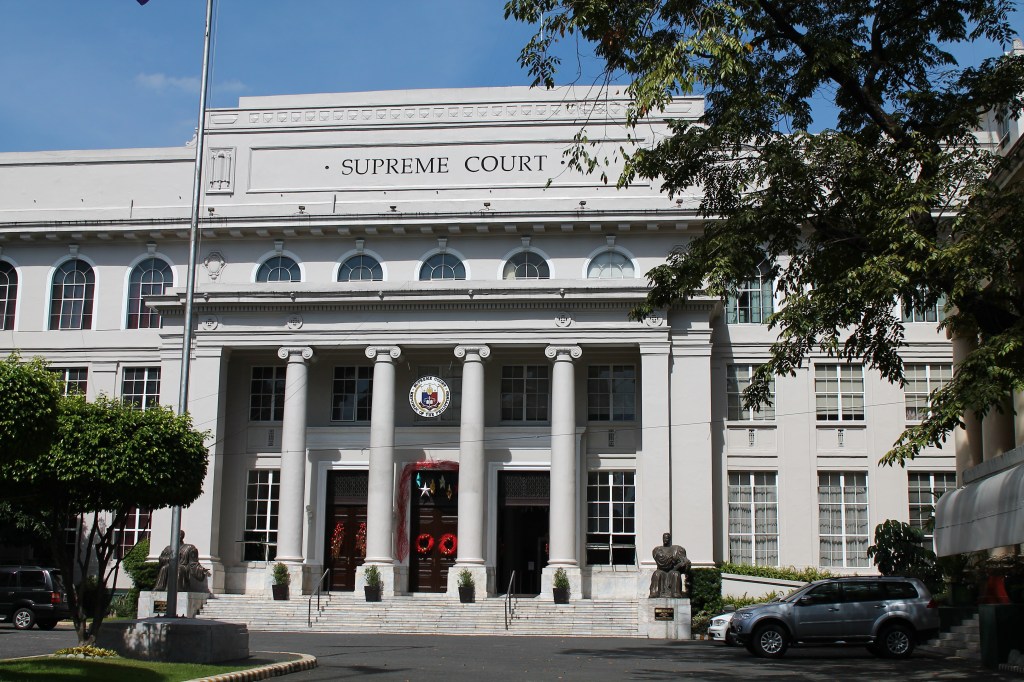
MANILA – The Supreme Court (SC) has upheld the conviction of former Lazi, Siquijor Mayor Orville Fua and four others for graft over the irregular procurement of more than PHP4.9 million worth of fertilizers and farm inputs.
In a Decision penned by Associate Justice Amy C. Lazaro-Javier, the SC Second Division affirmed the Sandiganbayan ruling finding Fua, former Lazi officials Rose Marie Tomogsoc, Natalio Bongcawel Jumawan Jr., and Sue Agnes Castillon, as well as private individual Merlyn Estallo Lu, guilty of violating Section 3(e) of Republic Act No. 3019, or the Anti-Graft and Corrupt Practices Act.
The case stemmed from the municipality’s Fertilizer Program in 2004, when Fua signed a purchase request for fertilizers and other farm inputs.
The Department of Agriculture (DA) subsequently entered into a memorandum of agreement with Lazi for the transfer of PHP8 million to fund the project.
Mangopina Trading, Inc., represented by Lu, eventually secured the contract among three bidders.
An investigation by the Office of the Ombudsman later found that Fua and the other respondents, together with Mangopina representatives, caused gross disadvantage to the government in the procurement process.
The Ombudsman found no records showing that the municipality had invited other bidders or suppliers from nearby areas. There was also no proof that the project had been published or advertised in a newspaper of general circulation.
The Commission on Audit (COA) likewise identified several procurement deficiencies, including the absence of a Special Allotment Release Order supporting the Fertilizer Program and proof that a pre-bid conference had been conducted.
The Sandiganbayan subsequently convicted Fua and the other respondents, prompting the case before the SC.
The High Court found that the elements of Section 3(e) of RA 3019 were established, including the public officers’ actions that resulted in undue injury to the government or gave unwarranted benefits or advantages to another party.
The SC ruled that the public officers had unjustly favored Mangopina in the procurement.
Fua and Tomogsoc approved the purchase request and certified the availability of funds even before the municipality had entered into the agreement with the DA. The court found that these actions had no basis at the time because the agreement was executed later and the funds were released only months afterward.
The procurement also failed to comply with Republic Act No. 9184, or the Government Procurement Reform Act. Mangopina and the other bidders did not submit the documents required to establish their qualifications.
The SC further found clear favoritism in the specification of particular fertilizer brands. The brands were registered to Mangopina, which was identified as their sole manufacturer and distributor.
Other mandatory procurement procedures were also disregarded, including the pre-procurement conference, proper advertisement or invitation to bid, post-qualification proceedings, issuance of a notice of award, and submission of a performance security.
The court also noted that the Bids and Awards Committee evaluated the bids of Mangopina and the two other bidders and recommended awarding the contract to Mangopina on the same day.
Fua immediately approved the transaction, resulting in the issuance of a purchase order directing Mangopina to deliver the fertilizers on the same day.
The SC also found that Mangopina was not qualified to supply the fertilizers because it had failed to pay the fees required to renew its mayor’s permit, while its manufacturer-distributor license had already expired.
Fua and the other respondents were sentenced to imprisonment of up to 10 years and perpetually disqualified from holding public office.



Leave a Reply