

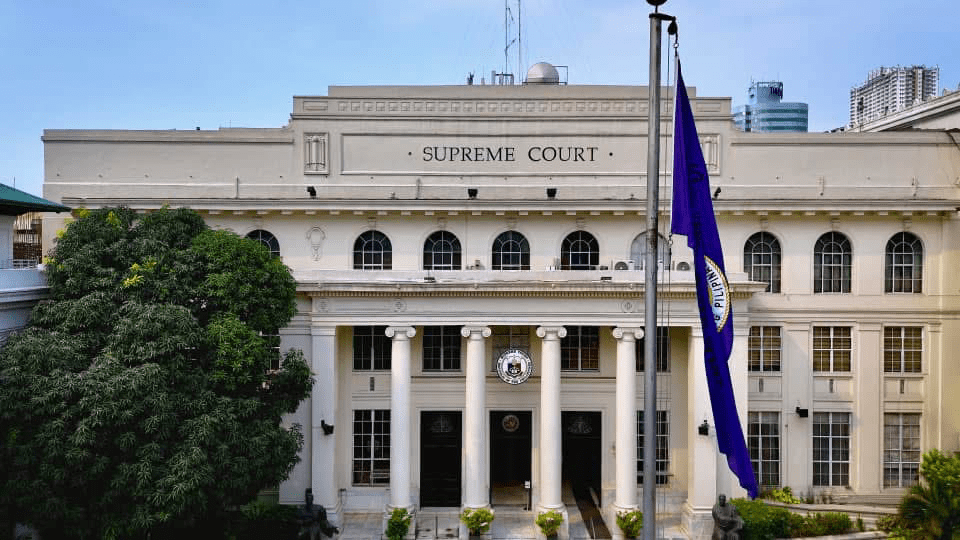
MANILA— The Supreme Court has ruled that a waiver of rights over inherited property may be treated as a valid donation when the parties intended to transfer ownership and the requirements for a donation are satisfied.
In a Decision penned by Associate Justice Jhosep Y. Lopez, the SC Second Division denied the consolidated petitions of Felix G. Cruz and sustained the Court of Appeals rulings upholding the transfer of two parcels of land to Cruz’s brothers, Robin and Osias.
The properties originally belonged to Judy Cruz, who died single and without a will. Her surviving heirs included her parents, Luis and Rosita, and five siblings, among them Felix, Robin, and Osias.
Following Judy’s death, Luis and Rosita separately signed notarized Waivers of Rights in favor of Robin and Osias.
The brothers subsequently executed an Extrajudicial Partition and Settlement of Estate and had the properties registered under their names.
Felix and his siblings Doris and Henry likewise signed waivers relinquishing any interest they might have had in the properties. Felix, who served as the family’s lawyer, prepared the documents.
The dispute arose after Rosita died. Felix went to court seeking to invalidate the transfer and cancel the titles issued to Robin and Osias. He argued that the properties should have remained part of Rosita’s estate and should have been available for inheritance, including his share as one of her heirs.
The Regional Trial Court dismissed Felix’s complaint, a ruling later affirmed by the CA, which held that the Waivers of Rights signed by Luis and Rosita were valid donations to Robin and Osias.
The SC upheld the lower courts’ rulings.
The Court said Judy’s properties passed immediately to Luis and Rosita upon her death because they were her legal heirs. As owners, they had the authority to dispose of the properties.
The SC found that despite being denominated as Waivers of Rights, the documents demonstrated Luis and Rosita’s intent to donate the properties to Robin and Osias.
Under Article 749 of the Civil Code, the Court said a valid donation of real property requires a reduction in the donor’s property, a corresponding increase in the donee’s property, intent to donate, execution through a public document, and acceptance by the donee. When acceptance is made through a separate document, the donor must also be informed.
The SC found that these conditions were satisfied.
Luis and Rosita relinquished their ownership in favor of Robin and Osias through notarized documents that expressly authorized the transfer. The brothers subsequently accepted the donation by executing the Extrajudicial Partition and Settlement and registering the properties in their names, with their actions made known to Luis and Rosita.
The Court consequently held that the donation was valid, meaning the properties were no longer part of Rosita’s estate when she died.
The SC also pointed to the separate waivers signed by Felix, Doris, and Henry. Since the siblings had relinquished whatever interests they might have had in the properties, the Court said Felix could not later challenge the legal effect of those waivers, particularly because he himself had prepared them.




Leave a comment