
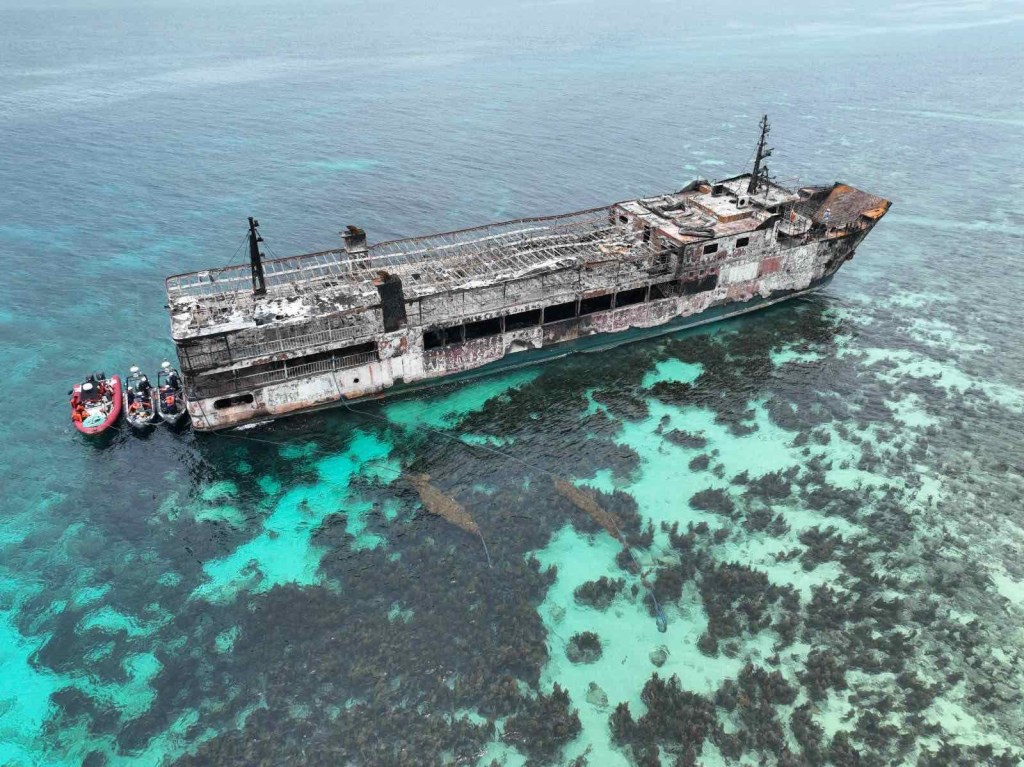
MANILA— Authorities are investigating possible criminal and anti-graft charges against the crew and owners of fire-hit MV June Aster, cargo handlers, and government personnel over a vessel blaze that killed 77 people, injured 43 others, and left eight missing.
Fire Chief Superintendent Wilberto Rico Neil Ang Kwan Tiu said during a Palace press briefing Friday that those found responsible could face charges of reckless imprudence resulting in multiple homicide, while government personnel who neglected their duties could also be charged under the Anti-Graft and Corrupt Practices Act.
“Automatically, it will be reckless imprudence resulting in multiple homicide, and at the same time violations of anti-graft and corrupt practices by those people in the government,” Kwan Tiu said.
The Bureau of Fire Protection (BFP) chief identified the vessel’s captain, chief mate, two able-bodied seamen, second mate, and safety officer among those who could be held liable, along with the vessel’s owner and officers and the contractor responsible for loading its cargo.
The MV June Aster, a passenger roll-on/roll-off vessel traveling from Batangas to Coron, Palawan, caught fire on Sept. 9, 2026.
Investigators are looking into possible violations involving the loading and declaration of dangerous cargo, including asphalt and calcium hypochlorite, a chemical commonly used in swimming pool disinfectants.
According to Kwan Tiu, the chemicals were reportedly stored near the vessel’s engine exhaust, where heat may have contributed to the fire. Rough seas may also have caused the cargo to shift, potentially allowing the substances to mix.
He said the excessive volume of chemicals could be considered an aggravating circumstance in determining the charges against those found responsible.
Authorities are also working with the Philippine Coast Guard and the Maritime Industry Authority to establish why the vessel was allowed to sail despite a reported mechanical problem that delayed its departure by four days.
The probe is also examining possible lapses at the port of origin, including whether personnel conducted the necessary inspections and ensured the cargo was properly secured before the vessel departed.





Leave a Reply