
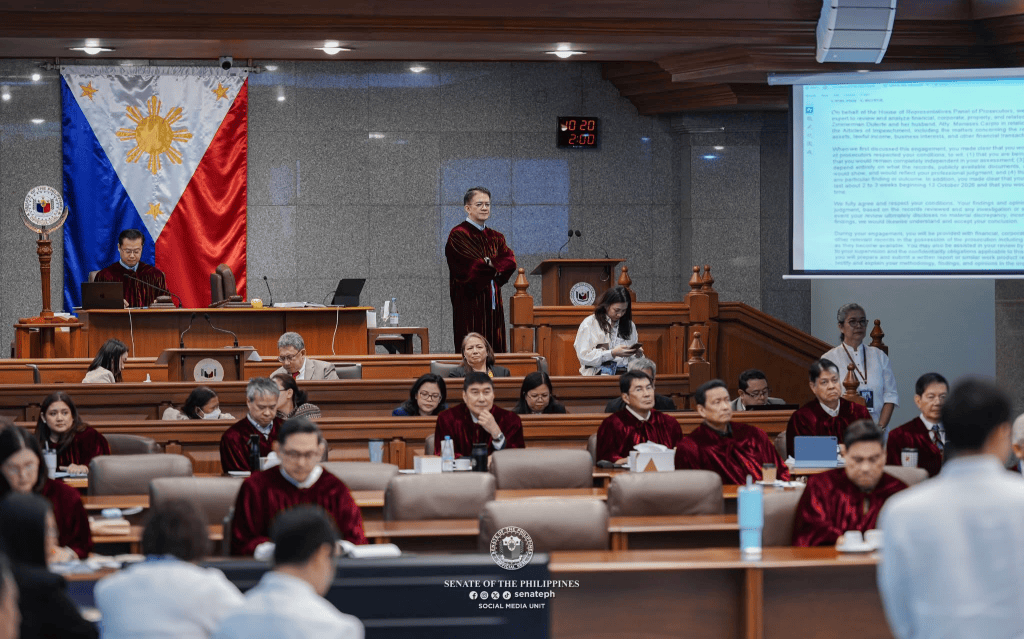
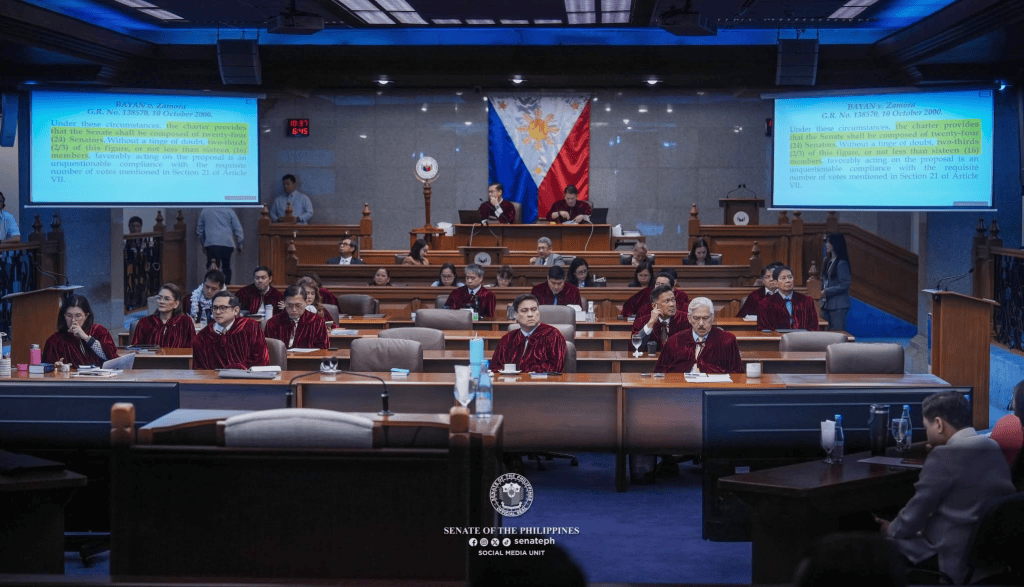
MANILA— The Senate Impeachment Court has admitted most of the prosecution’s documentary evidence against Vice President Sara Duterte in the impeachment trial, while excluding records linked to withdrawn charges involving confidential funds and two corporations.
In a statement Friday, impeachment court spokesperson Atty. Regie Tongol said Presiding Officer Francis “Chiz” G. Escudero issued two orders on Nov. 5: a 22-page resolution of the House prosecution panel’s formal offer of documentary evidence and a separate order enforcing the sub judice ban under Rule XVIII across all Articles of Impeachment.
Tongol said the ruling established the evidentiary boundaries for Article II ahead of Duterte’s presentation of her defense, scheduled to begin on Monday, Nov. 9, at 10 a.m.
The court rejected Duterte’s general objection that documents obtained through subpoenas constituted a “fishing expedition” or were inadmissible because they were not attached to the original impeachment complaints.
It ruled that the Articles of Impeachment establish the core charges, while lawful subpoenas may be used to obtain records needed to examine those allegations.
However, the court limited the use of financial, tax, corporate, property and Statement of Assets, Liabilities and Net Worth (SALN) records covering 2007 to 2021 to establishing Duterte’s financial position before she assumed office as vice president on June 30, 2022.
The records cannot be used to accuse her of separate offenses allegedly committed before her current term, in accordance with the Supreme Court’s ruling in Duterte v. House of Representatives.
The court also excluded all Commission on Audit disallowance records concerning confidential funds under withdrawn Article I, as well as corporate records and forensic computations involving TC Group of Companies Philippines, Inc. and Pikimong Pikimong Philippines Corporation.
Among the evidence admitted were Duterte’s SALNs, official records establishing her marriage to Manases Carpio, corporate documents involving 18 entities, procurement records, firearm certifications, land records, bank statements, insurance and investment documents, and tax records.
The court admitted the prosecution’s financial forensic report in part, allowing the analysis of admitted evidence but excluding schedules and computations derived from the records of the two excluded corporations.
It also admitted Anti-Money Laundering Council reports for Article II purposes, but excluded their use to establish allegations involving confidential-fund disallowances under withdrawn Article I.
Tongol emphasized that the admission of documents does not mean the court has accepted the prosecution’s allegations or findings as true.
“Admissibility simply means the documents met the legal standards to be placed on the table; how much weight they carry—and whether they prove or fail to prove Article II—belongs exclusively to the Senator-Judges at the end of the trial,” the statement read.
The court also prohibited the uploading or distribution of exhibits containing protected bank, tax, AMLC, foreign-currency or personal information outside the limits set by its Oct. 13 order and applicable laws.
With the prosecution’s case formally rested, the defense may directly adopt and use any admitted exhibit already in the official record without presenting it again.
In a separate order, the court ruled that the Rule XVIII sub judice ban applies to all Articles of Impeachment, whether withdrawn or still pending trial.
The order addressed an appeal or motion for reconsideration raised by Senator-Judge Francis Pangilinan on Oct. 13, as well as Duterte’s Nov. 4 manifestation stating that she was not waiving the rule and wanted the ban maintained.
The court barred all parties, counsels and other covered persons from making public statements on the merits of the pending trial or matters covered by the Articles of Impeachment, warning that violations would be subject to the penalties under its Aug. 26 guidelines.



Leave a Reply