
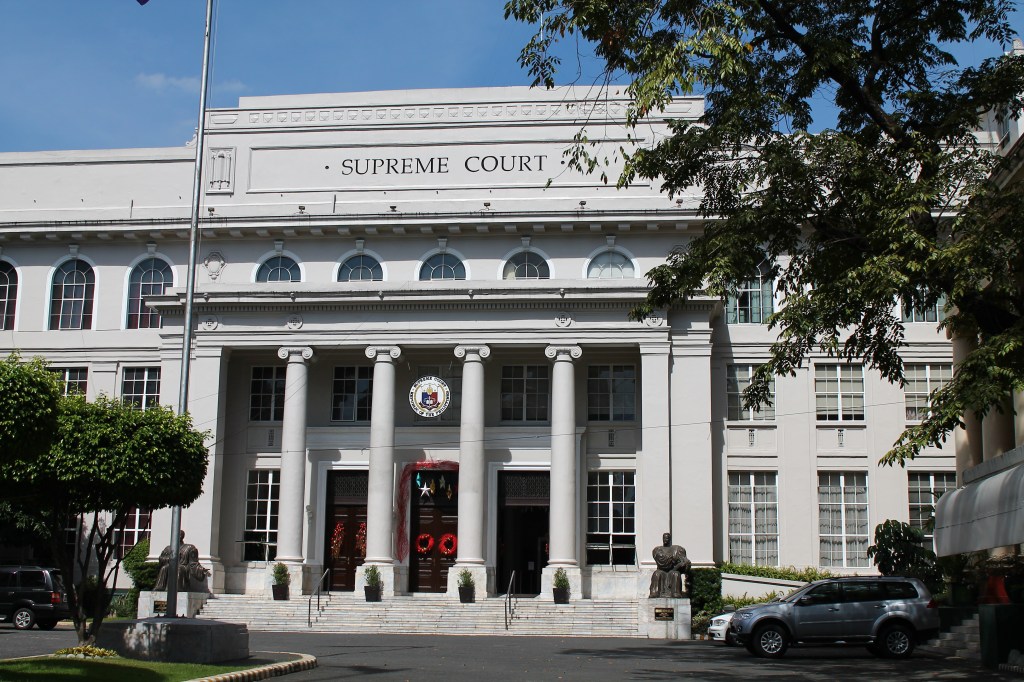
MANILA— The Supreme Court (SC) has upheld the constitutionality of Republic Act (RA) No. 12326, which extends the terms of barangay officials and Sangguniang Kabataan (SK) members to five years and moves the next barangay and SK elections (BSKE) to November 2028.
In a decision penned by then Associate Justice Rodil V. Zalameda, the high court dismissed a petition filed by Romulo B. Macalintal challenging the validity of the law.
Enacted on September 24, 2026, RA 12326 increased the tenure of barangay officials from four to five years and reduced the maximum number of consecutive terms they may serve from three to two.
Macalintal argued that the measure violated the guidelines established by the SC in its 2023 ruling in Macalintal v. COMELEC, which allows election postponements only for important, substantial or compelling reasons.
He also questioned the law’s compliance with substantive due process and argued that it infringed on the people’s right to vote and the constitutional requirement that barangay officials be elected.
However, the SC ruled that the 2023 Macalintal guidelines do not apply to RA 12326 because the measure primarily establishes the terms of barangay officials rather than postponing elections.
The court explained that scheduling the next BSKE in November 2028 is a consequence of the new five-year term and does not automatically make the measure an election-postponement law.
It added that Congress has the authority to determine, modify and extend the terms of barangay officials, provided the period before the start of the new term remains reasonable and is not unduly long. This limitation serves as protection against repeated postponements of barangay elections.
In evaluating the law, the SC noted that barangay officials were last elected on October 30, 2023, while the next elections are scheduled for November 2028, consistent with the new five-year term.
The high court also considered lawmakers’ concerns that holding the BSKE in 2027 could disrupt the Commission on Elections’ preparations for the May 2028 national and local elections. A five-year election cycle beginning in 2026 would also coincide with the 2031 national and local polls.
On the issue of substantive due process, the SC found that RA 12326 serves legitimate government objectives, including effective local governance and continuity of barangay programs.
It said the uniform five-year term and election cycle were reasonable measures, considering the need for long-term development planning, limited barangay resources, continuity of government initiatives and the costs associated with conducting elections.
The court likewise rejected the argument that the law violated the people’s right to suffrage, explaining that the Constitution does not prescribe a specific term length or election frequency for barangay officials.
Instead, the SC said voters must be given regular and predictable opportunities to elect their local officials at intervals established by law.
It stressed that RA 12326 does not abolish or indefinitely postpone barangay elections but establishes a five-year election cycle beginning in November 2028.
The SC further clarified that incumbent officials who remain in office until their successors are elected and qualified are not considered newly appointed by Congress.
Their continued service is covered by the hold-over provision of RA 12232, which RA 12326 retains.
Separate opinions
While Senior Associate Justice Marvic M.V.F. Leonen agreed that Congress has the authority to extend the terms of barangay officials and that RA 12326 is not oppressive, he maintained that the measure violated the people’s right to vote by extending the tenure of incumbent officials.
Leonen argued that postponing the BSKE weakens suffrage and undermines democratic principles and the concept of a republican government.
Associate Justice Alfredo Benjamin S. Caguioa also dissented, arguing that the law unconstitutionally restricts the right to vote.
He said the government’s justifications, including continuity of programs, were routine administrative concerns that did not constitute a compelling state interest.
Caguioa maintained that the five-year term could have been implemented prospectively without postponing the November 2026 elections. He also pointed out that repeated postponements had allowed officials elected in 2023 to remain in office beyond their three-year term without obtaining a renewed mandate from voters.
Associate Justice Jhosep Y. Lopez, meanwhile, agreed with the majority that RA 12326 was a term-setting measure and should not be covered by the Macalintal guidelines.
He argued that treating laws that incidentally affect election schedules as election-postponement measures would improperly restrict Congress’ constitutional authority to determine the terms of barangay officials.
Associate Justice Antonio T. Kho Jr. also dissented, maintaining that RA 12326 functions both as a term-setting measure and an election-postponement law and must therefore comply with the Macalintal guidelines.
Kho argued that the five-year term could still have been implemented if the November 2026 BSKE proceeded as scheduled.
He added that concerns over the proximity of the November 2026 elections to All Souls’ Day and the possible coincidence of future elections with the 2031 national and local polls were insufficient reasons to move the BSKE to November 2028.



Leave a Reply