

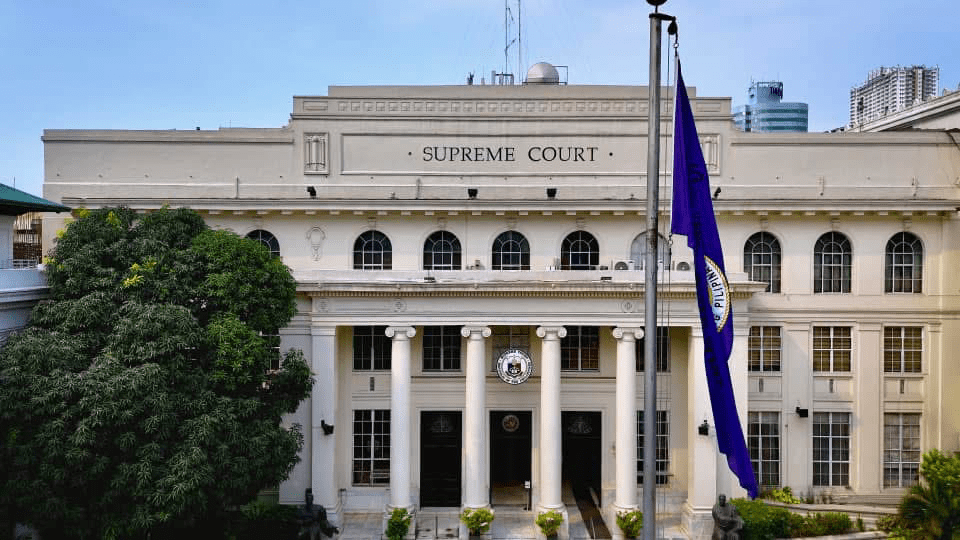
MANILA – The Supreme Court (SC) has ruled that the National Commission on Indigenous Peoples (NCIP) may exercise jurisdiction over disputes involving indigenous peoples (IPs) only when all parties belong to the same indigenous group.
In a Decision written by Associate Justice Henri Jean Paul B. Inting, the SC’s Third Division dismissed a petition filed by Elvin and Jocelyn Sending, who sought to compel a judge to set aside rulings in an ejectment case involving property registered to Kristoffer R. Co Uy.
The Sendings claimed membership in the Lumad KKK-Alimaong Higaonon Tribe and argued that their dispute with Co Uy should be resolved under customary laws, traditions, and practices pursuant to Republic Act No. 8371, or the Indigenous People Rights Act of 1997 (IPRA).
The case began when Co Uy filed an unlawful detainer complaint before the Municipal Circuit Trial Court (MCTC), seeking to have the Sendings vacate his property.
The MCTC, Regional Trial Court, and Court of Appeals (CA) all ruled in Co Uy’s favor and ordered the couple to leave the property.
After the CA decision became final and executory, the MCTC, acting on Co Uy’s motion, issued a resolution directing its enforcement.
It was only at this stage that the Sendings challenged the MCTC’s jurisdiction. They invoked their alleged membership in the Lumad KKK-Alimaong Higaonon Tribe and maintained that the dispute should fall under the jurisdiction of the NCIP and the Dadantulan Tribal Court.
The couple also sought to suspend the execution of the MCTC ruling while the jurisdictional issue was being resolved.
The MCTC, however, said it could no longer act on the Sendings’ motions because the CA decision had already become final.
The SC upheld the lower courts’ rulings, explaining that Section 66 of the IPRA limits NCIP jurisdiction over disputes involving IP rights to cases where all parties are members of the same indigenous group.
“If any party is not a member of the same IP community, jurisdiction belongs to the regular courts,” the SC said.
In this case, Co Uy was not identified as a member of any indigenous group. The SC said subjecting him to the customary laws of an IP community would run counter to the fundamental principles of fair play and due process.
The Court also found that the Sendings failed to substantiate their claim that they were members of an IP community.
Apart from their assertion of membership, the couple presented no supporting evidence and did not explain the customs, political structures, institutions, decision-making processes, or other characteristics that would establish their membership in the claimed indigenous community.
The SC further stressed that a final judgment cannot be easily disturbed, particularly when the parties had been given the opportunity to present their respective sides and the case had undergone judicial review.
It found that the Sendings invoked the NCIP’s authority only at the execution stage, despite having participated in the barangay proceedings and subsequent court proceedings.
According to the SC, the timing of their claim raised doubts about its credibility and indicated that they were invoking IP status to prevent the enforcement of the final judgment against them.
The Court consequently ordered the Sendings to vacate the subject property within 30 days from receipt of the Decision.
In a Concurring Opinion, Associate Justice Alfredo Benjamin S. Caguioa underscored the need to clearly delineate the jurisdictions of tribal and regular courts.
He also emphasized that such delineation must respect the autonomy of indigenous peoples and their customary laws while safeguarding the right to due process of non-indigenous parties.

 Republika News
Leave a comment