
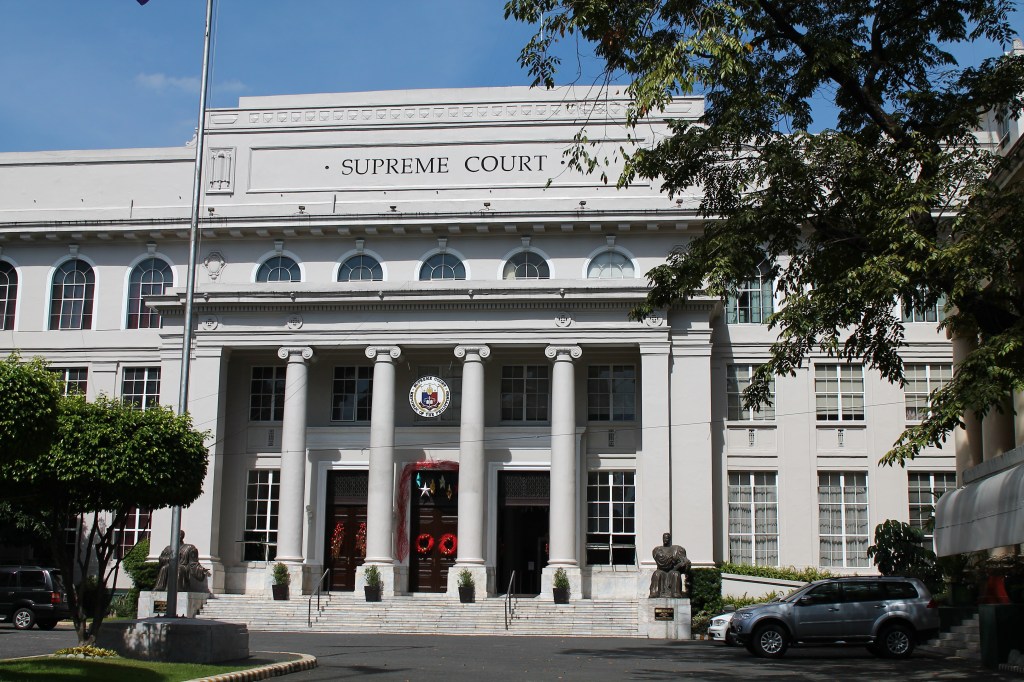
MANILA— The Supreme Court has voided a couple’s marriage after finding that they falsely claimed to have lived together as husband and wife for at least five years to secure an exemption from the marriage license requirement.
In a decision written by Associate Justice Henri Jean Paul B. Inting, the Supreme Court’s Third Division denied the Republic’s petition seeking to uphold the validity of the marriage despite the absence of a marriage license.
The couple began living together in December 2003. The husband left for Israel in 2006 for work and returned to the Philippines in 2009, when they got married.
To avoid securing a marriage license, the couple executed an Affidavit of Cohabitation declaring that they had lived together for six years and therefore qualified for an exemption under the Family Code.
The husband later challenged the marriage in 2013, saying the affidavit was false because he had spent most of the period covered by it working in Israel.
The Regional Trial Court granted his petition and declared the marriage void after finding that the couple had not continuously lived together for five years before their wedding.
The Court of Appeals upheld the ruling, finding that the husband’s three-year absence from the Philippines interrupted the required period of cohabitation. It also ruled that the affidavit could not take the place of a marriage license.
The Republic, through the Office of the Solicitor General, elevated the case to the Supreme Court.
It argued that cohabitation did not necessarily require the couple to maintain constant physical presence in the same place. The government also maintained that the husband’s employment in Israel did not end the relationship because he eventually returned to the Philippines for the wedding.
The Republic further argued that the husband could not later challenge the affidavit as false because he had voluntarily executed it and used it to obtain an exemption from the marriage license requirement.
The Supreme Court rejected the arguments.
Under Article 3(2) of the Family Code, a valid marriage license is among the formal requisites of marriage.
Article 34, however, provides an exemption for couples who have lived together as husband and wife for at least five years and have no legal impediment to marry each other. The couple must declare these circumstances in an affidavit, while the solemnizing officer must execute a sworn statement confirming the absence of a legal impediment.
Citing Niñal v. Bayadog, the court said the five-year period must be counted backward from the date of marriage. The required cohabitation must be continuous and exclusive, without interruption or the presence of a third party.
The court clarified that physical separation does not automatically terminate cohabitation if the couple continues to live as husband and wife. Factors such as maintaining a shared home and expenses or publicly presenting themselves as a married couple may show that the relationship remained intact despite a temporary absence.
In this case, however, the court found that the couple failed to establish the required five-year period.
From 2001 to 2004, the couple lived separately and only occasionally shared a rented room with relatives. From 2005 to 2009, the husband was in Israel, and the court found no evidence that they continued presenting themselves as spouses or that he intended to return to the Philippines to live with his wife.
The Supreme Court said the husband’s own testimony established that the couple had not continuously lived together for five years before their marriage.
The court also found that the testimony demonstrated that the Affidavit of Cohabitation submitted to the solemnizing officer contained false statements, meaning the couple did not qualify for the exemption from the marriage license requirement.
As a result, the absence of a valid marriage license rendered the marriage void.




Leave a comment