
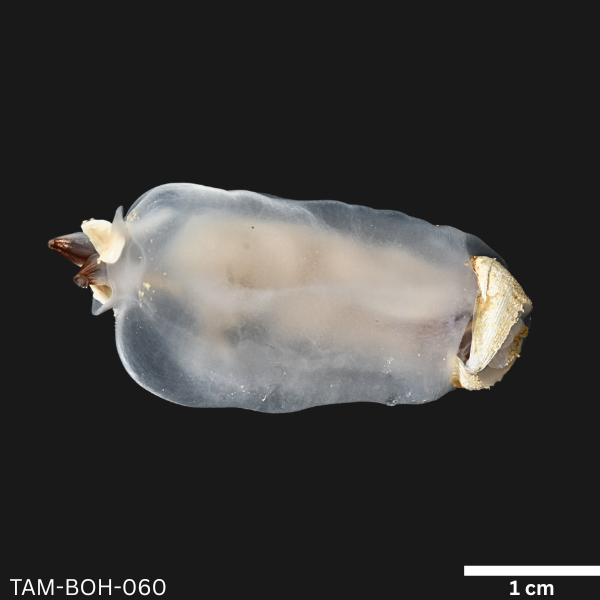
MANILA — A rare rock-eating marine species discovered in Bohol has been named one of five finalists for the International Mollusc of the Year, highlighting the Philippines’ unique biodiversity.
The species, locally known as “antingaw” and scientifically named Lithoredo abatanica, is a type of shipworm distinguished for its ability to bore through and ingest limestone—making it the first known shipworm to live in and feed on rock.
Researchers said the antingaw differs from typical shipworms, which usually burrow through wood, as its shell has evolved to cut through stone using larger and blunter denticles.
Despite their name, shipworms are classified as clams, with elongated, soft bodies and small shells adapted for boring into materials.
The University of the Philippines Marine Science Institute (UP MSI) is leading the campaign to secure votes for the antingaw in the annual competition, which is organized by the Senckenberg Society for Nature Research, the Senckenberg Ocean Species Alliance, and Unitas Malacologica.
Winners will be determined through public voting, which runs until April 26.
If selected, the antingaw will receive full genome sequencing as the grand prize, which researchers said could support the development of biotechnology products.
UP MSI is already studying the species under the TAMMILOC Project, which investigates shipworms and their microbial symbionts for potential applications in medicine and other fields.
Scientists have yet to fully understand how the antingaw derives nutrients from rock, but initial findings suggest that symbiotic microorganisms in its gills may play a role in processing its unusual diet.
The species is found exclusively in the Abatan River in Bohol, where it bores into limestone formations, leaving visible holes in the rock.




 Republika News
Leave a comment