

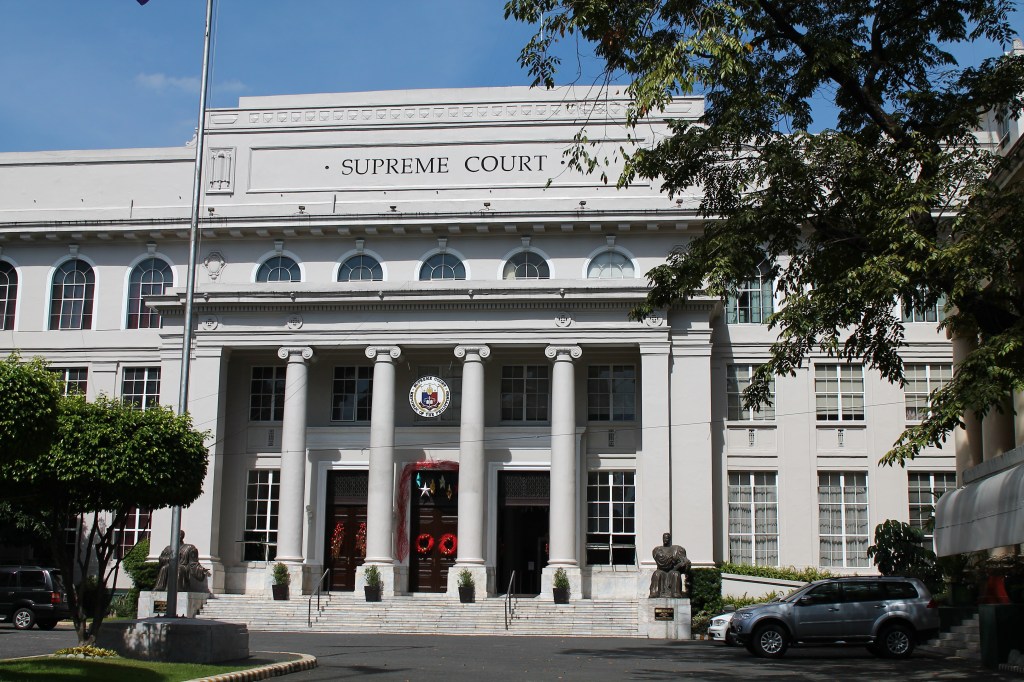
MANILA — Vice President Sara Duterte’s impeachment case could end up before the Supreme Court if questions arise over the number of votes needed for a conviction, constitutional experts and former lawmakers said.
According to a report, Retired Supreme Court Justice Adolfo Azcuna said the Senate has the sole authority to try and decide impeachment cases, but its ruling could still be questioned before the high court if there is an allegation of grave abuse of discretion.
“Supposing the threshold should be 16, but the vote is only 15, and, but the Senate tribunal enters a judgment of conviction saying that the threshold has been met, then that, can be questioned as a grave abuse of discretion, in my view,” he said.
Former Senate President Franklin Drilon said a petition questioning the Senate’s action could be filed before the Supreme Court, although it would first have to determine whether it has jurisdiction over an impeachment case.
“The Supreme Court may or may not entertain the petition, but that is an issue, which, on its surface — on its face can be brought to the Supreme Court,” he said.
Political scientist Julio Teehankee said the issue could eventually reach the Supreme Court, citing the current circumstances involving some senators.
He noted that Sen. Jinggoy Estrada is under detention while facing graft charges, Sen. Ronald “Bato” Dela Rosa is in hiding, and Sen. Rodante Marcoleta is facing a possible plunder complaint, making it more difficult to secure the constitutionally required votes unless prosecutors convince more than 16 senator-judges to convict.
“At the rate things are going nga, ‘no?” he said.
The impeachment proceedings against Duterte would be the country’s third full impeachment trial and the third in which not all 24 senators are expected to sit as judges.
Drilon, who served as a senator-judge during the impeachment trial of former President Joseph Estrada, said the issue of whether the two-thirds vote should be based on the full Senate membership or only on sitting senator-judges was never resolved during that proceeding.
He said the same question also did not arise during the impeachment trial of former Chief Justice Renato Corona, when only 23 senators participated. Corona was convicted after 20 senators voted to convict while three voted to acquit.
Azcuna said he believes suspended senators should still be included in determining the required number of votes because they continue to occupy their positions despite being unable to exercise their functions.
“What the Supreme Court said in one case is that someone suspended cannot hold public office.What it means is he cannot exercise the public office, but the position is still occupied by him or her,” he said.
Drilon, however, argued that requiring the threshold to always be based on 24 senators could lead to impractical results.
“Suppose 10 senators will resign. Then you would only have 14 senators. If there are only 14 senators, are you telling me that we cannot enforce an accountability measure in the Constitution, which is impeachment?”
He said the computation should follow the Supreme Court’s ruling in Avelino v. Cuenco, which has been used in determining the Senate’s quorum.
“Where, the particular senator is in hiding, as in the case of Senator Bato, or under detention, as in the case of, Senator Jinggoy, I do not believe that the two-thirds should be based on 24, but on 22,” he said.
Senate President Sherwin Gatchalian and Sen. Panfilo Lacson have maintained that 16 votes are still required to convict in an impeachment trial.
Lacson, however, said the impeachment court would ultimately decide the issue as a collegial body.
“The impeachment court as a collegial body will decide based on the wisdom of the majority of the senator-judges.”
He also suggested allowing suspended or detained senators to participate in the proceedings by limiting the suspension to their legislative functions.
“Otherwise, it’s going to be a crisis. There might as well be no impeachment trial,” he said.
Senate Minority Leader Alan Peter Cayetano opposed any move to reduce the number of votes needed for conviction.
“Are we going to really have an impartial trial, or aayusin at luto na? Are we going to tell [people] the truth that dapat 16 to convict, or babawasan ba ng anim na senador para maging 12 na lang?” he said.
Teehankee also warned that any perceived effort to prevent senators considered supportive of Duterte from participating in the trial could undermine public confidence in the impeachment process.
“Baka hindi rin ‘to tanggapin ng publiko, ‘no?” he said.




Leave a comment